Osmosis is the movement of water molecules across a semipermeable membrane from a region of higher water concentration (or lower solute concentration) to a region of lower water concentration (or higher solute concentration), until equilibrium is reached.

Search Colleges, Exams, Schools & more


Login
NCERT Exemplar Class 11 Biology Solutions Chapter 11 Transport in Plants
The NCERT Exemplar Class 11 Biology Solutions Chapter 11 Transport in Plants are a helpful resource for students preparing for exams and entrance tests. These solutions explain topics such as the transportation of water, minerals, and nutrients within plants. NCERT Exemplar Solutions include MCQs, very short questions, short questions, and long questions. Regular practice of these questions will result in the improvement of learning and scores in exams.
This Story also Contains
- Find the NCERT Exemplar Class 11 Biology Solutions Chapter 11 (Multiple Choice Questions)
- Access the Transport in Plants Class 11 NCERT Exemplar (Very Short Questions)
- Get Answers to NCERT Exemplar Class 11 Biology Solutions Chapter 11 (Short Questions)
- Detailed Answers to NCERT Exemplar Class 11 Biology Solutions Chapter 11
- Approach to Solve Transport in Plants Class 11 NCERT Exemplar
- Main topics of NCERT Exemplar Class 11 Biology Solutions Chapter 11
- Advantages of NCERT Exemplar Class 11 Biology Chapter 11 Solutions
- Important Questions for Transport in Plants Class 11 NCERT Exemplar
- NCERT Exemplar Class 11 Biology Solutions Chapter Wise
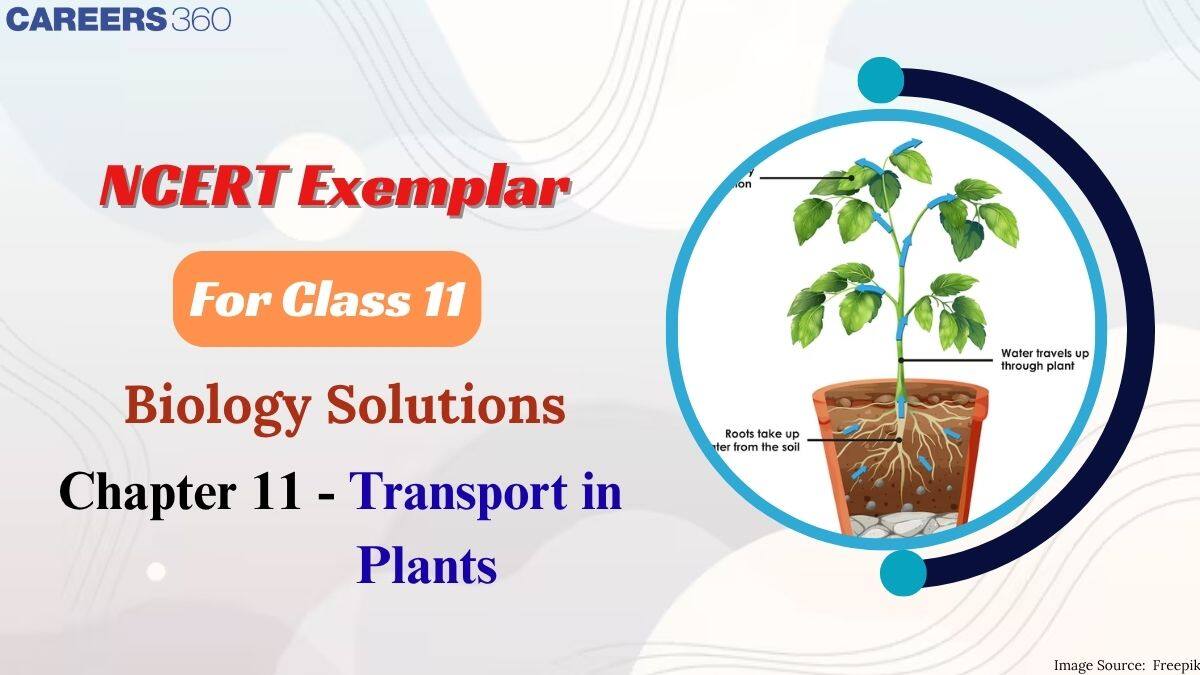
The Transport in Plants Class 11 NCERT Exemplar discusses topics such as osmosis, transpiration, and nutrient absorption. Students would gain confidence in answering questions related to Transport in Plants using the NCERT Exemplar Class 11 Biology Chapter 11. Subject experts have designed the answers in well-understandable language, which makes studying easier. NCERT Exemplar class 11 Biology helps them to score well in school exams and future competitive exams like NEET.
Find the NCERT Exemplar Class 11 Biology Solutions Chapter 11 (Multiple Choice Questions)
Here are different types of questions, like MCQs, short answers, and long answers, to help students check how well they understand the chapter. Solving the NCERT Exemplar Class 11 Biology Chapter 11 also makes it easier to manage time and write better answers in exams.
Question:1
Which of the following statements does not apply to reverse osmosis?
(a) It is used for water purification.
(b) In this technique, pressure greater than osmotic pressure is applied to the system.
(c) It is a passive process.
(d) It is an active process.
Answer:
The answer is option (d).
Explanation: -
Reverse osmosis is known as the process which facilitates the passing of a solvent across a porous or semipermeable membrane, opposite to the direction of the usual process of osmosis. In normal osmosis, the hydrostatic pressure is larger in comparison to the osmotic pressure. Given that reverse osmosis is the opposite, it is not an active process.
Question:2
Which one of the following will not directly affect transpiration?
(a) Temperature
(b) Light
(c) Wind speed
(d) Chlorophyll content of leaves
Answer:
The answer is option (d), Chlorophyll content of the leaves
Explanation: - Transpiration is the process by which plants lose water in the form of dewdrops on the surface of the leaves; this does not involve the chlorophyll content in the leaves and is indifferent to it. Temperature, light and wind speed are determinants of the process, on the other hand.
Question:3
The lower surface of the leaf will have more number of stomata in a
(a) Dorsiventral leaf
(b) Isobilateral leaf
(c) Both (a) and (b)
(d) None of the above
Answer:
The answer is option (a) Dorsiventral leaf
Explanation: - The lower side of a dicotyledonous leaf has a higher number of stomata than the other side. The isobilateral leaf has the same number of stomata on both sides.
Question:4
The form of sugar transported through the phloem is
(a) Glucose
(b) Fructose
(c) Sucrose
(d) Ribose
Answer:
The answer is option (c), Sucrose
Explanation: - It is a primary form of food, which is transported from the source by the vascular phloem tissue since it is an inactive form of sugar.
Question:5
The process of guttation takes place
(a) when the root pressure is high, and the rate of transpiration is low
(b) when the root pressure is low, and the rate of transpiration is high
(c) When the root pressure equals the rate of transpiration
(d) when the root pressure, as well as the rate of transpiration, is high.
Answer:
The answer is option (a). When the root pressure is high, and the rate of transpiration is low.
Explanation: - Guttation can only occur in the absence of transpiration, which is at night.
This process releases water droplets while water vapour is lost in the process of
transpiration.
Question:6
Which of the following is an example of imbibition?
(a) Uptake of water by root hair
(b) Exchange of gases in stomata
(c) Swelling of the seed when put in the soil
(d) Opening of stomata
Answer:
The answer is option (c), Swelling of seeds when put in the soil.
Explanation: - Imbibition is the process through which seeds are able to absorb water and germinate.
Question:7
When a plant undergoes senescence, the nutrients may be
(a) Accumulated
(b) Bound to the cell wall
(c) Translocated
(d) None of the above
Answer:
The answer is option (c) Translocated
Explanation: - Whenever a plant undergoes senescence, mineral ions are usually mobilised and relocated for the best use
Question:8
The water potential of pure water at standard temperature is equal to
(a) 10
(b) 20
(c) Zero
(d) None of these
Answer:
The answer is option (c) Zero
Explanation: - The water potential of pure water and the standard temperature is zero.
Question:9
Choose the correct option. Mycorrhiza is a symbiotic association of a fungus with the root system, which helps in
A. Absorption of water
B. Mineral nutrition
C. Translocation
D. Gaseous exchange
(a) Only A
(b) Only B –
(c) Both A and B
(d) Both B and C
Answer:
The answer is option (c) Both A & B
Explanation: - Mycorrhiza is a symbiotic association of a fungus which plays an important role in the absorption of water and mineral nutrients.
Question:10
Based on the figure given below, which of the following statements is not correct?
(a) Movement of solvent molecules will take place from chamber A to B
(b) Movement of solute will take place from A to B
(c) The presence of a semipermeable membrane is a prerequisite for this process to occur
(d) The direction and rate of osmosis depend on both the pressure gradient and concentration gradient.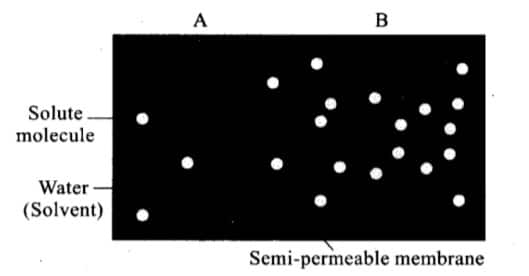
Answer:
The answer is option (b). Movement of the solute will take place from A to B
Explanation: - The movement will take place from B to A. The movement always takes place from high solvent concentration to low.
Question:11
Match the following and choose the correct option.
A | Leaves | i | Anti-transpirant |
B | Seed | ii | Transpirant |
C | Roots | iii | Negative osmotic potential |
D | Aspirin | iv | Imbibition |
E | Plasmolyzed cell | v | Absorpation |
Options:
(a) A—(ii), B—(iv), C—(v), D—(i), E—(iii)
(b) A—(iii), B—(ii), C—(iv), D—(i), E—(v)
(c) A—(i), B—(ii), C—(iii), D—(iv), E—(v)
(d) A—(v), B—(iv), C—(iii), D—(ii), E—(i)
Answer:
The answer is the option (a) A—(ii), B—(iv), C—(v), D—(i), E—(iii)
Explanation: -
Leaves- Transpiration, this is due to the fact that leaves are the main source of conducting the process of transpiration due to the presence of stomata, which aid and regulate the process.
Seed- Imbibition, seeds grow and germinate through the process of imbibition, which happens through the retention of water and leads to the seed's germination.
Roots - absorption, this is due to the reason that roots are the primary way of absorption of nutrients through the soil to nurture the plant and aid in the growth of the shoot.
Aspirin- anti-transpirant, this fits because aspirin is a metabolic inhibitor, which is a type of anti-transpirant.
Plasmolysed cell pairs with negative osmotic potential as plasmolysis occurs due to the hypertonic surroundings, which causes the shrinking of the protoplasm. This creates a negative osmotic potential.
Question:12
Mark the mismatched pair.
(a) Amyloplast—Store protein granule
(b) Elaioplast—Store oils or fats
(c) Chloroplasts—Contain chlorophyll pigments
(d) Chromoplasts—Contain coloured pigments other than chlorophyll
Answer:
The answer is option (a) Amyloplast—Store protein granule
Access the Transport in Plants Class 11 NCERT Exemplar (Very Short Questions)
Question:1
Answer:
Proteins
Question:2
Answer:
Antiport
Question:3
Answer:
Pressure and concentration gradient
Question:4
Answer:
Exosmosis
Question:5
Answer:
Imbibition Pressure
Question:6
Answer:
Transpiration Pull
Question:7
Answer:
The cell membrane is selectively permeable
Question:8
Answer:
Half
Question:9
Movement of substances in xylem is unidirectional, while in phloem it is bidirectional. Explain.
Answer:
Movement in phloem is active transport; on the other hand, the movement in the xylem is done by means of passive transport, which is why the food in the phloem sap can be transported both upwards and downwards, whereas the movement in the xylem stays limited.
Question:10
Identify the process occurring in I, II and III.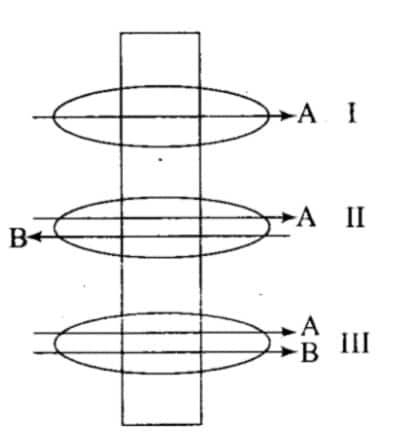
Answer:
i) Uniport, ii) Antiport, iii) Symport
Question:11
Given below is a table. Fill in the gaps.
S. No. | Property | Simple diffusion | Facilitated transport | Active transport |
i. | Highly selective | Yes | ||
ii. | Uphill transport | Yes | ||
iii. | Requires ATP | |||
Answer:
S. No. | Property | Simple diffusion | Facilitated transport | Active transport |
i. | Highly selective | No | Yes | Yes |
ii. | Uphill transport | No | No | Yes |
iii. | Requires ATP | No | No | Yes |
Question:12
Define water potential and solute potential.
Answer:
Water potential is the kinetic energy of water, and it decreases with the addition of a solute. The degree and magnitude by which the water potential reduces on the addition of a solute is known as solute potential.
Question:13
Why is solute potential always negative? Explain Ψw = Ψs + Ψp.
Answer:
The water potential is reduced when a solute dissolves in water as the concentration decreases, in comparison to pure water. The solute potential is the measure and indication of the decrease in water pollution caused by the solute. Water potential is always negatively affected by the solute potential and thus making the solute potential also negative.
At standard normal temperature, the solute potential and water potential are always equal. If the concentration is increased, the solutes, water potential rises and is denoted by the equation.
Ψw = Ψs + Ψp
The suffix of w is the water potential, while s is the solute potential, and p is the pressure, respectively.
Question:14
An onion peel was taken and
(a) Placed in salt solution for five minutes.
(b) After that, it was placed in distilled water. When seen under the microscope
What would be observed in (a) and (b)?
Answer:
When (a) happens, there is a loss of water since the concentration of water is higher in the peel than the surrounding salt-concentrated solution, which will lead to a loss of water. Thus, the cells will undergo osmosis and shrink.
In the case of (b), the surrounding solution is less concentrated than the onion peel, and thus the peels would gain water and swell up, which will cause the shrunken cells to become normal.
In both cases, the changes occur due to the process of osmosis of water.
Question:15
Answer:
The apoplast pathway facilitates the movement of water through the root, and this is due to the cortical cells being loosely arranged. The symplast pathway facilitates a very small amount of water transport. The water movement in the apoplast pathway is restricted to the Casparian strip, and thus, the symplast pathway is taken instead.
Question:16
How does most of the water move within the root?
Answer:
The boundary of the endodermis is the location where the Casparian strip is found, and it is composed of suberin, thus being impenetrable to water. This restricts the passage of water through the apoplast pathway and forces it to follow through the symplast pathway instead.
Question:17
Give the location of the Casparian strip and explain its role in the water movement.
Answer:
Endodermal cell plant roots contain the Casparian strips, which prevent the water movement from returning to the cortex, creating a positive hydrostatic pressure in the vascular tissue.
Question:18
Differentiate between guttation and transpiration.
Answer:
Guttation takes place at night while transpiration occurs during the day.
Guttation is the process through which water is lost by the leaves in the form of water droplets, and transpiration where water is lost through water vapour.
Guttation is facilitated through the leaves and their vein endings, while stomata in the leaves carry out transpiration.
Guttation is not a voluntary or controlled process, while transpiration is regulated and controllable.
Question:19
Transpiration is a necessary evil in plants. Explain.
Answer:
Many processes in plants are regulated and dependent on the process of transpiration, such as the ascent of sap. The plant functions are dependent on this process and regulate the growth of plants, especially tall plants. The process helps in the loss of water through the form of water vapour and regulates the water level, but sometimes can lead to an excess loss, thus creating a shortage. Thus, there is less water available for photosynthesis, and most of it is lost through transpiration. Thus, in some cases, the process is very necessary, but on the other hand, it also causes certain issues, thus making it a necessary evil.
Question:20
Describe briefly the three physical properties of water which help in the ascent of water in xylem.
Answer:
Cohesion is the ability by which water molecules stick to each other, which helps the ascent of water in a continuous stream.
Adhesion helps the ascent of water in the xylem, as this is the ability by which water sticks to a surface, causing easy transport.
Surface tension helps the ascent of water in the xylem, as this helps the water molecules to occupy the least surface area possible and helps in the maximum amount to move.
Question:21
Answer:
During summer, the water loss is much higher than the amount of water retained. This will cause the plant to wilt if it is not watered in summer. Transpiration during the day will add to the water loss, and it is reversible if the water is supplied at the correct time; a long delay will lead to wilting.
Question:22
Answer:
Facilitated diffusion is the molecular movement, and the diffusion of the substance is highly dependent on the liquid solubility. The diffusion cannot happen if the substance has a hydrophilic moiety, and to facilitate it, the special membrane proteins come to the rescue. As diffusion occurs from a region of high concentration to a low concentration, energy is not spent; instead, the process is natural. This process is highly selective and does not allow all substances to pass through.
Question:23
Correct the statements.
(a) Cells shrink in hypotonic solutions and swell in hypertonic solutions.
(b) Imbibition is a special type of diffusion when water is absorbed by living cells.
(c) Most of the water flow in the roots occurs via the symplast.
Answer:
(a) Cells swell in hypotonic solutions and shrink in hypertonic solutions.
(b) Imbibition is a special type of diffusion when water is absorbed by solids – colloids.
(c) Most of the water flow in the roots occurs via the apoplast.
Confused between CGPA and Percentage?
Get your results instantly with our calculator!
💡 Conversion Formula used is: Percentage = CGPA × 9.5
Get Answers to NCERT Exemplar Class 11 Biology Solutions Chapter 11 (Short Questions)
Question:1
Answer:
Minerals in the soil cannot all be taken by the plant and need to be regulated. The transportation is different, and sometimes it can be active or passive. Passive transportation occurs through the root hairs, where the special membrane proteins present in the epidermal cells regulate the active movement of nutrients. The transport proteins are also present in the endodermal cells, which help in the restricted uptake of nutrients. The proteins in these cells act as guards and allow the selective entry of solutes to enter the xylem. Moreover, the endodermis, a layer of suberin, allows only one direction of transport.
Question:2
Answer:
It helps in understanding the ways and structure in which the transportation of minerals happens. The xylem and its analysis depict that the maximum amount of nitrogen is converted into organic forms to facilitate movement and not into inorganic forms. The xylem and phloem also facilitate the exchange of nutrients, and while sodium and potassium are transported in organic compounds, it is not necessarily a compulsion. Therefore, it cannot be determined that the xylem causes only the inorganic substances and the phloem of the organic ones.
Question:3
Answer:
The life of a plant which is cut in a vase can be lengthened by placing the plant in water and watering it regularly, adding extra external nutrients to the water it is placed in, as well as exposing it to certain chemicals, such as cytokinin hormone, to not only increase the life span but also cause the plant growth.
Question:4
Answer:
The number and concentration of stomata, openings of the stomata, as well as the water level and the structure of the leaf, are the main determinants which regulate the process of transpiration. These differ from plant to plant, even if they are growing in the same area and can show different levels of transpiration.
Question:5
Answer:
Water is regarded as the universal solvent, and it dissolves most compounds, causing easy transport and absorption. It majorly forms the protoplast and is the primary element of most cells, thus being a part of their composition. The medium for most transportation is water, and it makes the process faster and easier through various membranes and processes.
The availability of nutrients in water is high, which helps the life of many organisms, such as the presence of oxygen. It helps in regulating temperature and processes like pollination, and also helps in the relief of heat and regulation of temperature.
Question:6
Answer:
A quiescent cell has a quite static membrane potential, and the stage is known as the potential resting stage. The intracellular intensity of K+ in the cell membrane is far higher than the animal extracellular levels. This is known as the sodium/proton pump and is caused by positive sodium and potassium ions. For every three positive sodium ions leaving, two positive potassium ions enter, and the positive ions increase and cause the change.
Question:7
Cut pieces of beetroot do not leave colour in cold water, but do so in hot water. Explain.
Answer:
In hot water, the plasma membrane of the beetroot leaks and the pigments are loose in the water, causing the colouring. The cold water is much lower in temperature, causing no damage to the plasma membrane and no colour is leaked.
Question:8
Answer:
Leaves have the ability to facilitate the process of photosynthesis when water is available.
The leaves are not able to transport or translate the substances, causing disruption, and the girdling adds to the damage, leading to phloem injury. This causes the girdle to die even if the water is available.
Question:9
Answer:
The soil hosts numerous minerals in the form of ions, and these cannot freely move across root walls and membranes due to the difference in the environment and concentration level. The soil has less concentration, and the particles are not permeable through the cell membrane. Therefore, diffusion alone does not solve the transport issue.
Question:10
How can plants be grown under a limited water supply without compromising on metabolic activities?
Answer:
Changes in the water level cause physiological changes in the plant. Transpiration is reduced, and leaves might wilt to conserve water and reduce loss. Thus, normal metabolic activities can be continued despite the water shortage.
Question:11
Answer:
For the ascent of sap, a lot of factors are considered, such as the pressure of the roots, forces of cohesion and adhesion, as well rate of transpiration and the action of the capillary. Adhesion makes the water molecules stick to a surface, while cohesion helps the water molecules stick together to move as one unit. Without these forces, the water molecules will lose their tendency, ability, and agility to seamlessly transport nutrients and move, disrupting the ascent of sap.
Question:12
Answer:
The coloured strands depict that water has flowed constantly through the stem, and this is due to the forces of cohesion and adhesion. This experiment effectively demonstrates the ascent of water in the stem due to the xylem.
Question:13
When a freshly collected Spirogyra filament is kept in a 10% potassium nitrate solution, it is observed that the protoplasm shrinks in size:
(a) What is this phenomenon called?
(b) What will happen if the filament is replaced in distilled water?
Answer:
(a) Plasmolysis
(b) This will cause more water to enter the cells, and the cells will swell and return to their natural shape and size.
Question:14
Sugar crystals do not dissolve easily in ice-cold water. Explain.
Answer:
The lower the temperature, the less kinetic energy is possessed by the water. Sugar thus does not dissolve in cold water and will dissolve easily in hotter temperatures.
Question:15
Answer:
Salt increases the concentration of the soil, causing the water in the roots to move out through osmosis in order to balance the concentration, leading to excessive water loss. While it can reduce weeds, the application of salt can also be harmful and damage plants and instead should be applied as a solution and not a direct application of salt.
Question:16
What is the chemical composition of xylem and phloem sap?
Answer:
The xylem sap consists mainly of sulphur and potassium inorganic substances and nitrogen in the organic state. The phloem sap is also a mixture of both, where the food is transported with the help of organic compounds, but the exchange is facilitated by the inorganic substances.
Question:17
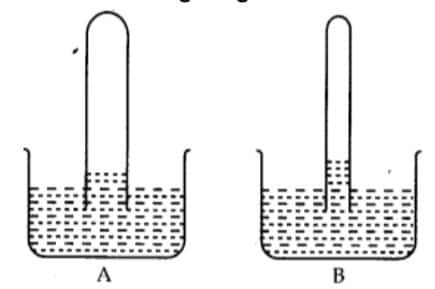
Why does B show a higher water rise than A?
Answer:
While lumen A is thicker, lumen B is longer, which creates a greater capillary effect, and the water rises higher due to the pressure created.
Question:18
What are 'aquaporins'? How does the presence of aquaporins affect osmosis?
Answer:
The integral membrane proteins are known as aquaporins. They are a part of the MIP- Major Intrinsic Proteins and constitute the pores of the cell membranes, which help increase the speed of osmosis.
Question:19
ABA (abscisic acid) is called a stress hormone.
(a) How does this hormone overcome stress conditions?
(b) From where does this hormone get released in leaves?
Answer:
(a) ABA helps when the water available is scarce and communicates with the stomata. This causes the stomata to close, thus stopping the process of transpiration and saving the excess loss of water and conserving it instead. This helps regulate stress situations.
(b) The stem apex releases ABA to travel to the leaves.
Question:20
Answer:
Some plants are adapted to survive in conditions with excess water and have features which make them acclimated to it. The stems of these plants are long and keep them above the surface of the water, while it is hollow to facilitate the easy passage of gases and foster growth.
Question:21
Differentiate between diffusion and translocation in plants.
Answer:
Diffusion is a passive process, while translocation is an active one.
Translocation employs energy in the form of ATP from the cell, while diffusion occurs naturally and does not require energy.
Diffusion causes the water to move as well, along with certain gases, but translocation involves the movement of only organic substances.
Question:22
How is facilitated diffusion different from diffusion?
Answer:
Diffusion is with the osmosis process and in the same direction, but facilitated diffusion is in the opposite direction.
Diffusion is quite a slow time-consuming process, but facilitated diffusion is comparatively a quick one.
Diffusion does not rely on the living system, but facilitated diffusion does.
Question:23
Explain the mass flow hypothesis of transport in the phloem.
Answer:
The mass flow hypothesis, is known as the pressure-flow hypothesis and is the movement of food along the phloem. The concentration of glucose causes the osmosis gradient to form, and the movement of water is facilitated to the phloem through the xylem to maintain the concentration.
The turgor pressure causes the phloem sap to transport sugar to the sink from the source, and the pressure which plays a key role here is the flow hypothesis. The substance is moved in bulk and is known as the mass flow hypothesis.
Question:24
Observe the diagram and answer the following:
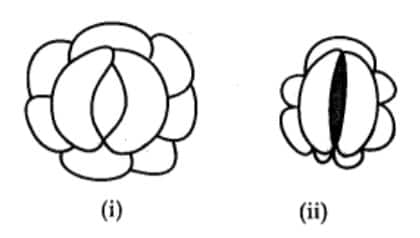
(a) Are these types of guard cells found in monocots or dicots?
(b) Which of these shows a higher water content (i) or (ii)?
(c) Which element plays an important role in the opening and closing of stomata?
Answer:
(a) Bean-shaped guard cells are located in dicots
(b) In (i), stomata are open and turgid and thus have a higher water level than in (ii), which is mostly closed and quite flaccid
(c) Potassium is the key element
Question:25
Define uniport, symport and antiport. Do they require energy?
Answer:
Uniport is the movement characterised when the molecules pass and move across cell membranes, irrespective of each other and without being dependent on each other.
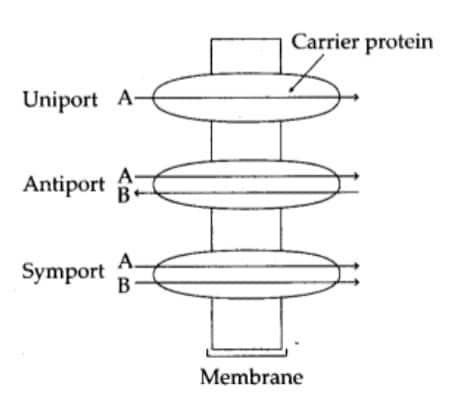
Antiport is the transportation when the said molecules act opposite and move in absolute contrary directions to each other.
Symport is the process in which the molecules move along in the same direction. All these ways do not require any energy from the cell.
Detailed Answers to NCERT Exemplar Class 11 Biology Solutions Chapter 11
Question:1
Answer:
There are several elements and nutrients placed and located in the soil, but the plant needs to regulate and adjust the kind of minerals that travel to the xylem.
Some of these ions present in the soil travel from the soil to the root hair in a passive way. The active transport of ions in the soil is regulated by the epidermal cell's special membrane proteins. Transportation of certain proteins can also be facilitated by the endodermal cells, which regulate and allow the selective entry of ions. The proteins located in these cells screen and take care of which ions to allow entry. The suberin layer of the endodermis allows transport in only one direction.
Question:2
Answer:
- Temporary wilting is only the temporary change causing a turgidity loss, while permanent wilting is a permanent, irreversible loss in turgidity in cells.
- The process of temporary wilting only occurs when the rate of water supply is lower than the rate of transpiration; however, permanent wilting occurs when the difference is even lower than the critical level.
- Temporary wilting is reversible and can be taken care of as soon as there is a regular supply of water, but permanent wilting cannot be reversed and will lead to the plant's death.
- Temporary wilting is a phase after which the plant resumes normal functioning, but that is not the case with permanent wilting.
Question:3
Which of these is a semipermeable membrane (S.P) and which is selectively permeable (S.L)
(a) Animal bladder
(b) Plasmalemma
(c) Tonoplast
(d) Parchment membrane
(e) Egg membrane
Answer:
(a) Animal Bladder - Semi-permeable
(b) Plasmalemma - Selectively permeable
(c) Tonoplast - Selectively permeable
(d) Parchment membrane - Semi-permeable
(e) Egg membrane - Semi-permeable
Question:4
Answer:
Halophytes are plants which are conditioned and have adapted to growing in a salt-based and concentrated environment. Concentration in the soil is much higher than the water present in the stem of the plant. Water potential is much lower in the soil and can cause excessive water loss in the plant, creating a stressful situation. Therefore, the plants adapt to this situation by storing high-concentration salts, and halophytes maintain high turgor (pressure potential) even in saline soils.. This helps the plant to regulate and maintain its cell composition and pressure.
Question:5
Answer:
To observe the creation of carbohydrates and the following movement of starch from various parts of the plant to the others, the radiolabelled carbon dioxide is supplied. Photosynthesis occurs in the leaves; the radioactive carbon dioxide will travel to the leaf parenchyma.
Following the process of photosynthesis, the radioactive carbon will be the Carbohydrate in the leaves. This can also be proved by the presence of starch, which is a by-product of photosynthesis. The carbohydrates soon transform into starch and are moved to the other organs to store them. Thus, the radioactive carbon can be detected in the tubers, as the starch is stored in them tubers.
Question:6
Answer:
Water is known to be a highly polar molecule; the hydrogen atom is positive, by the oxygen atom is negative, which creates the polar charge. Therefore, the two atoms attract each other and create a force which is one of the major determinants for the surface tension that is formed on any liquid, complemented by certain intermolecular forces. This helps the plant to absorb water from the soil through the root and the xylem, eventually reaching the leaves. The forces of cohesion and adhesion help molecules to stick to each other as well as a surface and enable it to be transported in a continuous fashion. All these factors help and assist the ascent of sap.
Question:7
Comment on the experimental setup.
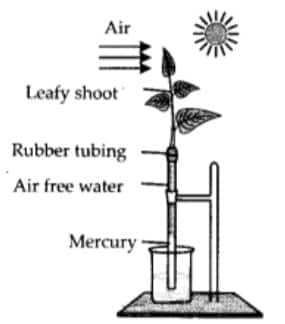
(a) What does the setup demonstrate?
(b) What will happen to the level of water if a blower is placed close to the setup?
(c) Will the mercury level fluctuate (go up/ down) if phenyl mercuric acetate is sprayed on leaves?
Answer:
(a) The changes in the process of transpiration due to fluctuation in the wind speed are demonstrated
(b) If the blower is closer, the wind speed will increase, thus lowering the level of water and subsequently increasing the speed of transpiration.
(c) Mercury level would decrease if phenyl mercuric chloride is sprayed as it will lower the speed of transpiration.
Also, check the NCERT Books and the NCERT Syllabus here
Approach to Solve Transport in Plants Class 11 NCERT Exemplar
The students should start by understanding the basic concepts like diffusion, osmosis, active transport, and water potential thoroughly. They should practice diagrams such as the root pressure mechanism, xylem and phloem structures, and translocation pathways. Students also have to solve numerically based questions on water potential and pressure potential. Definitions and processes like transpiration pull, cohesion-tension theory, and phloem loading and unloading should be noted down. Regular revision of the NCERT exemplar class 11 solutions is needed to improve conceptual clarity.
Also, read the NCERT Solution subject-wise
Main topics of NCERT Exemplar Class 11 Biology Solutions Chapter 11
This chapter explains how plants move water, minerals, and food throughout their bodies using various physical and biological processes. Students can use the NCERT Exemplar Class 11 Biology Chapter 11 to understand these topics easily.
Means of transport in plants
Diffusion and facilitated diffusion
Osmosis and water potential
Plasmolysis and imbibition
Long-distance transport of water
Transpiration pull and cohesion-tension theory
Transport of minerals
Phloem transport and pressure flow hypothesis
NCERT Exemplar Class 11 Solutions for Other Subjects
Advantages of NCERT Exemplar Class 11 Biology Chapter 11 Solutions
The chapter Transport in Plants explains how water, minerals, and other organic substances move through different plant tissues. Solving the exemplar problems helps students understand the important concepts without any confusion.
- NCERT Exemplar Class 11 Biology Chapter 11 Solutions improve the conceptual understanding of processes like diffusion, transpiration, and translocation.
- Solving the exemplar problems also help students to know how to write answers in the exams correctly.
- All the complex processes are broken down into simple and easy-to-understand explanations, so that students can understand topics without any confusion.
- Practising the exemplar problems strengthens the problem-solving skills and boosts confidence.
- The exemplar solutions help students prepare for the application-based questions, which are frequently asked in the board exams and competitive exams like NEET.
Important Questions for Transport in Plants Class 11 NCERT Exemplar
Given below are some important questions from Chapter 11 that helps students understand the concepts related to the movement of water, minerals, and nutrients in plants. For more such questions, students can refer to the NCERT Exemplar Class 11 Biology Chapter 11.
Question 1: Match the following
A | Leaves | i | Anti-transpirant |
B | Seed | ii | Transpiration |
C | Roots | iii | Negative osmotic potential |
D | Aspirin | iv | Imbibition |
E | Plasmolyzed cell | v | Absorption |
Options:
(a) A—(ii), B—(iv), C—(v), D—(i), E—(iii)
(b) A—(i), B—(ii), C—(v), D—(iv), E—(iii)
(c) A—(ii), B—(iii), C—(iv), D—(v), E—(i)
(d) A—(v), B—(ii), C—(i), D—(iv), E—(iii)
Answer: The correct answer is option(a), A—(ii), B—(iv), C—(v), D—(i), E—(iii)
Explanation:
Leaves- Transpiration, this is due to the fact that leaves are the main source of conducting the process of transpiration due to the presence of stomata, which aid and regulate the process.
Seed- Imbibition, seeds grow and foster through the process of imbibition, which happens through the retention of water and leads to seed germination.
Roots - absorption, this is due to the reason that roots are the primary way of absorption of nutrients through the soil to nurture the plant and aid in the growth of the shoot.
Aspirin- Anti-transpirant, this fits because aspirin is a metabolic inhibitor, which is a type of anti-transpirant.
Plasmolysed cell pairs with negative osmotic potential as plasmolysis occurs due to the hypertonic surroundings, which causes the shrinking of the protoplasm. This creates a negative osmotic potential.
Question 2: Which of the following factors does not affect the rate of transpiration in plants?
Options:
(a) Light intensity
(b) Temperature
(c) Wind speed
(d) Presence of chlorophyll
Answer: The correct answer is option (d) Presence of chlorophyll
Explanation:
The rate of transpiration is influenced by environmental factors such as light, temperature, and wind. Chlorophyll is involved in photosynthesis and does not directly control transpiration.
Question 3: Ascent of sap in tall trees is mainly explained by which of the following mechanisms?
Options:
(a) Root pressure
(b) Capillary action
(c) Diffusion
(d) Cohesion–tension theory
Answer: The correct answer is option (d) Cohesion–tension theory
Explanation:
The cohesion–tension theory explains the upward movement of water due to transpiration pull, cohesion between water molecules, and adhesion to xylem walls. It is the most accepted theory for the ascent of sap in tall plants.
Question 4. Which of the following ions is absorbed by plants mainly through diffusion?
Options:
(a) Potassium (K⁺)
(b) Calcium (Ca²⁺)
(c) Nitrate (NO₃⁻)
(d) Phosphate (PO₄³⁻)
Answer: The correct answer is option (b) Calcium (Ca²⁺)
Explanation:
Calcium ions are absorbed passively by diffusion because they move along their concentration gradient. In contrast, ions like nitrate and phosphate usually require active transport.
Question 5. Guttation occurs due to
Options:
(a) High transpiration rate
(b) Root pressure
(c) Low humidity
(d) Increased temperature
Answer: The correct answer is option (b) Root pressure
Explanation:
Guttation is the exudation of water droplets from leaf margins through hydathodes, occurring mainly at night or early morning when transpiration is low, and root pressure is high.
Must Read NCERT Notes subject-wise
NCERT Exemplar Class 11 Biology Solutions Chapter Wise
Students can explore the chapter-wise links given below in the table for quick and easy access.
Frequently Asked Questions (FAQs)
Q: Which topics are covered in this chapter?
A:
In the NCERT Exemplar Class 11 Biology Solutions Chapter 11 Transport in Plants, transportation of water and mineral in plants are discussed along with transpiration, translocation, and plant water relation are covered.
Q: What is the difference between the Diffusion and facilitated diffusion?
A:
Diffusion is the passive movement of molecules from a region of higher concentration to lower concentration without the help of proteins. Facilitated diffusion is also passive but requires specific carrier or channel proteins in the membrane to allow larger or polar molecules to cross. Both do not require energy, but facilitated diffusion is selective and faster.
Q: Is there a diagram included in the solutions?
A:
Yes, our experts have included well-labelled and descriptive diagrams in the NCERT Exemplar Class 11 Biology Solutions Chapter 11 Transport in Plants.
Q: Are these solutions helpful?
A:
Yes, the NCERT Exemplar Class 11 Biology Solutions Chapter 11 Transport in Plants are very helpful for students who want to prepare better and score well.
Q: What is the meaning of osmosis?
A:
Q: Why is solving the NCERT Exemplar for Transport in Plants important for Class 11 students?
A:
Solving NCERT Exemplar helps students understand key processes like osmosis, transpiration, and translocation in a clearer way. It also improves conceptual application, which is useful for both board exams and NEET preparation.
Q: Are the questions in the NCERT Exemplar for Transport in Plants tougher than the textbook exercises?
A:
Yes, Exemplar questions are generally higher-order and application-based. They are designed to deepen understanding and enhance analytical skills, helping students tackle challenging problems confidently during exams.
Articles
Upcoming School Exams

Colleges After 12th

Applications for Admissions are open.
Study at a world-renowned UK university in India | Admissions open for UG & PG programs.
Victoria University, Delhi NCR
ApplyApply for UG & PG programmes from Victoria University, Delhi NCR Campus
Illinois Tech Mumbai
ApplyAdmissions open for UG & PG programs at Illinois Tech Mumbai
University of Aberdeen Mumbai
ApplyApply for UG & PG courses at University of Aberdeen, Mumbai Campus
University of York, Mumbai
ApplyUG & PG Admissions open for CS/AI/Business/Economics & other programmes.
University of Bristol, Mumbai Enterprise Campus
ApplyBristol's expertise meets Mumbai's innovation. Admissions open for UG & PG programmes