


AP Inter 2nd Year Syllabus 2025-26 PDF – Download AP Intermediate Syllabus for All Subjects
The Board of Intermediate Education, Andhra Pradesh, releases the AP Inter syllabus 2026 on the official website, bieap.apcfss.in. The AP intermediate syllabus 2026 for the Arts, Commerce, and Science stream is released by the board for students to prepare for the final examination. The AP intermediate syllabus 2026 includes important topics, exam patterns, and marks distribution for all the subjects. Here, we have shared the syllabus PDF links for the students to download and check out the curriculum they need to follow.
This Story also Contains
- AP Intermediate Revised Syllabus 2025-26
- AP Intermediate Syllabus PDF 2026
- AP Intermediate Syllabus for Language Subject
- AP Intermediate Mathematics Syllabus
- AP Intermediate Physics Syllabus
- AP Intermediate Chemistry Syllabus
- AP Intermediate Botany Syllabus
- AP Intermediate Zoology Syllabus
- AP Intermediate Syllabus for Psychology
- AP Intermediate Syllabus for Geography
- AP Intermediate Syllabus for Sociology
- AP Intermediate Syllabus 2026 - Points to Remember

All the questions in the AP inter-board exams are asked from the AP intermediate 2nd year syllabus. Students must complete the syllabus before the examination and plan their preparation strategy for the examination. Read further to download the AP Inter 2nd year syllabus 2026 for all the subjects.
AP Intermediate Revised Syllabus 2025-26
The Andhra Pradesh Intermediate Board has proposed significant revisions to the AP 1st year and 2nd year syllabus for the upcoming academic year. Some key aspects of the proposed changes are given below:
1. Introduction of NCERT Syllabus:
- 1st Year (2025-26): The first year of Intermediate will now follow the NCERT syllabus, aligning the state's curriculum with national standards. This is expected to better prepare students for national-level competitive examinations like NEET and JEE.
- 2nd Year: The second year will also gradually transition to the NCERT syllabus in the coming years.
2. Subject Combinations and Flexibility:
- More Options for Students: Students will have greater flexibility in choosing subject combinations based on their interests and career goals.
- Focus on Core Subjects: There will be an increased emphasis on core subjects with a focus on developing a strong foundation in key areas.
- New Subject Combinations: New subject combinations may be introduced to cater to emerging career demands and student interests.
3. Marking Scheme and Evaluation:
- Realignment of Marks: The weightage of theory and practical examinations will be realigned across subjects, with a focus on a more balanced assessment.
- Internal Assessments: The role of internal assessments will be increased to encourage continuous evaluation and holistic development.
4. Syllabus Updates:
- The BIEAP will be updating textbooks and syllabi to ensure they are current and align with the latest academic and competitive examination requirements.
5. Public Consultation:
The BIEAP has sought feedback from students, parents, and educators on these proposed reforms. This input will be considered while finalising the revised syllabus and implementation plan.
AP Intermediate Syllabus PDF 2026
The AP board has published the AP Inter syllabus 2026. We have provided the direct link to the AP Inter syllabus 2026 below. Students can check out the AP inter syllabus for reference in the table mentioned below.
Confused between CGPA and Percentage?
Get your results instantly with our calculator!
AP Intermediate Syllabus for Language Subject
English is one of the highest-scoring subjects in AP intermediate exams. Below, students must go through the detailed syllabus of English for the previous year. We will update the recent AP Inter Syllabus 2026 as soon as the board releases it.
AP Inter 2nd Year Syllabus for Languages
| Units | Chapters |
|---|---|
| English Part I | |
Prose | 1. Respond Instead of Reacting by Azim Premji 2. How to Live to be 200 by Stephen Leacock 3 . Albert Einstein at School by Patrick Pringle 4. Eight Cousins or One Brother? By D.Balasubramanian 5. Spoon-Feeding by W.R.Inge 6. Mother’s Day: One-Act play by J.B.Priestley |
Poetry | 1. Equipment by Edgar Albert Guest 2. The Giving Tree by Shel Silverstein 3. Human Family by Maya Angelou 4. Bull in the City by Sri Sri (Translated by Velcheru Narayana Rao) 5. Harvest Hymn by John Betjeman |
Non-Detailed Text | 1. Animal Farm (an abridged version) by George Orwell |
Study skills and communication skills | 1. Conversation Practice 2. Vocabulary 3. Reading Comprehension 4. Interpretation of Non-Verbal Information 5. The Language of Advertisements 6. Letter Writing 7. Note Making 8. Word Stress 9. Describing a Process 10. Completing a Form 11. Curriculum Vitae |
English: Part II | |
Prose | 1. Playing the English Gentleman - M.K. Gandhi 2. The Bet - Anton Chekov 3. The Mad Tea Party - Lewis Carroll 4. On Smiles - A.G. Gardiner 5. The Prize Poem Sir P. G. Wodehouse 6. Sale - Anita Desai 7. Riders to the Sea - J.M. Synge |
Poetry | 1. Ulysses - Alfred Lord Tennyson 2. The Second Coming - W.B. Yeats 3. The Unknown Citizen - W.H. Auden 4. To the Indians who Died in South Africa -T.S. Eliot 5. The Night of the Scorpion - Nissim Ezekiel 6. Rakhi - Vikram Seth 7. Telephone Conversation - Wole Soyinka |
Non-Detailed Text | Julius Caesar - Shakespeare Orient Longman Edition |
AP Intermediate Syllabus - Part II Languages
Other languages prescribed by the Andhra Pradesh Board are mentioned below.
Telugu
Hindi
Sanskrit
French
Urdu
Arabic
Tamil
Oria
Also, Check
AP Intermediate Mathematics Syllabus
Students should plan their studies as per the prescribed Andhra Pradesh Board of Intermediate Education (year 2) exam syllabus mentioned below. Science is the subject whose concept should be very clear to score high in the AP intermediate result. Find below the detailed previous year AP Intermediate syllabus and marking scheme for Mathematics.
| Chapters | Important Topics |
|---|---|
Mathematics II A | |
01. Complex Numbers | 1.1 Complex number as an ordered pair of real numbers. Fundamental operations 1.2 Representation of complex number in the form a+ib 1.3 Modules and Amplitude of a complex number- Illustrations 1.4 Geometrical and Polar representation of complex number in Argand plane-Argand diagram |
02. De Moivre’s Theorem | 2.1 De Moivre’s Theorem- Integral and Rational Indices 2.2 nth roots of unity-Geographical Interpretations- Illustrations |
03. Quadratic Expressions | 3.1 Quadratic Expressions, Equations in one Variable 3.2 Sign of quadratic expressions-Change in signs and Maximum and Minimum 3.3 Quadratic Inequations |
04. Theory of Equations | 4.1 Relation between the roots and the coefficients in an Equation 4.2 Solving an equation when two or more of its roots are connected by certain relations 4.3 Equations with real coefficients – occurrence of complex roots in conjugate pairs and their consequences 4.4 Transformation of equations – Reciprocal equations |
05. Permutations and Combinations | 5.1 Fundamental Principles of Counting – Linear and Circular Permutations 5.2 Permutations of n dissimilar things taken r at a time 5.3 Permutations when repetitions are allowed 5.4 Circular Permutations 5.5 Permutations with Constant repetitions 5.6 Combinations- Definitions and Certain Theorems |
06. Binomial Theorem | 6.1 Binomial Theorem for positive integral index 6.2 Binomial Theorem for Rational Index 6.3 Approximations using Binomial Theorem |
07. Partial fractions | 7.0 Rational Fractions 7.1 Partial Fractions of f(x)/g(x), when g(x) contains non-repeated linear factors 7.2 Partial Fractions of f(x)/g(x), when g(x) contains repeated and I or non-repeated linear factors 7.3 Partial Fractions of f(x)/g(x), when g(x) contains irreducible factors |
08. Measures of Dispersion | 8.1 Range 8.2 Mean Deviation 8.3 Variance and Standard Deviation of ungrouped /grouped data 8.4 Coefficient of Variation and analysis of frequency distributions with equal means but different variances |
09. Probability | 9.1 Random Experiments and Events 9.2 Classical definition of probability, Axiomatic approach and addition theorem of probability 9.3 Independent and Dependent events, Conditional Probability, Multiplication Theorem1 and Bayes’ Theorem |
10. Random Variables and Probability Distributions | 10.1 Random Variables 10.2 Theoretical discrete distributions Binomial and Poisson distributions |
AP Intermediate Syllabus for Mathematics II B
| Chapters | Important Topics |
|---|---|
Mathematics II B | |
01. Circle | 1.1 Equation of a circle, standard form, centre and radius 1.2 Position of a point in the plane of a circle Definition of a tangent 1.3 Position of a straight line in the plane of a circle Condition for a line to be tangent 1.4 Chord of contact and polar 1.5 Relative Positions of two circles |
02. System of Circles | 2.1 Angle between two intersecting circles 2.2 Radical axis of two circles |
03. Parabola | 3.1 Conic Sections 3.2 Equation of tangent and normal at a point on the Parabola |
04. Ellipse | 4.1 Equation of ellipse in standard form, Parametric equations 4.2 Equation of tangent and normal at a point on the ellipse |
05. Hyperbola | 5.1 Equation of hyperbola in standard form Parametric equations 5.2 Equation of Tangent and Normal at a point on the hyperbola |
06. Integration | 6.1 Integration as the inverse process of differentiation, standard forms and properties of integrals 6.2 Method of substitution-Integration of algebraic, exponential, logarithmic, trigonometric and inverse trigonometric functions-Integration by parts 6.2(A) Integration by the method of substitution-Integration of algebraic and trigonometric functions 6.2(B) Integration by parts-Integration of exponential, logarithmic and inverse trigonometric functions 6.3 Integration- Partial fractions method 6.4 Reduction formulae |
07. Definite Integrals | 7.1 Define Integral as the limit of sum 7.2 Interpretation of definite integral as an area 7.3 The Fundamental Theorem of Integral Calculus 7.4 Properties 7.5 Reduction Formulae 7.6 Applications of definite integral to areas |
08. Differential equations | 8.1 Formation of differential equations-Degree and order of an ordinary differential Equation 8.2 Solving Differential Equations 8.2 (a) Variables separable method 8.2(b) Homogenous Differential Equation 8.2(c) Non-Homogeneous Different Equations 8.2(d) Linear Differential Equations |
Also, check
AP Intermediate Physics Syllabus
Students must go through the AP Intermediate Physics syllabus mentioned below. We have also provided important topics for the convenience of the students as per the previous year's syllabus.
| Chapters | Important Topics |
|---|---|
Chapter 1 - WAVES | Introduction, Transverse and longitudinal waves, Displacement relation in a progressive wave, The speed of a travelling wave, The Principle of superposition of waves, Reflection of waves, Beats, Doppler effect |
Chapter 2 - RAY OPTICS AND OPTICAL INSTRUMENTS | Introduction, Reflection of Light by Spherical Mirrors, Refraction, Total Internal Reflection, Refraction at Spherical Surfaces and by Lenses, Refraction through a Prism, Dispersion by a Prism, Some Natural Phenomena due to Sunlight, Optical Instruments |
Chapter 3 - WAVE OPTICS | Introduction, Huygens Principle, Refraction and reflection of plane waves using Huygens Principle, Coherent and Incoherent Addition of Waves, Interference of Light Waves and Young’s Experiment, Diffraction, Polarisation |
Chapter 4 - ELECTRIC CHARGES AND FIELDS | Electric Charges, Conductors and Insulators, Charging by Induction, Basic Properties of Electric Charge, Coulomb’s Law, Forces between Multiple Charges, Dipole in a Uniform External Field, Continuous Charge Distribution, Gauss’s Law, Application of Gauss’s Law, etc. |
Chapter 5 - ELECTROSTATIC POTENTIAL AND CAPACITANCE | Electrostatic Potential, Potential due to a Point Charge, Potential due to an Electric Dipole, Potential due to a System of Charges, Equipotential Surfaces, Potential Energy of a System of Charges, The Parallel Plate Capacitor, Effect of Dielectric on Capacitance, Combination of Capacitors, Energy Stored in a Capacitor, Van de Graaff Generator, etc. Potential Energy in an External Field, etc. |
Chapter 6 - CURRENT ELECTRICITY | Electric Current, Electric Currents in Conductor, Ohm’s Law, Temperature Dependence of Resistivity, Electrical Energy, Power Combination of Resistors - Series and Parallel Cells, emf, Internal Resistance, Cells in Series and in Parallel, Kirchhoff’s Laws, Wheatstone Bridge, Meter Bridge, Potentiometer, etc. |
Chapter 7 - MOVING CHARGES AND MAGNETISM | Magnetic Force, Motion in a Magnetic Field, Motion in Combined Electric and Magnetic Fields, Magnetic Field due to a Current, Element, Biot-Savart Law, Magnetic Field on the Axis of a Circular Current Loop, Torque on Current Loop, Magnetic Dipole, The Moving Coil Galvanometer, etc. |
Chapter 8 - MAGNETISM AND MATTER | The Bar Magnet, Magnetism and Gauss’s Law, The Earth’s Magnetism, Magnetisation and Magnetic Intensity, Magnetic Properties of Materials, Permanent Magnets and Electromagnets, etc. |
Chapter 9 - ELECTROMAGNETIC INDUCTION | The Experiments of Faraday and Henry, Magnetic Flux, Faraday’s Law of Induction, Lenz’s Law and Conservation of Energy, Inductance, AC Generator, etc. |
Chapter 10 - ALTERNATING CURRENT | AC Voltage Applied to a Resistor, Representation of AC Current and Voltage by Rotating Vectors - Phasors, AC Voltage Applied to an Inductor, AC Voltage Applied to a Capacitor, AC Voltage Applied to a Series LCR Circuit, Power in AC Circuit: The Power Factor, LC Oscillations, Transformers, etc. |
Chapter 11 - ELECTROMAGNETIC WAVES | Displacement Current, Electromagnetic Waves, Electromagnetic Spectrum, etc. |
Chapter 12 - DUAL NATURE OF RADIATION AND MATTER | Electron Emission, Photoelectric Effect, Experimental Study of Photoelectric Effect, Photoelectric Effect and Wave Theory of Light, Einstein’s Photoelectric Equation: Energy Quantum of Radiation, Particle Nature of Light: The Photon Wave Nature of Matter, Davisson and Germer Experiment, etc. |
Chapter 13 - ATOMS | Alpha-particle Scattering and Rutherford’s Nuclear Model of Atom, Atomic Spectra, Bohr Model of the Hydrogen Atom, The Line Spectra of the Hydrogen Atom, DE Broglie’s Explanation of Bohr’s Second Postulate of Quantisation, etc. |
Chapter 14 - NUCLEI | Atomic Masses and Composition of Nucleus, Size of the Nucleus, Mass-Energy and Nuclear Binding Energy, Nuclear Force, Radioactivity, Nuclear Energy, etc. |
Chapter 15 - SEMICONDUCTOR ELECTRONICS: MATERIALS, DEVICES AND SIMPLE CIRCUITS | Classification of Metals, Conductors and Semiconductors, Intrinsic Semiconductor, Application of Junction Diode as a Rectifier, Special Purpose p-n Junction Diodes, Junction Transistor, Digital Electronics and Logic Gates, Integrated Circuits, etc. |
Chapter 16 - COMMUNICATION SYSTEMS | Elements of a Communication System, Basic Terminology Used in Electronic Communication Systems, Bandwidth of Signals, Bandwidth of Transmission Medium, Propagation of Electromagnetic Waves, Modulation and its Necessity, Amplitude Modulation, etc. |
AP Intermediate Chemistry Syllabus
Chemistry is a subject that needs thorough study. Students are advised to refer to the table below to know the complete AP Intermediate Chemistry syllabus along with important topics.
| Chapters | Important Topics |
|---|---|
Chapter 1: SOLID STATE | General characteristics of solid-state, Amorphous and crystalline solids, Classification of crystalline solids based on different binding forces (molecular, ionic, metallic and covalent solids), Imperfections in solids, types of point defects: stoichiometric and non-stoichiometric defects, Electrical properties: conduction of electricity in metals, etc. |
Chapter 2: SOLUTIONS | Types of solutions, expressing concentration of solutions mass percentage, volume percentage, mass by volume percentage, parts per million, Abnormal molar masses-van’t Hoff factor, etc. |
Chapter 3: ELECTROCHEMISTRY AND CHEMICAL KINETICS | ELECTROCHEMISTRY Electrochemical cells, Galvanic cells: measurement of electrode potentials, the Nernst equation, and the equilibrium constant from Nernst equation- electrochemical cell and Gibbs energy of the cell reaction, Corrosion of metals, Hydrogen economy, etc. |
Chapter 4: SURFACE CHEMISTRY | Adsorption and absorption, mechanism of adsorption, types of adsorption,n characteristics of physisorption - adsorption from solution phase, applications of adsorption, Emulsions, etc. |
Chapter 5: GENERAL PRINCIPLES OF METALLURGY | The occurrence of metals, magnetic separation, froth flotation, leaching, Extraction of crude metal from concentrated ore, conversion to oxide, Uses of aluminium, copper, zinc and iron, etc. |
Chapter 6: p-BLOCK ELEMENTS | GROUP-15 ELEMENTS Occurrence- electronic configuration, atomic and ionic radii, ionisation energy, electronegativity, physical and chemical properties, Phosphorus halides, etc. GROUP-16 ELEMENTS Occurrence- electronic configuration, atomic and ionic radii, ionisation enthalpy, electron gain enthalpy, electronegativity, physical and chemical properties, Dioxygen-preparation, etc. GROUP-17 ELEMENTS Occurrence, electronic configuration, atomic and ionic radii, ionisation enthalpy, electron gain enthalpy, electronegativity, physical and chemical properties, etc. GROUP-18 ELEMENTS Occurrence, electronic configuration, ionisation enthalpy, atomic radius, i electron gain enthalpy, Xenon-oxygen, compounds XeO3 and XeOF4 - their formation and structures, etc. |
Chapter 7: d AND f BLOCK ELEMENTS & COORDINATION COMPOUNDS d AND f BLOCK ELEMENTS | Actinides-electronic configuration, atomic and ionic sizes, oxidation states, general characteristics, and comparison with lanthanide, Some important compounds of transition elements-oxides and oxoanions of metals: preparation and properties of potassium dichromate and potassium permanganate-structures of chromate, dichromate, etc. COORDINATION COMPOUNDS: Structural isomerism linkage, coordination, ionisation and solvate isomerism, bonding in coordination compounds, etc. |
Chapter 8: POLYMERS | Types of polymerisation reactions: addition polymerisation or chain growth polymerisation-ionic polymerisation, free radical mechanism, preparation of addition polymers-polythene, Teflon, Polymers of commercial importance:e polypropene, polystyrene, polyvinyl chloride(PVC), urea-formaldehyde resin, etc. |
Chapter 9: BIOMOLECULES | Enzymes: Enzymes, mechanism of enzyme action, Hormones: Definition, different types of hormones, their production, biological activity, diseases Due to their abnormal activities, etc. |
Chapter 10: CHEMISTRY IN EVERYDAY LIFE | Chemicals in food, artificial sweetening agents, food preservatives, Drug-enzyme Interaction Receptors as drug targets, cleansing agents, soaps, ps and synthetic detergents, etc. |
Chapter 11: HALOALKANES AND HALOARENES | Classification and nomenclature, Nature of C-X bond, by the addition of hydrogen halides and halogens to alkenes-by halogen exchange, triiodomethane, tetrachloro methane, freons and DDT, etc. |
Chapter 12: ORGANIC COMPOUNDS CONTAINING C, H AND O (Alcohols, Phenols, Ethers, Aldehydes, Ketones and Carboxylic acids) | ALCOHOLS, PHENOLS AND ETHERS: Alcohols, phenols and ethers -classification, Nomenclature: (a)Alcohols, (b)phenols and (c)ethers, Structures of hydroxy and ether functional groups, Methods of preparation, Cleavage of the C-O bond, and electrophilic substitution of aromatic ethers, etc. ALDEHYDES AND KETONES: Nomenclature and structure of carbonyl group, Preparation of aldehydes and ketones-(1) by oxidation of alcohol, etc. CARBOXYLIC ACIDS: Nomenclature and structure of carboxyl group, Methods of preparation of carboxylic acids, Reactions involving -COOH group-reduction, decarboxylation, Uses of carboxylic acids, etc. |
Chapter 13: ORGANIC COMPOUNDS CONTAINING NITROGEN | AMINES: Structure of amines, Classification, Nomenclature, Preparation of amines: reduction of nitro compounds, ammonolysis of alkyl halides, reduction of nitriles, reduction of amides, Gabriel phthalimide synthesis and Hoffmann bromamide degradation reaction, Physical properties DIAZONIUM SALTS: Methods of preparation of diazonium salts (by diazotisation), Physical properties, Chemical reactions: Reactions involving displacement of nitrogen, reactions involving retention of the diazo group CYANIDES AND ISOCYANIDES: Structure and nomenclature of cyanides and isocyanides, etc. |
AP Intermediate Botany Syllabus
Find the detailed AP Intermediate Botany syllabus in the table mentioned below. Study according to the AP intermediate time table to plan the study time efficiently. Also, study important topics with the utmost concentration in order to score high.
| Units | Chapters | Important Topics |
|---|---|---|
Unit-I Plant Physiology | Chapter 1: Transport in Plants | Means of Transport, Phloem Transport: Flow from Source to Sink, Long Distance Transport of Water, etc. |
Chapter 2: Mineral Nutrition | Methods to Study the Mineral Requirements of Plants, Essential Mineral Elements, Metabolism of Nitrogen, etc. | |
Chapter 3: Enzymes | The concentration of Substrate, Classification and Nomenclature of Enzymes, etc. | |
Chapter 4: Photosynthesis in Higher Plants | Early Experiments, Site of Photosynthesis, Pigments Involved in Photosynthesis, Factors Affecting Photosynthesis, etc. | |
Chapter 5: Respiration of Plants | Cellular respiration, Glycolysis, Fermentation, Aerobic Respiration, Amphibolic Pathway, Respiratory Quotient, etc. | |
Chapter 6: Plant Growth and Development | Development, Plant Growth Regulators, Seed Dormancy, Photoperiodism, Vernalisation, etc. | |
UNIT II: Microbiology | Chapter 7: Bacteria | Morphology of Bacteria, Bacterial cell structure, The importance of Bacteria to Humans, etc. |
Chapter 8: Viruses | Multiplication of Bacteriophages- The Lysogenic Cycle, Viral diseases in Plants, etc. | |
UNIT III: Genetics | Chapter 9: Principles of Inheritance and Variation | Mendel’s Experiments, Chromosomal Theory of Inheritance, Linkage and Recombination, Mutations, etc. |
UNIT IV: Molecular Biology | Chapter 10: Molecular Basis of Inheritance | The DNA, Transcription, Translation, Regulation of Gene Expression, etc. |
UNIT V: Biotechnology | Chapter 11: Principles and processes of Biotechnology | Principles of Biotechnology, Processes of Recombinant DNA Technology, etc. |
Chapter 12: Biotechnology and its applications | Biotechnological Applications in Agriculture, Transgenic plants, Biosafety and Ethical issues, etc. | |
UNIT VI: Plants, Microbes and Human Welfare | Chapter 13: Strategies for enhancement in food production | Plant breeding, Single-cell protein, Tissue culture, etc. |
Chapter 14: Microbes in Human Welfare | Primary treatment, Secondary treatment or Biological treatment, Microbes as Biofertilizers, Challenges posed by Microbes, etc. |
AP Intermediate Zoology Syllabus
Below is the AP Zoology syllabus for 12th. Know the important topics and make the study timetable accordingly.
| Units | Important Topics |
|---|---|
UNIT-I Human Anatomy and Physiology-I | carbohydrates and fats, egestion, The calorific value of proteins, carbohydrates and fats, etc. |
UNIT II: Human Anatomy and Physiology-II | Human circulatory system – structure of the human heart and blood vessels; Cardiac cycle, cardiac output, double circulation; regulation of cardiac activity, etc. |
UNIT III: Human Anatomy and Physiology-III | Myasthenia gravis, tetany, muscular dystrophy, arthritis, osteoporosis, gout, etc. |
UNIT IV: Human Anatomy and Physiology-IV | Dwarfism, acromegaly, cretinism, goitre, exophthalmic goitre, diabetes, Addison’s disease, Cushing’s syndrome, etc. |
UNIT V: Human Reproduction | Fertilization, Embryo development up to blastocyst formation, implantation, etc. |
UNIT VI: Genetics | Colour blindness; Mendelian disorders in humans: Thalassemia, Haemophilia, Sickle-cell anaemia, cystic fibrosis, PKU, Alkaptonuria, etc. |
UNIT VII: Organic Evolution | Hardy-Weinberg law; Types of Natural Selection; Gene flow and genetic drift; Variations (mutations and genetic recombination), etc. |
UNIT VIII: Applied Biology | Human insulin and vaccine production; Gene Therapy; Transgenic animals; ELISA; Vaccines, MABs, Cancer biology, stem cells, etc. |
Click here to download the AP Intermediate Civics syllabus.
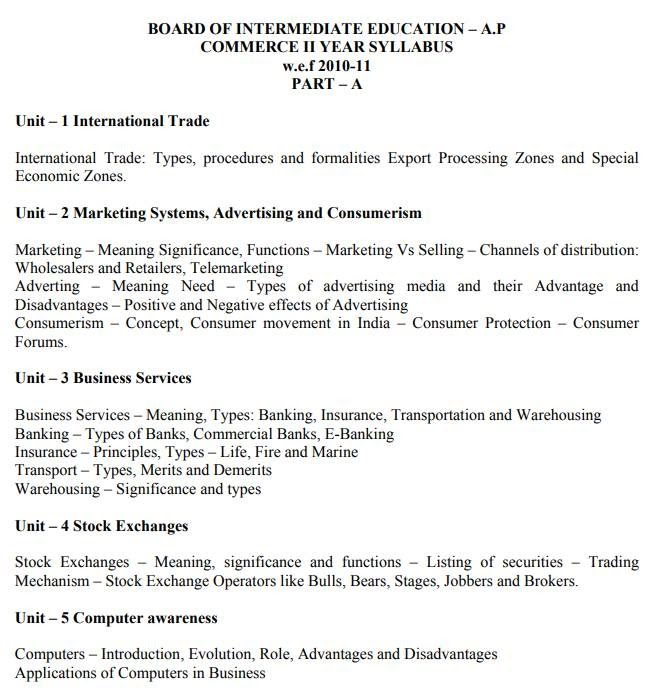
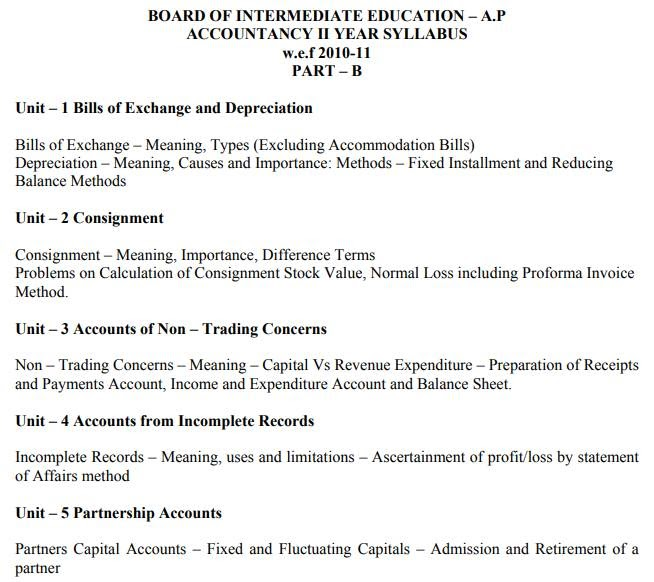
AP Intermediate Commerce Syllabus
We have provided the detailed syllabus of Commerce Part A and B. Find the picture of the syllabus below.
Also, check
AP Intermediate Economics Syllabus
Find the AP syllabus of Economics in the table given below and study after referring to the prescribed syllabus. Students should also solve AP intermediate question papers to know the trend of questions asked in the exam.
| Chapters | Important Topics |
|---|---|
Chapter 1: Economic Growth And Development | Economic growth, Economic Development, Differences Between Economic Growth and Development, etc. |
Chapter 2: Population and Human Resources Development | World Population, Causes of the rapid growth of population in India, Occupational distribution of the population of India, Meaning of Human Resources Development, etc. |
Chapter 3: National Income | Income Inequalities, Causes of Income Inequalities, Measures to control income inequalities, Unemployment in India, etc. |
Chapter 4: Agriculture Sector | Cropping pattern in India, Organic Farming, Irrigation facilities in India, Productivity of agriculture, Landholdings in India, etc. |
Chapter 5: Industrial Sector | National Manufacturing Policy, Disinvestment, National Investment Fund (NIF), Foreign Direct Investment, Special Economic Zones, etc. |
Chapter 6: Tertiary Sector | Tourism, Banking and Insurance, Communication, Science and Technology, etc. |
Chapter 7: Planning And Economic Reforms | Regional Imbalances, Role of Trade in Economic Development, Economic Reforms in India, GATT, etc. |
Chapter 8: Environment and Sustainable Economic Development | Environment, Economic Development, Environment and Economic Linkages, etc. |
Chapter 9: Economy Of Andhra Pradesh | Education, Environment, Agricultural sector, Industrial sector, etc. |
Chapter 10: Economic Statistics | Methods of Studying Variation, Measures of Dispersion for average, Lorenz Curve, Correlation, etc. |
Read More:
AP Intermediate Syllabus for Psychology
| Subjects | Units |
|---|---|
Psychology | I. Motivation |
II. Human Abilities | |
III. Social behaviour | |
IV. Groups and Leadership | |
V. Communication Skills | |
VI. Personality | |
VII. Issues in contemporary society | |
VIII. Health Psychology |
Click here to download the entire AP intermediate syllabus of Psychology
AP Intermediate Syllabus for Geography
| Sections | Chapters |
|---|---|
Section - I | 1. Human Geography |
2. Man and Environment | |
3. World Population | |
4. Human activities | |
SECTION – II | 5. Resources |
6. Agriculture | |
7. Minerals | |
8. Industries | |
9. Transportation | |
SECTION – III | 1. Physical features of India |
2. Major rivers of India | |
3. Climate of India | |
4. The natural vegetation of India | |
5. Soils | |
6. Population | |
7. Irrigation | |
8. Agriculture | |
9. Minerals | |
10. Industries | |
11. Transportation | |
12. Geography of Andhra Pradesh |
Click here to download the detailed AP syllabus of 12th Geography.
AP Intermediate Syllabus for Sociology
Sociology is one of the most scoring subjects in the Arts. Students must go through the syllabus of the same given below.
AP Inter Sociology Syllabus
| Subjects | Units |
|---|---|
Sociology | Unit I: Social Structure of Indian Society |
Unit-II Unity in Diversity | |
Unit-III The disadvantaged groups in India: | |
Unit-IV Social Problems | |
Unit-V Contemporary Social Problems in India | |
Unit-VI Social Policy & Programmes | |
Unit-VII Social Skills for Intervention | |
Unit-VIII Civic awareness & Civic responsibility |
AP Intermediate Syllabus for Public Administration
| Subjects | Units |
|---|---|
Public Administration | I. Administrative Machinery in India |
II. Planning Machinery in India | |
III.Urban Development Administration | |
IV. Rural Development Administration | |
V. Social Welfare Administration | |
VI. Citizen Administration | |
VII. Good Governance | |
VIII. Emerging Trends and Issues in Administration |
AP Intermediate Syllabus 2026 - Points to Remember
Students can go through the important points that need to be remembered regarding AP 2nd year syllabus 2026 in this section.
They can download the AP Intermediate Board 2026 syllabus from the official website, bie.ap.gov.in.
The syllabus is released for the subjects of all the streams - Science, Arts, and Commerce in a PDF format.
As per the AP intermediate syllabus, 2026 students are supposed to score a minimum of 35 per cent marks per subject to pass the exam.
Also, check -
Frequently Asked Questions (FAQs)
AP Board 12th exams 2026 has been conducted from February 23 to March 25, 2026, and from February 24 to March 23, 2026, for 1st-year and 2nd-year students, respectively.
Students need to score a minimum of 35 per cent marks in each subject to pass the AP board Inter examination.
To download PDF of AP Intermediate Syllabus 2026, students should visit the official website at bieap.apcfss.in
The complete Andhra Pradesh board of intermediate education (year 2) exam syllabus is given above in the article.
The AP Intermediate result will be declared in the second week of April 2026.

Questions related to AP Intermediate Board
On Question asked by student community
Hello,
To download the AP Inter 1st year supplementary exam question paper 2026, click on the Ebook link, which is given below.
Hello Samira,
For AP SSC Class 10 Maths Betterment 2026, practice PYQs and model papers to focus on repeated and high-scoring questions.
https://school.careers360.com/boards/bseap/ap-ssc-question-papers
Hi, some of the schools near Anand Vihar are as following. You can find more details about these schools in the official website of Careers360.
- Vivekanand School
- Bhai Parmanand Vidya Mandir
- GD Goenka Public School
- Shaheed Rajpal DAV Public School
- Bharat National Public School
- Laxmi Public School
- Sapphire International School
Hi Student
You can click on the link below to get the AP Board and TS Intermediate 1st year question papers for the Physics subject.
Hello aspirant,
Intermediate 2nd year Maths 2B practice papers for exam preparation. Practicing previous year papers and sample papers is very helpful to understand the exam pattern and important questions.
You can download Maths 2B question papers and practice papers from Careers360 using the links below:
• AP Inter 2nd