
Search Colleges, Exams, Schools & more


Login
NCERT Solutions for Class 11 Maths Chapter 3 Trigonometric Functions
Have you ever wondered how engineers design huge buildings, how sailors and pilots navigate their journey, or how shadows change their length throughout the day? You can find all these answers in trigonometry, a fascinating branch of mathematics. In class 11 Maths NCERT chapter 3, trigonometric functions, contains the advanced concepts of trigonometry like radian measure, relation between degree and radian, sign of trigonometric functions, graphs of trigonometric functions, domain and range of trigonometric functions, and trigonometric functions of the sum and difference of two angles. Understanding these concepts will make students more efficient in solving problems involving height, distance, and angles. These NCERT Solutions of class 11 will also build a strong foundation for more advanced trigonometric concepts, which have many practical and real-life applications, such as construction, navigation, architecture, etc.
This Story also Contains
- NCERT Solutions for Class 11 Maths Chapter 3 Trigonometric Functions: Download Free PDF
- Trigonometric Functions Class 11 NCERT Solutions (Exercises)
- Trigonometric Functions Class 11 NCERT Solutions: Exercise-wise
- Class 11 Maths NCERT Chapter 3: Extra Question
- Trigonometric Functions Class 11 Chapter 3: Topics
- Trigonometric Functions Class 11 Solutions: Important Formulae
- Approach to Solve Questions of Trigonometric Functions Class 11
- What Extra Should Students Study Beyond the NCERT for JEE?
- Why are Class 11 Maths Chapter 3 Trigonometric Functions question answers important?
- NCERT Solutions for Class 11 Mathematics: Chapter Wise
NCERT Solutions for Class 11 Maths offer clear and step-by-step solutions for the exercise problems in the NCERT Class 11 Maths Book. NCERT Solutions are widely recommended by teachers because they are aligned with the exam format. Students requiring trigonometric functions class 11 solutions will find this article useful. These NCERT Solutions are trustworthy and reliable, as they are created by subject matter experts at Careers360, making them an essential resource for exam preparation.
NCERT Solutions for Class 11 Maths Chapter 3 Trigonometric Functions: Download Free PDF
Careers360 provides NCERT Solutions for Class 11 Maths Chapter 3, curated by experts to make maths easy to understand and solve. Students can download the complete PDF from the link provided below.
Trigonometric Functions Class 11 NCERT Solutions (Exercises)
Below you will find NCERT Class 11 Maths Chapter 3 Trigonometric Functions question answers explained step by step.
|
Trigonometric Functions Class 11 Question Answers |
Question 1: Find the radian measures corresponding to the following degree measures:
(i) $25 ^\circ$
(ii) $-47 ^\circ$ $30'$
(iii) $240^\circ$
(iv) $520^\circ$
Answer:
It is solved using the relation between degrees and radians
(i) $25^\circ$
We know that $180^\circ$ = $\pi$ radian
So, $1^\circ = \frac{\pi }{180}$ radian
$25^\circ = \frac{\pi }{180}\times 25$ radian $=\frac{5\pi }{36}$ radian
(ii) $-47^\circ30'$
We know that
$-47^\circ30' = -47\frac{1}{2}^\circ = -\frac{95}{2}^\circ$
Now, we know that $180^\circ = \pi \Rightarrow 1^\circ = \frac{\pi}{180}$ radian
So, $-\frac{95}{2}^\circ = \frac{\pi}{180}\times \left (-\frac{95}{2} \right )$ radian $= \frac{-19\pi}{72}$ radian
(iii) $240^\circ$
We know that
$180^\circ = \pi \Rightarrow 1^\circ = \frac{\pi}{180}$ radian
So, $240^\circ = \frac{\pi}{180}\times 240 = \frac{4\pi}{3}$ radian
(iv) $520^\circ$
We know that
$180^\circ = \pi \Rightarrow 1^\circ = \frac{\pi}{180}$ radian
So, $520^\circ = \frac{\pi}{180}\times 520$ radian $= \frac{26\pi}{9}$ radian
Answer:
(i) $\frac{11}{16}$
We know that
$\pi$ radian $= 180^\circ \Rightarrow 1\ radian = \frac{180}{\pi}^\circ$
So, $\frac{11}{16}\ radian = \frac{180}{\pi}\times \frac{11}{16}^\circ$ (we need to take $\pi = \frac{22}{7}$ )
$\frac{11}{16}\ radian = \frac{180\times 7}{22}\times \frac{11}{16}^\circ = \frac{315}{8}^\circ$
(we use $1^\circ = 60'$ and 1' = 60'')
Here, 1' represents 1 minute and 60" represents 60 seconds
Now,
$\frac{315}{8}^\circ$
$=39\frac{3}{8}^\circ$
$ =39^\circ +\frac{3\times 60}{8}'$
$ = 39^\circ +22' + \frac{1}{2}'$
$ = 39^\circ +22' +30''= \frac{315}{8}^\circ = 39^\circ22'30''$
(ii) $-4$
We know that
$\pi$ radian $= 180^\circ \Rightarrow 1\ radian = \frac{180}{\pi}^\circ$ (we need to take $\pi = \frac{22}{7}$ )
So, $-4\ radian = \frac{-4\times 180}{\pi}= \frac{-4\times 180\times 7}{22} = -\frac{2520}{11}^\circ$
(we use $1^\circ = 60'$ and 1' = 60'')
$\Rightarrow \frac{-2520}{11}^\circ$
$= -229\frac{1}{11}^\circ $
$=-229^\circ + \frac{1\times 60}{11}' $
$= -229^\circ + 5' + \frac{5}{11}' $
$= -229^\circ +5' +27''= -229^\circ5'27''$
(iii) $\frac{5\pi}{3}$
We know that
$\pi$ radian $= 180^\circ \Rightarrow 1\ radian = \frac{180}{\pi} ^\circ$ (we need to take $\pi = \frac{22}{7}$ )
So, $\frac{5\pi}{3}\ radian = \frac{180}{\pi}\times \frac{5\pi}{3}^\circ = 300^\circ$
(iv) $\frac{7\pi}{6}$
We know that
$\pi$ radian $= 180^\circ \Rightarrow 1\ radian = \frac{180}{\pi} ^\circ$ (we need to take $\pi = \frac{22}{7}$ )
So, $\frac{7\pi}{6}\ radian = \frac{180}{\pi}\times \frac{7\pi}{6} = 210^\circ$
Question 3: A wheel makes 360 revolutions in one minute. Through how many radians does it turn in one second?
Answer:
Number of revolutions made by the wheel in 1 minute = 360
$\therefore$ Number of revolutions made by the wheel in 1 second = $\frac{360}{60} = 6$
($\because$ 1 minute = 60 seconds)
In one revolution, the wheel will cover $2\pi$ radians
So, in 6 revolutions it will cover = $6\times 2\pi = 12\pi$ radian
$\therefore$ In 1, the second wheel will turn $12\pi$ radians.
Question 4: Find the degree measure of the angle subtended at the centre of a circle of radius 100 cm by an arc of length 22 cm (use $\small \pi =\frac{22}{7}$ )
Answer:
We know that
$l = r\theta$ ( where $l$ is the length of the arc, $r$ is the radius of the circle and $\theta$ is the angle subtended)
here $r$ = 100 cm
and $l$ = 22 cm
Now,
$\theta = \frac{l}{r} = \frac{22}{100}$ radian
We know that
$\pi\ radian = 180^\circ$
So, 1 radian = $\frac{180}{\pi}^\circ$
$\therefore \frac{22}{100}\ radian = \frac{180}{\pi}\times\frac{22}{100}^\circ= \frac{180\times7}{22}\times\frac{22}{100} = \frac{63}{5}^\circ$
So, $\frac{63}{5}^\circ = 12\frac{3}{5}^\circ = 12^\circ + \frac{3\times60}{5}' = 12^\circ + 36' = 12 ^\circ36'$
Thus, the angle subtended at the centre of a circle $\theta = 12^\circ36'$.
Question 5: In a circle of diameter 40 cm, the length of a chord is 20 cm. Find the length of the minor arc of the chord.
Answer:
Given: radius ($r$) of circle = $\frac{Diameter}{2} = \frac{40}{2} = 20$ cm
length of chord = 20 cm
We know that
$\theta = \frac{l}{r}$ ($r$ = 20 cm , $l$ = ? , $\theta$ = ?)
Now,
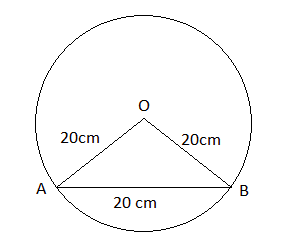
AB is the chord of length 20 cm, and OA and OB are radii of the circle, i.e. 20 cm each
The angle subtended by OA and OB at the centre = $\theta$
$\because$ OA = OB = AB
$\therefore$ $\Delta$ OAB is equilateral triangle
So, each angle is $60^\circ$
$\therefore$ $\theta = 60^\circ$ $= \frac{\pi}{3}$ radian
Now, we have $\theta$ and $r$
So, $l = r\theta = 20\times\frac{\pi}{3}=\frac{20\pi}{3}$
$\therefore$ the length of the minor arc of the chord ($l$) = $\frac{20\pi}{3}$ cm.
Answer:
Given: $\theta_1 = 60^\circ, \theta_2 = 75^\circ\\$ and $l_1 = l_2$
We need to find the ratio of their radii $\frac{r_1}{r_2}$
We know that arc length $l = r \theta$
So, $l_1 = r_1 \theta_1$ and $l_2 = r_2\theta_2$
Now, $l_1 = l_2$
So, $\frac{ r_1 }{ r_2}= \frac{\theta_2}{\theta_1} = \frac {75}{60} = \frac{5}{4}$, which is the ratio of their radii.
Answer:
(i) We know that
$l = r \theta$
Now,
$r$ = 75 cm
$l$ = 10 cm
So,
$\theta = \frac{l}{r} = \frac{10}{75} = \frac{2}{15}$ radian
(ii) We know that
$l = r \theta$
Now,
$r$ = 75 cm
$l$ = 15 cm
So,
$\theta = \frac{l}{r} = \frac{15}{75} = \frac{1}{5}$ radian
(iii) We know that
$l = r \theta$
Now,
$r$ = 75 cm
$l$ = 21 cm
So,
$\theta = \frac{l}{r} = \frac{21}{75} = \frac{7}{25}$ radian
|
Trigonometric Functions Class 11 Question Answers Exercise: 3.2 Page Number: 57 Total Questions: 10 |
Answer:$\cos x = -\frac {1}{2}$
$\because \sec x = \frac{1}{\cos x} = \frac{1}{-\frac {1}{2}} = -2$
$x$ lies in III quadrants. Therefore, sec x is negative
$\sin ^{2}x +\cos^{2}x = 1 ⇒ \sin^{2}x = 1 - \cos^{2}x$
$⇒ \sin^{2}x = 1 -\left ( -\frac{1}{2} \right )^{2}$
$⇒ \sin^{2}x = 1 - \frac{1}{4} = \frac{3}{4}$
$⇒ \sin x = \sqrt{\frac{3}{4}} = \pm \frac{\sqrt{3}}{2}$
$x$ lies in III quadrants. Therefore, sin x is negative
$\therefore \sin x= - \frac{\sqrt{3}}{2}$
$\because cosec \ x = \frac {1}{\sin x}= \frac{1}{- \frac{\sqrt{3}}{2}} =- \frac{2}{\sqrt{3}}$
$x$ lies in III quadrants. Therefore, cosec x is negative
$\tan x = \frac{\sin x}{\cos x} = \frac {-\frac{\sqrt{3}}{2}}{-\frac{1}{2}} = \sqrt{3}$
$x$ lies in III quadrants. Therefore, tan x is positive
$\cot x = \frac{1}{\tan x} = \frac{1}{\sqrt{3}}$
$x$ lies in III quadrants. Therefore, cot x is positive.
Answer: $\sin x = \frac {3}{5}$
$cosec \ x = \frac{1}{\sin x}=\frac {1}{\frac {3}{5}} = \frac {5}{3}$
$x$ lies in the second quadrant. Therefore, cosec x is positive
$\sin^{2}x + \cos ^{2}x = 1$
$⇒ \cos ^{2}x = 1 - \sin ^{2}x$
$⇒ \cos ^{2}x = 1 - \left ( \frac{3}{5} \right )^{2}$
$⇒ \cos ^{2}x = 1 - \frac {9}{25} = \frac {16}{25}$
$⇒ \cos x = \sqrt{\frac {16}{25}} = \pm \frac {4}{5}$
$x$ lies in the second quadrant. Therefore, cos x is negative
$\therefore \cos x = - \frac {4}{5}$
$\sec x = \frac {1}{\cos x} = \frac{1}{- \frac {4}{5}} = -\frac {5}{4}$
$x$ lies in the second quadrant. Therefore, sec x is negative
$\tan x = \frac {\sin x}{\cos x} = \frac {\frac{3}{5}}{-\frac{4}{5}} = -\frac {3}{4}$
$x$ lies in the second quadrant. Therefore, tan x is negative
$\cot x = \frac {1}{\tan x} = \frac {1}{-\frac {3}{4}} = -\frac{4}{3}$
$x$ lies in the second quadrant. Therefore, cot x is negative.
Answer:
$\cot x= \frac {3}{4}$
$\tan x = \frac{1}{\cot x}= \frac{1}{\frac {3}{4}} = \frac {4}{3}$
$1 + \tan ^ {2}x = \sec ^{2}x$
$⇒ 1+\frac{4^2}{3^2} = \sec ^{2}x$
$⇒ 1 + \frac {16}{9} = \sec ^{2}x$
$⇒ \frac {25}{9} = \sec ^{2}x$
$⇒ \sec x = \sqrt {\frac {25}{9}} = \pm \frac {5}{3}$
$x$ lies in the third quadrant. therefore sec x is negative
$\sec x = -\frac{5}{3}$
$\cos x = \frac {1}{\sec x} = \frac {1}{-\frac{5}{3}} = -\frac{3}{5}$
$\sin ^{2 }x+ \cos ^{2}x = 1⇒ \sin ^{2 }x = 1 - \cos ^{2}x$
$⇒ \sin ^{2 }x = 1 -\left ( -\frac{3}{5} \right )^{2}$
$⇒ \sin ^{2 }x = 1 - \frac {9}{25}$
$⇒ \sin ^{2 }x = \frac{16}{25}$
$⇒ \sin x = \sqrt {\frac{16}{25}} = \pm \frac{4}{5}$
$x$ lies in the third quadrant. Therefore, sin x is negative
$\sin x = -\frac {4}{5}$
$cosec \ x = \frac {1}{\csc} = \frac {1}{-\frac{4}{5}} = - \frac{5}{4}$.
Answer:
$\sec x = \frac {13}{5}$
$\cos x = \frac {1}{\sec x} = \frac{1}{\frac {13}{5}} = \frac {5}{13}$
$\sin^{2}x + \cos^{2}x = 1⇒ \sin^{2}x = 1 - \cos^{2}x$
$⇒ \sin^{2}x = 1 - (\frac {5}{13})^2$
$⇒ \sin^{2}x = 1 - \frac {25}{169} = \frac {144}{169}$
$⇒ \sin x = \sqrt { \frac {144}{169}} = \pm \frac {12}{13}$
$x$ lies in the fourth quadrant. Therefore, $\sin x$ is negative.
$\sin x =- \frac {12}{13}$
$\csc x = \frac {1}{\sin x} = \frac {1}{-\frac {12}{13}} = -\frac {13}{12}$
$\tan x = \frac {\sin x}{\cos x} = \frac {-\frac{12}{13}}{\frac{5}{13}} = -\frac {12}{5}$
$\cot x = \frac {1}{\tan x} = \frac {1}{-\frac{12}{5}} = -\frac{5}{12}$.
Question 5: Find the values of the other five trigonometric functions as $\small \tan x = -\frac{5}{12}$, $x$ lies in second quadrant.
Answer:
$\tan x = -\frac {5}{12}$
$\cot x = \frac {1}{\tan x} = \frac {1}{-\frac{5}{12}} = -\frac {12}{5}$
$1 + \tan^{2}x = \sec^{2}x$
$⇒ 1 + \left ( -\frac{5}{12} \right )^{2} = \sec^{2}x$
$⇒ 1 + \frac {25}{144} = \sec^{2}x$
$⇒ \frac {169}{144} = \sec^{2}x$
$⇒ \sec x = \sqrt {\frac {169}{144}} = \pm \frac {13}{12}$
$x$ lies in the second quadrant. Therefore, the value of $\sec x$ is negative
$\sec x = - \frac {13}{12}$
$\cos x = \frac{1}{\sec x}= \frac{1}{-\frac{13}{12}} = -\frac {12}{13}$
$\sin^{2}x + \cos^{2}x = 1$
$⇒ \sin^{2}x = 1 - \cos^{2}x$
$⇒ \sin^{2}x = 1 - \left ( -\frac{12}{13} \right )^{2}$
$⇒ \sin^{2}x = 1 - \frac{144}{169}⇒\sin^{2}x = \frac {25}{169}$
$⇒ \sin x = \sqrt {\frac{25}{169}} = \pm \frac{5}{13}$
$x$ lies in the second quadrant.
Therefore, the value of $\sin x$ is positive.
$\sin x = \frac {5}{13}$
$\csc = \frac {1}{\sin x} = \frac {1}{\frac {5}{13}} = \frac {13}{5}$.
Question 6: Find the values of the trigonometric functions $\small \sin 765^\circ$
Answer:
We know that values of $\sin x$ repeat after an interval of $2\pi$ or $360^\circ$
$\sin765^\circ = \sin (2\times360^\circ + 45^\circ ) = \sin45^\circ = \frac {1}{\sqrt{2}}$.
Question 7: Find the values of the trigonometric functions $\small cosec \ (-1410^\circ)$
Answer:
We know that the value of $\operatorname{cosec} x$ repeats after an interval of $2\pi$ or $360^\circ$.
$\operatorname{cosec} (-1410^\circ) = \operatorname{cosec} (360^\circ\times4+(-1410^\circ))= \operatorname{cosec}\ 30^\circ = 2$
Question 8: Find the values of the trigonometric functions $\small \tan \frac{19\pi }{3}$
Answer:
We know that $\tan x$ repeats after an interval of $\pi$ or 180$^\circ$.
$\tan (\frac{19\pi}{3}) = \tan (6\pi+\frac{\pi}{3})= \tan \frac{\pi}{3} =\tan 60^\circ = \sqrt{3}$
Question 9: Find the values of the trigonometric functions $\sin\left ( -\frac{11\pi}{3} \right )$
Answer:
We know that $\sin x$ repeats after an interval of $2\pi$ or $360^\circ$
$\sin \left ( -\frac{11\pi}{3} \right ) = \sin \left (4\pi +(-\frac{11\pi}{3}) \right ) = \sin \frac{\pi}{3} = \frac {\sqrt{3}}{2}$
Question 10: Find the values of the trigonometric functions $\small \cot \left ( -\frac{15\pi }{4} \right )$
Answer:
We know that $\cot x$ repeats after an interval of $\pi$ or 180$^\circ$.
$\cot \left ( -\frac{15\pi}{4} \right ) = \cot \left (4\pi +(-\frac {15\pi}{4}) \right ) = \cot \left ( \frac{\pi}{4} \right ) = 1$
|
Trigonometric Functions Class 11 Question Answers Exercise: 3.3 Page Number: 67-68 Total Questions: 25 |
Answer:
We know the values of sin 30°, cos 60°, and tan 45°.
$\sin \left ( \frac{\pi}{6} \right ) = \left ( \frac{1}{2} \right ), \\ \cos \left ( \frac{\pi}{3} \right ) = \left ( \frac{1}{2} \right ), \\ \tan \left ( \frac{\pi}{4} \right ) = 1$
L.H.S. $=\sin^{2}\frac{\pi}{6}+\cos^{2}\frac{\pi}{3}-\tan^{2}\frac{\pi}{4}=$ $\left ( \frac{1}{2} \right )^{2}+ \left ( \frac {1}{2} \right )^{2}-1^{2}$
$= \frac{1}{4}+\frac{1}{4}-1= -\frac{1}{2} =$ R.H.S.
Answer:
$\sin\frac{\pi}{6} = \frac {1}{2}, \operatorname{cosec} \frac{7\pi}{6} = \operatorname{cosec}\left ( \pi + \frac{\pi}{6} \right ) = - \operatorname{cosec} \frac{\pi}{6}=-2, \\ \cos \frac{\pi}{3} = \frac{1}{2}$
L.H.S. = $2\sin^{2}\frac{\pi}{6} + \operatorname{cosec}^{2}\frac{7\pi}{6}\cos^{2}\frac{\pi}{3} = 2\left ( \frac{1}{2} \right )^{2}+\left ( -2 \right )^{2}\left ( \frac{1}{2} \right )^{2}= 2\times\frac{1}{4} + 4\times\frac{1}{4} = \frac {1}{2} + 1= \frac{3}{2}$
= R.H.S.
Answer:
We know the values of cot 30°, tan 30°, and cosec 30°.
$\cot \frac{\pi}{6} = \sqrt{3}, \operatorname{cosec}\frac{5\pi}{6} = \operatorname{cosec}\left ( \pi - \frac{\pi}{6} \right )=\operatorname{cosec}\frac{\pi}{6} = 2, \tan\frac{\pi}{6}= \frac{1}{\sqrt{3}}$
L.H.S. $=\cot^{2}\frac{\pi}{6} + \operatorname{cosec}\frac{5\pi}{6} +3\tan^{2}\frac{\pi}{6} = \left ( \sqrt{3} \right )^{2} + 2 + 3\times\left ( \frac{1}{\sqrt{3}} \right )^{2}= 3+2+1 = 6=$ R.H.S.
Answer:
$\sin \frac{3\pi}{4} = \sin\left ( \pi-\frac{\pi}{4} \right ) = \sin \frac{\pi}{4}= \frac{1}{\sqrt{2}},\cos \frac{\pi}{4} = \frac{1}{\sqrt{2}}, \sec\frac{\pi}{3}= 2$
Using the above values
L.H.S. $=2\sin^{2}\frac{3\pi}{4} +2\cos^{2}\frac{\pi}{4}+2\sec^{2}\frac{\pi}{3} $
$= 2\times\left ( \frac{1}{\sqrt{2}} \right )^{2}+2\times\left ( \frac{1}{\sqrt{2}} \right )^{2}+2\left ( 2 \right )^{2}\\ \\ \Rightarrow 1+1+8=10=$ R.H.S.
Question 5(i): Find the value of $\small (i) \sin 75^\circ$
Answer:
$\sin 75^\circ = \sin(45^\circ + 30^\circ)$
We know that
$\sin(x+y)=\sin x\cos y + \cos x\sin y$
Using this identity
$\sin 75^\circ = \sin(45^\circ + 30^\circ) = \sin45^\circ\cos30^\circ + \cos45^\circ\sin30^\circ$
$= \frac{1}{\sqrt{2}}\times\frac{\sqrt{3}}{2} + \frac{1}{\sqrt{2}}\times\frac{1}{2}\\ \\ \Rightarrow \frac{\sqrt{3}}{2\sqrt{2}}+\frac{1}{2\sqrt{2}} = \frac{\sqrt{3}+1}{2\sqrt{2}}$
Question 5 (ii): Find the value of
$\small (ii) \tan 15^\circ$
Answer:
$\tan 15^\circ = \tan (45^\circ - 30^\circ)$
We know that,
$\left [ \tan(x-y)= \frac{\tan x - \tan y}{1+\tan x\tan y} \right ]$
By using this, we can write,
$\tan (45^\circ - 30^\circ)= \frac{\tan 45^\circ - tan30^\circ}{1+\tan45^\circ\tan30^\circ}= \frac{1-\frac{1}{\sqrt{3}}}{1+1\left ( \frac{1}{\sqrt{3}} \right )} = \frac{\frac{\sqrt{3}-1}{\sqrt{3}}}{\frac{\sqrt{3}+1}{\sqrt{3}}} = \frac{\sqrt{3}-1}{\sqrt{3}+1}$
$=\frac{\left ( \sqrt{3}-1 \right )^{2}}{\left ( \sqrt{3}+1 \right )\left ( \sqrt{3} -1\right )}=\frac{3+1-2\sqrt{3}}{\left ( \sqrt{3} \right )^{2}-\left ( 1 \right )^{2}}\\ \\ \Rightarrow \frac {4-2\sqrt{3}}{3-1}=\frac{2\left ( 2-\sqrt{3} \right )}{2}= 2-\sqrt{3}$
Answer:
$\cos\left ( \frac{\pi}{4}-x \right )\cos\left ( \frac{\pi}{4}-y \right ) - \sin\left ( \frac{\pi}{4}-x \right )\sin\left ( \frac{\pi}{4}-y \right )$
Multiply and divide by 2 both the cos and the sin functions
We get,
$\frac{1}{2}\left [2 \cos\left ( \frac{\pi}{4}-x \right )\cos\left ( \frac{\pi}{4}-y \right ) \right ] + \frac{1}{2}\left [- 2\sin\left ( \frac{\pi}{4}-x \right )\sin\left ( \frac{\pi}{4}-y \right ) \right ]$
Now, we know that
2cosAcosB = cos(A+B) + cos(A-B) --------(i)
-2sinAsinB = cos(A+B) - cos(A-B) ----------(ii)
We use these two identities
In our question A = $\left (\frac{\pi}{4}-x \right )$
B = $\left (\frac{\pi}{4}-y \right )$
So,
$\frac{1}{2}\left [ \cos \left \{ \left ( \frac{\pi}{4}-x \right) +\left ( \frac{\pi}{4}-y \right ) \right \} + \cos \left \{ \left ( \frac{\pi}{4}-x \right) -\left ( \frac{\pi}{4}-y \right ) \right \} \right ] +\\ \\ \frac{1}{2}\left [ \cos \left \{ \left ( \frac{\pi}{4}-x \right) +\left ( \frac{\pi}{4}-y \right ) \right \} - \cos \left \{ \left ( \frac{\pi}{4}-x \right) +\left ( \frac{\pi}{4}-y \right ) \right \} \right ]$
$= 2 \times \frac{1}{2} \left [ \cos \left \{ \left ( \frac{\pi}{4}-x \right )+\left ( \frac{\pi}{4}-y \right ) \right \} \right ]$
$= \cos \left [ \frac{\pi}{2}-(x+y) \right ]$
As we know that
$(\cos \left ( \frac{\pi}{2} - A \right ) = \sin A)$
By using this
$= \cos \left [ \frac{\pi}{2}-(x+y) \right ]$ $=\sin(x+y)=$ R.H.S.
Answer:
As we know that
$(\tan (A +B ) = \frac {\tan A + \tan B}{1- \tan A\tan B})$ and $\tan (A-B) = \frac {\tan A - \tan B }{1+ \tan A \tan B}$
So, by using these identities
L.H.S. $=\frac{\tan \left ( \frac{\pi}{4}+x \right )}{\tan \left ( \frac{\pi}{4}-x \right )} = \frac{\frac{\tan \frac {\pi}{4} + \tan x}{1- \tan \frac{\pi}{4}\tan x}} {\frac{\tan \frac {\pi}{4} - \tan x}{1+ \tan \frac{\pi}{4}\tan x}} =\frac{ \frac {1+\tan x }{1- \tan x}} { \frac {1-\tan x }{1+ \tan x}} = \left ( \frac{1 + \tan x}{1 - \tan x} \right )^{2}=$ R.H.S.
Answer:
As we know,
$\cos(\pi+x) = -\cos x$ , $\sin (\pi - x ) = \sin x$ , $\cos \left ( \frac{\pi}{2} + x\right ) = - \sin x$ and $\cos (-x) = \cos x$
By using these, our equation simplifies to
$\frac{\cos x \times -\cos x}{\sin x \times - \sin x} = \frac{- \cos^{2}x}{-\sin^{2}x} = \cot ^ {2}x$ $(\because \cot x = \frac {\cos x}{\sin x})=$ R.H.S.
Answer:
We know that
$\cos \left ( \frac{3\pi}{2}+x \right ) = \sin x, \cos (2\pi +x)= \cos x, \cot\left ( \frac{3\pi}{2} -x\right ) = \tan x, \cot (2\pi + x) = \cot x$
So, by using these, our equation simplifies to
$\cos \left ( \frac{3\pi }{2} +x\right )\cos (2\pi +x)\left [ \cot \left ( \frac{3\pi }{2}-x \right ) +\cot (2\pi +x)\right ]$
$=\sin x\cos x [\tan x + \cot x] = \sin x\cos x [\frac {\sin x}{\cos x} + \frac{\cos x}{\sin x}]$
$= \sin x\cos x\left [ \frac{\sin^{2}x+\cos^{2}x}{\sin x\cos x } \right ] =\sin^{2}x+\cos^{2}x = 1=$ R.H.S.
Question 10: Prove the following $\small \sin (n+1)x\sin(n+2)x + \cos(n+1)x\cos(n+2)x =\cos x$
Answer: Multiply and divide by 2,
$
=\frac{2 \sin (n+1) x \sin (n+2) x+2 \cos (n+1) x \cos (n+2) x}{2}
$
Now, by using identities
$
\begin{aligned}
& -2 \sin \mathrm{~A} \sin \mathrm{~B}=\cos (\mathrm{A}+\mathrm{B})-\cos (\mathrm{A}-\mathrm{B}) \\
& 2 \cos \mathrm{~A} \cos \mathrm{~B}=\cos (\mathrm{A}+\mathrm{B})+\cos (\mathrm{A}-\mathrm{B}) \\
& \text { Now, } \frac{\{-(\cos (2 n+3) x-\cos (-x))+(\cos (2 n+3)+\cos (-x))\}}{2}\\&(\because \cos (-x)=\cos x) \\
& =\frac{2 \cos x}{2}=\cos x=\text { R.H.S. }
\end{aligned}
$
Answer:
We know that
[ cos(A+B) - cos (A-B) = -2sinAsinB ]
By using this identity
$\cos \left ( \frac {3\pi}{4}+x \right ) - \cos \left ( \frac {3\pi}{4}-x \right ) = -2\sin\frac{3\pi}{4}\sin x = -2\times \frac{1}{\sqrt{2}}\sin x\\ \\ = -\sqrt{2}\sin x=$ R.H.S.
Question 12: Prove the following $\small \sin^{2}6x - \sin^{2}4x = \sin2x\sin10x$
Answer: We know that
$a^{2} - b^{2} = (a+b)(a-b)$
So, $\sin^{2}6x - \sin^{2}4x =(\sin6x + \sin4x)(\sin6x - \sin4x)$
Now, we know that
$\sin A + \sin B = 2\sin \left ( \frac{A+B}{2} \right )\cos\left ( \frac{A-B}{2} \right ), \sin A - \sin B = 2\cos \left ( \frac{A+B}{2} \right )\sin\left ( \frac{A-B}{2} \right )$
By using these identities
$\sin 6 x+\sin 4 x=2 \sin 5 x \cos x$
$\sin 6 x-\sin 4 x=2 \cos 5 x \sin x$
$\Rightarrow \sin^{2}6x - \sin^{2}4x = (2\cos5x\sin5x)(2\sin x\cos x)$
Now,
$
\begin{aligned}
& 2 \sin A \cos B=\sin (A+B)+\sin (A-B) \\
& 2 \cos A \sin B=\sin (A+B)-\sin (A-B)
\end{aligned}
$
by using these identities
$
\begin{aligned}
& 2 \cos 5 x \sin 5 x=\sin 10 x-0 \\
& 2 \sin x \cos x=\sin 2 x+0
\end{aligned}
$
So, $\sin^{2}6x-\sin^{2}4x = \sin2x\sin10x$
Question 13: Prove the following $\small \cos^{2}2x - \cos^{2}6x = \sin4x\sin8x$
Answer:
As we know that
$a^{2}-b^{2} =(a-b)(a+b)$
$\therefore \cos^{2}2x -\cos^{2}6x = (\cos2x-\cos6x)(\cos2x+\cos6x)$
Now, $\cos A - \cos B = -2\sin\left ( \frac{A+B}{2} \right )\sin\left ( \frac{A-B}{2} \right )\\ \\ \cos A + \cos B = 2\cos\left ( \frac{A+B}{2} \right )\cos\left ( \frac{A-B}{2} \right )$
By using these identities
$
\begin{aligned}
& \cos 2 x-\cos 6 x=-2 \sin (4 x) \sin (-2 x)=2 \sin 4 x \sin 2 x\\ &(\because \sin (-x)=-\sin x \text { and } \cos (-x)=\cos x) \\
& \cos 2 x+\cos 6 x=2 \cos 4 x \cos (-2 x)=2 \cos 4 x \cos 2 x
\end{aligned}
$
So our equation becomes
$(\cos2x-\cos6x)(\cos2x+\cos6x)$
$=(2\sin4x\sin2x)(2\cos4x\cos2x)$
$=(2\sin2x\cos2x)(2\sin4x\cos4x)$
$=\sin4x\sin8x=$ R.H.S.
Question 14: Prove the following $\small \sin2x +2\sin4x + \sin6x = 4\cos^{2}x\sin4x$
Answer:
We know that
$
\sin A+\sin B=2 \sin \left(\frac{A+B}{2}\right) \cos \left(\frac{A-B}{2}\right)
$
We are using this identity
$
\begin{aligned}
& \sin 2 x+2 \sin 4 x+\sin 6 x=(\sin 2 x+\sin 6 x)+2 \sin 4 x \\
& \sin 2 x+\sin 6 x=2 \sin 4 x \cos (-2 x)=2 \sin 4 x \cos (2 x)(\because \cos (-x)=\cos x)
\end{aligned}
$
So, our equation becomes
$
\sin 2 x+2 \sin 4 x+\sin 6 x=2 \sin 4 x \cos (2 x)+2 \sin 4 x
$
Now, take the $2 \sin 4 x$ common
$
\begin{aligned}
& \sin 2 x+2 \sin 4 x+\sin 6 x=2 \sin 4 x(\cos 2 x+1)\left(\because \cos 2 x=2 \cos ^2 x-1\right) \\
& =2 \sin 4 x\left(2 \cos ^2 x-1+1\right) \\
& =2 \sin 4 x\left(2 \cos ^2 x\right) \\
& =4 \sin 4 x \cos ^2 x=\text { R.H.S }
\end{aligned}
$
Question 15: Prove the following $\small \cot4x(\sin5x + \sin3x) = \cot x(\sin5x - \sin3x)$
Answer: We know that
$\sin x + \sin y = 2\sin\left ( \frac{x+y}{2} \right )\cos\left (\frac{x-y}{2} \right )$
By using this, we get
$\sin5x + \sin3x = 2\sin4x\cos x$
$\frac{\cos4x}{\sin4x}\left ( 2\sin4x\cos x \right ) = 2\cos4x\cos x\\ \\$
Now multiply and divide by sin x
$\\\ \\ \frac{2\cos4x\cos x \sin x}{\sin x} =\cot x (2\cos4x\sin x) \left ( \because \frac{\cos x}{\ sin x} = \cot x \right )\\ \\$
Now we know that
$\\ 2\cos x\sin y = \sin(x+y) - \sin(x-y)\\ \\$
By using this, our equation becomes
$=\cot x (\sin5x - \sin3x)=$ R.H.S.
Question 16: Prove the following $\small \frac{\cos 9x - \cos 5x}{\sin17x - \sin3x} = -\frac{\sin2x}{\cos10x}$
Answer:
As we know that
$\\ \cos x - \cos y = -2\sin\frac{x+y}{2}\sin\frac{x-y}{2 },$
$ \cos 9x - \cos 5x = -2\sin 7x \sin2x$
$\sin x - \sin y = 2\cos\frac{x+y}{2}\sin\frac{x-y}{2 }, \sin 17x - \sin 3x = 2\cos10x \sin7x$
Now, $\frac{\cos 9x - \cos 5x}{\sin 17x - \sin 3x} =\frac{-2\sin 7x \sin2x}{2\cos10x \sin7x} = -\frac{\sin 2x}{\cos10x}=$ R.H.S.
Question 17: Prove the following $\small \frac{\sin5x + \sin3x}{\cos5x + \cos3x} = \tan4x$
Answer:
We know that
$\\ \sin A + \sin B = 2\sin\frac{A+B}{2}\cos\frac{A-B}{2}$ and $\cos A + \cos B = 2\cos\frac{A+B}{2}\cos\frac{A-B}{2} \\$
We use these identities
$\\ \sin5x + \sin3x = 2\sin4x\cos x, \cos5 x + \cos 3x = 2\cos4x\cos x$
Now, $\frac{\sin5x + \sin3x}{\cos5 x + \cos 3x} = \frac{ 2\sin4x\cos x}{2\cos4x\cos x} = \frac{\sin4x}{\cos 4x} = \tan 4x=$ R.H.S.
Question 18: Prove the following $\small \frac{\sin x - \sin y}{\cos x+\cos y} = \tan \frac{(x-y)}{2}$
Answer:
We know that
$\sin x - \sin y = 2\cos\frac{x+y}{2 }\sin\frac{x-y}{2}$ and $\cos x +\cos y = 2\cos\frac{x+y}{2 }\cos\frac{x-y}{2}\\$
We use these identities
$\frac{\sin x - \sin y}{\cos x +\cos y} =\frac{2\cos\frac{x+y}{2 }\sin\frac{x-y}{2}}{ 2\cos\frac{x+y}{2 }\cos\frac{x-y}{2}} = \frac{\sin\frac{x-y}{2}}{\cos\frac{x-y}{2}} = \tan \frac{x-y}{2}=$ R.H.S.
Question 19: Prove the following $\small \frac{\sin x + \sin 3x}{\cos x + \cos3x} = \tan2x$
Answer:
We know that
$\sin x + \sin y = 2\sin\frac{x+y}{2}\cos\frac{x-y}{2}$
$\cos x + \cos y = 2\cos\frac{x+y}{2}\cos\frac{x-y}{2}$
We use these equations,
$\sin x + \sin3x = 2\sin2x\cos(-x) = 2\sin2x\cos x (\because \cos(-x) = \cos x)$
$\cos x + \cos3x = 2\cos2x\cos(-x) =2\cos2x\cos x (\because \cos(-x) = \cos x)$
Now, $\frac{\sin x + \sin3x}{\cos x + \cos3x} = \frac {2\sin2x\cos x}{2\cos2x\cos x}= \frac{\sin2x}{\cos2x} = \tan2x=$ R.H.S.
Question 20: Prove the following $\small \frac{\sin x - \sin 3x}{\sin^{2}x-\cos^{2}x} = 2\sin x$
Answer:
We know that
$\sin3x = 3\sin x - 4\sin^{3}x, \cos^{2}x-\sin^{2}x = \cos2x$ and $\cos2x = 1 - 2\sin^{2}x$
We use these identities
$\sin x - \sin3x = \sin x - (3\sin x - 4\sin^{3}x) = 4\sin^{3}x - 2\sin x = 2\sin x (2\sin^{2}x - 1)$
$\sin^{2}x-\cos^2x = \sin^{2}x-(1-\sin^2x) =2\sin^{2}x-1$
Now, $\frac{\sin x - \sin3x}{\sin^{2}-\cos^{2}x } = \frac{ 2\sin x (2\sin^{2}x - 1)}{ 2\sin^{2}x - 1} = 2\sin x=$ R.H.S.
Question 21: Prove the following $\small \frac{\cos 4x + \cos 3x + \cos 2x}{\sin 4x + \sin 3x + \sin 2x} = \cot 3x$
Answer:
We know that
$\cos x + \cos y = 2\cos\frac{x+y}{2}\cos\frac{x-y}{2}$ and $\sin x + \sin y = 2\sin\frac{x+y}{2}\cos\frac{x-y}{2}$
We use these identities
$\frac{(\cos4x + \cos2x) + \cos3x}{(\sin4x+\sin2x)+\sin3x} = \frac{2\cos3x\cos x + \cos3x}{2\sin3x\cos x+\sin3x} = \frac{2\cos3x(\cos x+1)}{2\sin3x(\cos x+1)}=\cot 3x=$ R.H.S.
Question 22: prove the following $\small \cot x \cot2x - \cot2x\cot3x - \cot3x\cot x =1$
Answer:
L.H.S.
= $\cot x \cot2x - \cot3x(\cot2x - \cot x)$
Now we can write $\cot3x = \cot(2x + x)$
⇒ $\cot(a+b) = \frac{\cot a \cot b - 1}{\cot a + \cot b}$
So, $\cot x \cot2x-\frac{\cot 2x \cot x - 1}{\cot 2x + \cot x}(\cot2x+\cot x)$
= $\cot x \cot2x - (\cot2x\cot x -1)$
= $\cot x \cot2x - \cot2x\cot x +1= 1 =$ R.H.S.
Question 23: Prove that $\small \tan4x = \frac{4\tan x(1-\tan^{2}x)}{1-6 \tan^{2}x+\tan^{4}x}$
Answer:
We know that
$\tan2A=\frac{2\tan A}{1 - \tan^{2}A}$
and we can write tan 4x = tan 2(2x)
So, $\tan4x=\frac{2\tan 2x}{1 - \tan^{2}2x}$ = $\frac{2( \frac{2\tan x}{1 - \tan^{2}x})}{1 - (\frac{2\tan x}{1 - \tan^{2}x})^{2}}$
= $\frac{2 (2\tan x)(1 - \tan^{2}x)}{(1-\tan x)^{2} - (4\tan^{2} x)}$
= $\frac{(4\tan x)(1 - \tan^{2}x)}{(1)^{2}+(\tan^{2} x)^{2} - 2 \tan^{2} x - (4\tan^{2} x)}$
= $\frac{(4\tan x)(1 - \tan^{2}x)}{1^{2}+\tan^{4} x - 6 \tan^{2} x }$ = R.H.S.
Question 24: Prove the following $\small \cos4x = 1 - 8\sin^{2}x\cos^{2}x$
Answer:
We know that
$\cos2x=1-2\sin^{2}x$
We use this in our problem
$\cos 4x = \cos 2(2x)$
= $1-2\sin^{2}2x$
= $1-2(2\sin x \cos x)^{2}$ $(\because \sin2x = 2\sin x \cos x)$
= $1-8\sin^{2}x\cos^{2}x=$ R.H.S.
Question 25: Prove the following $\small \cos6x = 32\cos^{6}x -48\cos^{4}x + 18\cos^{2}x-1$
Answer:
We know that
$\cos 3x = 4 \cos^{3}x - 3\cos x$
We use this in our problem
we can write $\cos 6x$ as $\cos 3(2x)$
$\cos 3(2x) = 4 \cos^{3}2x - 3\cos 2x$
= $4(2\cos^{2}x - 1)^{3} - 3(2\cos^{2}x - 1) (\because \cos 2x = 2\cos^{2}x - 1)$
= $4[(2\cos^{2}x)^{3} -(1)^{3}-3(2\cos^{2}x)^{2}(1) + 3(2\cos^{2}x)(1)^{2}]-6\cos^{2}x + 3[(a-b)^{3} = a^{3} - b^{3} - 3a^{2}b+ 3ab^{2}]$
= $32\cos^{6}x - 4 - 48 \cos^{4}x + 24 \cos^{2}x - 6\cos^{2}x + 3$
= $32\cos^{6}x - 48 \cos^{4}x + 18\cos^{2}x - 1 =$ R.H.S.
|
Trigonometric Functions Class 11 Question Answers Miscellaneous Exercise Page Number: 71-72 Total Questions: 10 |
Question 1: Prove that $\small 2\cos\frac{\pi }{13}\cos\frac{9\pi }{13}+\cos\frac{3\pi }{13}+\cos\frac{5\pi }{13}=0$
Answer:
We know that
cos A+ cos B = $2\cos(\frac{A+B}{2})\cos(\frac{A-B}{2})$
We use this in our problem
$\small 2\cos\frac{\pi }{13}\cos\frac{9\pi }{13}+2\cos\frac{(\frac{3\pi }{13}+\frac{5\pi}{13})}{2}\cos\frac{(\frac{3\pi}{13}-\frac{5\pi }{13})}{2}$
= $\small 2\cos\frac{\pi }{13}\cos\frac{9\pi }{13}+2\cos\frac{4\pi }{13}\cos\frac{-\pi}{13}$ ( we know that cos(-x) = cos x )
= $\small 2\cos\frac{\pi }{13}\cos\frac{9\pi }{13}+2\cos\frac{4\pi }{13}\cos\frac{\pi}{13}$
= $\small 2\cos\frac{\pi }{13}(\cos\frac{9\pi }{13}+\cos\frac{4\pi }{13})$
Again, use the above identity
= $\small 2\cos\frac{\pi }{13}(2\cos(\frac{\frac{9\pi }{13}+\frac{4\pi }{13}}{2})\cos(\frac{\frac{9\pi }{13}-\frac{4\pi }{13}}{2})$
= $\small 2\cos\frac{\pi }{13}2\cos\frac{\pi }{2}\cos\frac{5\pi }{26}$
we know that $\small \cos\frac{\pi }{2}$ = 0
So, $\small 2\cos\frac{\pi }{13}2\cos\frac{\pi }{2}\cos\frac{5\pi }{26}$ = 0 = R.H.S.
Question 2: Prove that $\small (\sin 3x + \sin x)\sin x + (\cos 3x - \cos x )\cos x = 0$
Answer:
We know that
$\sin3x=3\sin x - 4\sin^{3}x$ and $\cos3x=4\cos^{3}x - 3\cos x$
We use this in our problem
$\small (\sin 3x + \sin x)\sin x + (\cos 3x - \cos x )\cos x$
= $(3\sin x - 4\sin^{3}x+ \sin x) \sin x$ + $(4\cos^{3}x - 3\cos x- \cos x)\cos x$
= (4sinx - 4 $\small \sin^{3}x$ )sin x + (4 $\small \cos^{3}x$ - 4cos x)cos x
Now take the 4sinx common from 1st term and -4cosx from 2nd term
= 4 $\small \sin^{2}x$ (1 - $\small \sin^{2}x$ ) - 4 $\small \cos^{2}x$ (1 - $\small \cos^{2}x$ )
= 4 $\small \sin^{2}x$ $\small \cos^{2}x$ - 4 $\small \cos^{2}x$ $\small \sin^{2}x$ ($\small \because \cos^{2}x = 1 - \sin^2x$ and $\sin^{2}x = 1 -\cos^{2}x$)
= 0 = R.H.S.
Question 3: Prove that $\small (\cos x + \cos y)^{2} + (\sin x - \sin y)^{2} = 4 \cos^{2}\left ( \frac{x+y}{2} \right )$
Answer:
We know that $(a+b)^{2} = a^{2} + 2ab + b^{2}$ and $(a-b)^{2} = a^{2} - 2ab + b^{2}$
We use these two in our problem
$(\sin x-\sin y)^{2} = \sin^{2}x - 2\sin x\sin y + \sin^{2}y$ and $(\cos x+\cos y)^{2} = \cos^{2}x + 2\cos x\cos y + \cos^{2}y$
$\small (\cos x + \cos y)^{2} + (\sin x - \sin y)^{2}$ = $\cos^{2}x + 2\cos x\cos y + \cos^{2}y$ + $\sin^{2}x - 2\sin x\sin y + \sin^{2}y$
= 1 + 2 cos x cos y + 1 - 2 sin x sin y $\left ( \because \sin^{2}x + \cos^{2}x = 1\ and \ \sin^{2}y + \cos^{2}y = 1 \right )$
= 2 + 2(cos x cos y - sin x sin y)
= 2 + 2cos(x + y)
= 2(1 + cos(x + y) )
Now we can write
$\cos(x + y) =2\cos^{2}\frac{(x + y)}{2} - 1$ $\left ( \because \cos2x = 2\cos^{2}x - 1 \ \Rightarrow \cos x = 2\cos^{2}\frac{x}{2} - 1\right )$
= $2(1 + 2\cos^{2}\frac{(x + y)}{2} - 1)$
= $4\cos^{2}\frac{(x + y)}{2}$
= R.H.S.
Question 4: Prove that $\small (\cos x-\cos y)^{2} + (\sin x - \sin y)^{2} = 4\sin^{2}\left ( \frac{x-y}{2} \right )$
Answer:
We know that $(a+b)^{2} = a^{2} + 2ab + b^{2}$ and $(a-b)^{2} = a^{2} - 2ab + b^{2}$
We use these two in our problem
$(\sin x-\sin y)^{2} = \sin^{2}x - 2\sin x\sin y + \sin^{2}y$ and $(\cos x-\cos y)^{2} = \cos^{2}x - 2\cos x\cos y + \cos^{2}y$
$\small (\cos x - \cos y)^{2} + (\sin x - \sin y)^{2}$ = $\cos^{2}x - 2\cos x\cos y + \cos^{2}y$ + $\sin^{2}x - 2\sin x\sin y + \sin^{2}y$
= 1 - 2cos x cos y + 1 - 2sin x sin y $\left ( \because \sin^{2}x + \cos^{2}x = 1\ and \ \sin^{2}y + \cos^{2}y = 1 \right )$
= 2 - 2(cos x cos y + sin x sin y)
= 2 - 2cos(x - y) $\small (\because \cos(x-y) =\cos x \cos y + \sin x \sin y)$
= 2(1 - cos(x - y) )
Now we can write
$\cos(x - y) = 1 -2\sin^{2}\frac{(x - y)}{2}$ $\left ( \because \cos2x = 1 - 2\sin^{2}x \ \Rightarrow \cos x = 1 - 2\sin^{2}\frac{x}{2} \right )$
So, $2(1 - \cos(x - y) ) = 2(1 - ( 1 -2\sin^{2}\frac{(x - y)}{2}))$
= $4\sin^{2}\frac{(x - y)}{2}$ = R.H.S.
Question 5: Prove that $\small \sin x + \sin 3x + \sin 5x + \sin 7x = 4\cos x\cos2x \sin4x$
Answer:
we know that $\sin A + \sin B =2\sin\frac{A+B}{2}\cos\frac{A-B}{2}$
We use this identity in our problem
If we notice we need sin4x in our final result so it is better if we need a combination of sin7x and sin x, sin3x and sin5x to get sin4x.
$(\sin7x + \sin x) + (\sin5x + \sin3x) = 2\sin\frac{7x+x}{2}\cos\frac{7x-x}{2}$ $+2\sin\frac{5x+3x}{2}\cos\frac{5x-3x}{2}$
$=$ $2\sin4x\cos3x + 2\sin4x\cos x$
take 2sin4x common
= 2sin4x(cos3x + cosx)
We know that
$\cos A + \cos B =2\cos\frac{A+B}{2}\cos\frac{A-B}{2}$
We use this
$\cos3x + \cos x =2\cos\frac{3x+x}{2}\cos\frac{3x-x}{2}$
= $2\cos2x\cos x$
Now 2sin4x(cos3x + cosx) = 2sin4x( $2\cos2x\cos x$)
= $4\cos x \cos2x\sin4x$ = R.H.S.
Answer:
We know that
$\sin A + \sin B = 2\sin\frac{A+B}{2}\cos\frac{A-B}{2}$
$\cos A + \cos B =2\cos\frac{A+B}{2}\cos\frac{A-B}{2}$
We use these two identities in our problem
sin7x + sin5x = $2\sin\frac{7x+5x}{2}\cos\frac{7x-5x}{2}$ = $2\sin6x\cos x$
sin 9x + sin 3x = $2\sin\frac{9x+3x}{2}\cos\frac{9x-3x}{2}$ = $2\sin6x\cos 3x$
cos 7x + cos5x = $2\cos\frac{7x+5x}{2}\cos\frac{7x-5x}{2}$ = $2\cos6x\cos x$
cos 9x + cos3x = $2\cos\frac{9x+3x}{2}\cos\frac{9x-3x}{2}$ = $2\cos6x\cos 3x$
$\small \frac{(\sin 7x + \sin 5x) + (\sin9x + \sin 3x)}{(\cos7x + \cos5x) + (\cos9x + \cos3x)}$ = $\small \frac{(2\sin 6x\cos x) + (2\sin6x \cos3x)}{(2\cos6x cos x) + (2\cos6x \cos3x)}$
= $\small \frac{2\sin6x(\cos x + \cos3x)}{2\cos6x (\cos x + \cos3x)} = \tan6x$ = R.H.S. $\small \left ( \because \frac{\sin x}{\cos x} = \tan x\right )$
Question:7: Prove that $\small \sin3x + \sin2x - \sin x = 4\sin x \cos\frac{x}{2}\cos\frac{3x}{2}$
Answer:
We know that
$\cos A + \cos B = 2\cos\frac{A+B}{2}\cos\frac{A-B}{2}$
$\sin A - \sin B = 2\cos\frac{A+B}{2}\sin\frac{A-B}{2}$
We use these identities
$\sin3x - \sin x = 2\cos\frac{3x+x}{2}\sin\frac{3x-x}{2}$
$= 2\cos2x\sin x$
sin2x + $2\cos2x\sin x$ = 2sinx cosx + $2\cos2x\sin x$
Take 2 sinx common
$2\sin x ( \cos x + \cos2x) = 2\sin x(2\cos\frac{2x+x}{2}\cos\frac{2x-x}{2})$
$= 2\sin x(2\cos\frac{3x}{2}\cos\frac{x}{2})$
$= 4\sin x\cos\frac{3x}{2}\cos\frac{x}{2} =$ R.H.S.
Question 8: Find $\small \sin\frac{x}{2} , \cos\frac{x}{2} , and \tan\frac{x}{2}$ in $\small \tan x = - \frac{4}{3}$ , x in quadrant II.
Answer:
tan x = $-\frac{4}{3}$
We know that,
$\sec^{2}x = 1 + \tan^{2}x$
$= 1 +\left ( -\frac{4}{3} \right )^{2}$
$= 1 + \frac{16}{9}$ = $\frac{25}{9}$
$\sec x = \sqrt{\frac{25}{9}}$ = $\pm\frac{5}{3}$
x lies in the II quadrant, that's why sec x is -ve
So, $\sec x =-\frac{5}{3}$
Now, $\cos x = \frac{1}{\sec x}$ = $-\frac{3}{5}$
We know that,
$\cos x = 2\cos^{2}\frac{x}{2}- 1$ ( $\because \cos2x = 2\cos^{2}x - 1 \Rightarrow \cos x = 2\cos^{2}\frac{x}{2} - 1$ )
⇒ $-\frac{3}{5}+ 1 = 2$ $\cos^{2}\frac{x}{2}$
⇒ $\frac{-3+5}{5}$ = $2\cos^{2}\frac{x}{2}$
⇒ $\frac{2}{5}$ = $2\cos^{2}\frac{x}{2}$
⇒ $\cos^{2}\frac{x}{2}$ = $\frac{1}{5}$
⇒ $\cos\frac{x}{2}$ = $\sqrt{\frac{1}{5}}$ = $\pm\frac{1}{\sqrt5}$
x lies in II quadrant so value of $\cos\frac{x}{2}$ is +ve
$\cos\frac{x}{2}$ = $\frac{1}{\sqrt5} = \frac{\sqrt5}{5}$
We know that
$\cos x =1 - 2\sin^{2}\frac{x}{2}$
⇒ $2\sin^{2}\frac{x}{2}$ = 1 - $(-\frac{3}{5})$ = $\frac{8}{5}$
⇒ $\sin^{2}\frac{x}{2} = \frac{4}{5}\\ \\=\sin\frac{x}{2} = \sqrt{ \frac{4}{5}} = \pm \frac{2}{\sqrt{5}}$
x lies in the II quadrant, so the value of sin x is +ve
$\sin\frac{x}{2} = \frac{2}{\sqrt{}5} = \frac{2\sqrt5}{5}$
$\tan \frac{x}{2} = \frac{\sin\frac{x}{2}}{\cos\frac{x}{2}} = \frac{\frac{2\sqrt5}{5}}{\left ( \frac{\sqrt5}{5} \right )} = 2$
Answer:
$\pi < x < \frac{3\pi}{2}⇒ \frac{\pi}{2} < \frac{x}{2} < \frac{3\pi}{4}$
We know that
cos x = $2\cos^{2}\frac{x}{2} - 1$
$2\cos^{2}\frac{x}{2} =$ cos x + 1 = $\left ( -\frac{1}{3} \right )$ + 1 = $\left ( \frac{-1+3}{3} \right )$ = $\frac{2}{3}$
⇒ $\cos\frac{x}{2} = \sqrt{ \frac{1}{3}} = \pm \frac{1}{\sqrt3}$
⇒ $\cos\frac{x}{2} = - \frac{1}{\sqrt3} = - \frac{\sqrt3}{3}$ (As x lies in 3rd quadrant)
We know that
cos x = $1 - 2\sin^{2}\frac{x}{2}$
⇒ $2\sin^{2}\frac{x}{2} = 1 - \cos x$ = 1 - $\left ( -\frac{1}{3} \right )$ = $\frac{3+1}{3}$ = $\frac{4}{3}$
⇒ $2\sin^{2}\frac{x}{2} = \frac{4}{3}⇒ \sin^{2}\frac{x}{2} = \frac{2}{3}⇒ \sin\frac{x}{2} = \pm \sqrt{ \frac{2}{3}} = \frac{\sqrt6}{3}$
Because $\sin\frac{x}{2}$ is +ve in given quadrant
$\tan\frac{x}{2} = \frac{\sin\frac{x}{2}}{\cos\frac{x}{2}} = \frac{\frac{\sqrt6}{3}}{\frac{-\sqrt3}{3}} = - \sqrt2$
Question 10: Find $\small \sin\frac{x}{2} , \cos\frac{x}{2} , and \tan\frac{x}{2}$ in $\small \sin x = \frac{1}{4}$ ,x in quadrant II
Answer:
$\frac{\pi}{2} < x < \pi⇒ \frac{\pi}{4} < \frac{x}{2} < \frac{\pi}{2}$ all functions are positive in this range
We know that
$\cos^{2}x = 1 - \sin^{2}x$ = 1 - $\left ( \frac{1}{4} \right )^{2}$ = $1 - \frac{1}{16}$ = $\frac{15}{16}$
cos x = $\sqrt\frac{15}{16} = \pm \frac{\sqrt15}{4} = - \frac{\sqrt15}{4}$ (cos x is -ve in II quadrant)
We know that
cosx = $2\cos^{2}\frac{x}{2} - 1$
$2\cos^{2}\frac{x}{2} = \cos x + 1 = -\frac{\sqrt15}{4} + 1 = \frac{-\sqrt15+4}{4}$
$\cos^{2}\frac{x}{2} = \frac{-\sqrt15+4}{8}$
$\cos\frac{x}{2} = \pm \sqrt\frac{-\sqrt15+4}{8} = \frac{\sqrt{-\sqrt15+4}}{2\sqrt2} = \frac{\sqrt{8-2\sqrt15}}{4}$ (because all functions are posititve in given range)
Similarly,
cos x = $1-2\sin^{2}\frac{x}{2}$
$2\sin^{2}\frac{x}{2} = 1 - \cos x⇒ 2\sin^{2}\frac{x}{2} = 1 -\left (\frac{-\sqrt15}{4} \right ) = \frac{4+\sqrt15}{4}$
$\sin\frac{x}{2} = \pm \sqrt\frac{\sqrt15+4}{8} = \frac{\sqrt{\sqrt15+4}}{2\sqrt2} = \frac{\sqrt{8+2\sqrt15}}{4}$ (because all functions are posititve in given range)
$\tan\frac{x}{2} = \frac{\sin\frac{x}{2}}{\cos\frac{x}{2}} = \frac{\frac{\sqrt{8+2\sqrt15}}{4}}{\frac{\sqrt{8-2\sqrt15}}{4}} = \frac{{8+2\sqrt15}}{\sqrt{64 - 15\times4}} = \frac{{8+2\sqrt15}}{\sqrt{4}} = 4 + \sqrt15$
Trigonometric Functions Class 11 NCERT Solutions: Exercise-wise
Exercise-wise NCERT Solutions of Trigonometric Functions Class 11 Maths Chapter 3 are provided in the links below.
- NCERT Solutions for Class 11 Maths Chapter 3 Trigonometric Functions Exercise 3.1
- NCERT Solutions for Class 11 Maths Chapter 3 Trigonometric Functions Exercise 3.2
- NCERT Solutions for Class 11 Maths Chapter 3 Trigonometric Functions Exercise 3.3
- NCERT Solutions for Class 11 Maths Chapter 3 Trigonometric Functions Miscellaneous Exercise
Class 11 Maths NCERT Chapter 3: Extra Question
Question:
The solution of $\frac{\sqrt{3}+1}{\sin x}+\frac{\sqrt{3}-1}{\cos x}=4 \sqrt{2}$ in the interval $\left(0, \frac{\pi}{2}\right)$ is:
Solution:
$\begin{aligned} & \frac{\sqrt{3}+1}{\sin x}+\frac{\sqrt{3}-1}{\cos x}=4 \sqrt{2} \\ \Rightarrow & \left(\frac{\sqrt{3}+1}{2 \sqrt{2}}\right) \frac{1}{\sin x}+\left(\frac{\sqrt{3}-1}{2 \sqrt{2}}\right) \frac{1}{\cos x}=2 \\ \Rightarrow & \frac{\cos \frac{\pi}{12}}{\sin x}+\frac{\sin \frac{\pi}{12}}{\cos x}=2 \\ \Rightarrow & \cos \left(x-\frac{\pi}{12}\right)=\sin 2 x \\ & \Rightarrow \sin \left(\frac{\pi}{2}-\left(x-\frac{\pi}{12}\right)\right)=\sin 2 x \\ \Rightarrow & \frac{\pi}{2}-\left(x-\frac{\pi}{12}\right)=n \pi+(-1)^{\mathrm{n}} 2 x \\ &⇒ x=\frac{7 \pi}{36}, \frac{5 \pi}{12}\end{aligned}$
Hence, the correct answer is $\frac{7 \pi}{36}, \frac{5 \pi}{12}$.
Also, check,
Trigonometric Functions Class 11 Chapter 3: Topics
Students will explore the following topics in NCERT Class 11 Maths Chapter 3 Trigonometric Functions:
- Introduction
- Angles
- Trigonometric Functions
- Trigonometric Functions of the Sum and Difference of Two Angles
Trigonometric Functions Class 11 Solutions: Important Formulae
Angle Conversion:
Radian Measure = $\frac{π}{180}$ × Degree Measure
Degree Measure = $\frac{180}{π}$ × Radian Measure
Trigonometric Ratios:
$\begin{aligned} \sin \theta & =\frac{P}{H} \\ \cos \theta & =\frac{B}{H} \\ \tan \theta & =\frac{P}{B} \\ \operatorname{cosec} \theta & =\frac{H}{P} \\ \sec \theta & =\frac{H}{B} \\ \cot \theta & =\frac{B}{P}\end{aligned}$
Reciprocal Trigonometric Ratios:
$\begin{aligned} & \sin \theta=\frac{1}{\operatorname{cosec} \theta} \\ & \operatorname{cosec} \theta=\frac{1}{\sin \theta} \\ & \cos \theta=\frac{1}{\sec \theta} \\ & \sec \theta=\frac{1}{\cos \theta} \\ & \tan \theta=\frac{1}{\cot \theta} \\ & \cot \theta=\frac{1}{\tan \theta}\end{aligned}$
Trigonometric Ratios of Complementary Angles:
$\begin{aligned} \sin \left(90^{\circ}-\theta\right) & =\cos \theta \\ \cos \left(90^{\circ}-\theta\right) & =\sin \theta \\ \tan \left(90^{\circ}-\theta\right) & =\cot \theta \\ \cot \left(90^{\circ}-\theta\right) & =\tan \theta \\ \sec \left(90^{\circ}-\theta\right) & =\operatorname{cosec} \theta \\ \operatorname{cosec} \left(90^{\circ}-\theta\right) & =\sec \theta\end{aligned}$
Periodic Trigonometric Ratios:
$\begin{aligned} \sin \left(\frac{\pi}{2}-\theta\right) & =\cos \theta \\ \cos \left(\frac{\pi}{2}-\theta\right) & =\sin \theta \\ \sin (\pi-\theta) & =\sin \theta \\ \cos (\pi-\theta) & =-\cos \theta \\ \sin (\pi+\theta) & =-\sin \theta \\ \cos (\pi+\theta) & =-\cos \theta \\ \sin (2 \pi-\theta) & =-\sin \theta \\ \cos (2 \pi-\theta) & =\cos \theta\end{aligned}$
Trigonometric Identities:
$\begin{array}{r}\sin ^2 \theta+\cos ^2 \theta=1 \\ \operatorname{cosec} ^2 \theta-\cot ^2 \theta=1 \\ \sec ^2 \theta-\tan ^2 \theta=1\end{array}$
Product to Sum Formulas:
$\begin{aligned} \sin x \sin y & =\frac{1}{2}[\cos (x-y)-\cos (x+y)] \\ \cos x \cos y & =\frac{1}{2}[\cos (x-y)+\cos (x+y)] \\ \sin x \cos y & =\frac{1}{2}[\sin (x+y)+\sin (x-y)] \\ \cos x \sin y & =\frac{1}{2}[\sin (x+y)-\sin (x-y)]\end{aligned}$
Sum to Product Formulas:
$\begin{aligned} & \sin x+\sin y=2 \sin \left(\frac{x+y}{2}\right) \cos \left(\frac{x-y}{2}\right) \\ & \sin x-\sin y=2 \cos \left(\frac{x+y}{2}\right) \sin \left(\frac{x-y}{2}\right) \\ & \cos x+\cos y=2 \cos \left(\frac{x+y}{2}\right) \cos \left(\frac{x-y}{2}\right) \\ & \cos x-\cos y=-2 \sin \left(\frac{x+y}{2}\right) \sin \left(\frac{x-y}{2}\right)\end{aligned}$
General Trigonometric Formulas:
$\begin{aligned} & \sin (x+y)=\sin x \cos y+\cos x \sin y \\ & \cos (x+y)=\cos x \cos y-\sin x \sin y \\ & \cos (x-y)=\cos x \cos y+\sin x \sin y \\ & \sin (x-y)=\sin x \cos y-\cos x \sin y\end{aligned}$
Sum and Difference Formulas for tan:
$\begin{aligned} & \tan (x+y)=\frac{\tan x+\tan y}{1-\tan x \tan y} \\ & \tan (x-y)=\frac{\tan x-\tan y}{1+\tan x \tan y}\end{aligned}$
Double Angle Formulas for tan:
$\tan 2 \theta=\frac{2 \tan \theta}{1-\tan ^2 \theta}$
Triple Angle Formulas for sin, cos, and tan:
$\begin{aligned} & \sin 3 \theta=3 \sin \theta-4 \sin ^3 \theta \\ & \cos 3 \theta=4 \cos ^3 \theta-3 \cos \theta \\ & \tan 3 \theta=\frac{3 \tan \theta-\tan ^3 \theta}{1-3 \tan ^2 \theta}\end{aligned}$
Approach to Solve Questions of Trigonometric Functions Class 11
Here are some approaches that students can use to approach the questions related to trigonometric functions.
- Identify the perpendicular, base, and hypotenuse in a right-angled triangle efficiently to find the trigonometric ratios of sine, cosine, tangent, secant, cosecant and cotangent.
- Learn the relationship between degrees and radians because this chapter includes many questions requiring conversions between them. Remember that π radians = 180°
- Draw a table to understand the values of all the trigonometric ratios of standard angles (0°, 30°, 45°, 60°, 90°) in both degrees and radians.
- Use graphs wherever necessary to understand the maximum and minimum values of trigonometric functions over intervals.
- Be comfortable with the various trigonometric identities to simplify expressions and master the fundamental identities.
$\begin{aligned} & \sin ^2 x+\cos ^2 x=1 \\ & 1+\tan ^2 x=\sec ^2 x \\ & 1+\cot ^2 x=\operatorname{cosec}^2 x\end{aligned}$ - Practice all the formulas, such as the sine rule, cosine rule, projection rule and areas related to triangles, including their applications.
- Memorise the ASTC rule (All, Sine, Tangent, Cosine) to determine the sign of a trigonometric ratio in each quadrant.
What Extra Should Students Study Beyond the NCERT for JEE?
Here is a comparison list of the concepts in Trigonometric Functions that are covered in JEE and NCERT, to help students understand what extra they need to study beyond the NCERT for JEE:
|
Concept Name |
JEE |
NCERT |
|
✅ |
✅ | |
|
✅ |
✅ | |
|
✅ |
✅ | |
|
✅ |
✅ | |
|
✅ |
✅ | |
|
✅ |
✅ | |
|
✅ |
✅ | |
|
✅ |
❌ | |
|
✅ |
❌ | |
|
✅ |
❌ | |
|
✅ |
❌ | |
|
✅ |
❌ | |
|
✅ |
❌ | |
|
✅ |
✅ | |
|
✅ |
❌ | |
|
✅ |
❌ | |
|
✅ |
❌ | |
|
✅ |
✅ | |
|
✅ |
❌ | |
|
Trigonometric Equation using Minimum and Maximum Value of a Function |
✅ |
❌ |
|
✅ |
❌ | |
|
✅ |
❌ | |
|
✅ |
❌ | |
|
✅ |
❌ | |
|
✅ |
❌ | |
|
✅ |
❌ | |
|
✅ |
❌ | |
|
✅ |
❌ | |
|
✅ |
❌ | |
|
✅ |
❌ | |
|
✅ |
❌ | |
|
✅ |
❌ | |
|
✅ |
❌ | |
|
✅ |
❌ | |
|
✅ |
❌ | |
|
✅ |
❌ | |
|
✅ |
✅ | |
|
✅ |
❌ | |
|
✅ |
❌ |
Why are Class 11 Maths Chapter 3 Trigonometric Functions question answers important?
This chapter on Trigonometric Functions helps us understand how angles and ratios are related. It extends what students have learned in Class 10 and makes it more useful for solving complex problems. These Class 11 Maths chapter 3 Trigonometric Functions question answers help them get better at using formulas and solving real-world angle problems. Here are some more points on why these question answers are important:
- It helps us learn the basics of angles and trigonometric functions, which are used in geometry and physics.
- Students get to understand how to find functions for the sum and difference of angles, a key skill in solving advanced trigonometric equations.
- It improves our problem-solving speed and formula handling, which is helpful in exams.
- Studying Class 11 Maths chapter 3 Trigonometric Functions question answers builds the base for calculus and higher trigonometry in Class 12 and beyond.
NCERT Solutions for Class 11 Mathematics: Chapter Wise
Given below is the chapter-wise list of the NCERT Class 11 Maths solutions with their respective links:
Also, read,
- NCERT Exemplar Class 11 Maths Solutions Chapter 3 Trigonometric Functions
- NCERT Notes Class 11 Maths Chapter 3 Trigonometric Functions
NCERT Solutions for Class 11 - Subject Wise
Here are the subject-wise links for the NCERT solutions of class 11:
- NCERT solutions for class 11 biology
- NCERT solutions for class 11 maths
- NCERT solutions for class 11 chemistry
- NCERT solutions for Class 11 physics
NCERT Books and NCERT Syllabus
Here are some useful links for NCERT books and the NCERT syllabus for class 11:
Frequently Asked Questions (FAQs)
Q: Where can I download the NCERT Class 11 Mathematics Trigonometric Functions Solutions in PDF format?
A:
Many educational platforms, such as Careers360, offer free downloadable PDFs of Class 11 Trigonometric Functions Chapter 3 Solutions. Students can download the PDF for free from this article itself.
Q: How do NCERT Solutions help students understand graphs of sine, cosine, and tangent functions?
A:
NCERT solutions explain step-by-step methods to draw graphs and understand their amplitude, period, and behaviour.
Q: How to solve trigonometric equations in Class 11 Maths Chapter 3?
A:
To solve trigonometric equations in Class 11 Maths Chapter 3, express the given terms in basic trigonometric functions like sin, cos, and tan, then try to apply proper trigonometric identities and use simplification.
Q: What are trigonometric identities and why are they important?
A:
Trigonometric identities are mathematical relationships between trigonometric functions. They help simplify expressions and solve equations efficiently.
Q: Do trigonometric functions have real-life applications?
A:
Yes, trigonometric functions are used in physics, engineering, architecture, navigation, astronomy, and computer graphics.
Q: How do trigonometric functions help in higher-level mathematics?
A:
They are widely used in calculus, coordinate geometry, differential equations, and wave analysis.
Q: What is the difference between degree measure and radian measure?
A:
Degree measure expresses angles in degrees, while radian measure expresses angles in terms of arc length and radius, which is more useful in advanced mathematics.
Articles
Upcoming School Exams

Colleges After 12th
Courses After 12th

Applications for Admissions are open.
As per latest syllabus. Physics formulas, equations, & laws of class 11 & 12th chapters
JEE Main Important Chemistry formulas
Get nowAs per latest syllabus. Chemistry formulas, equations, & laws of class 11 & 12th chapters
JEE Main high scoring chapters and topics
Get nowAs per latest 2024 syllabus. Study 40% syllabus and score upto 100% marks in JEE
JEE Main Important Mathematics Formulas
Get nowAs per latest syllabus. Maths formulas, equations, & theorems of class 11 & 12th chapters