
NCERT Solutions for Exercise 6.4 Class 10 Maths Chapter 6 - Triangles
Upcoming Event
CBSE Class 10th Exam Date:17 Feb' 26 - 17 Feb' 26
NCERT Solutions For Class 10 Maths Chapter 6 Exercise 6.4
NCERT Solutions for Exercise 6.4 Class 10 Maths Chapter 6 Triangles are discussed here. These NCERT solutions are created by subject matter expert at Careers360 considering the latest syllabus and pattern of CBSE 2023-24. Class 10 maths ex 6.4 states the theorem “The square of the ratio of the corresponding sides of two comparable triangles is equal to the ratio of their areas”. Also discusses about criteria to find similarities between triangles and learn about simple geometry problems.
NCERT solutions for exercise 6.4 Class 10 Maths chapter 6 Triangles discusses mainly on the ratio of area and ratio of squared sides. 10th class Maths exercise 6.4 answers are designed as per the students demand covering comprehensive, step by step solutions of every problem. Practice these questions and answers to command the concepts, boost confidence and in depth understanding of concepts. Students can find all exercise together using the link provided below.
Assess NCERT Solutions for Class 10 Maths chapter 6 exercise 6.4
Triangles Class 10 Chapter 6 Exercise: 6.4
Q1 Let $\Delta ABC \sim \Delta DEF$ and their areas be, respectively, 64 $cm^2$ and 121 $cm^2$ . If EF = 15.4 cm, find BC.
Answer:
$\Delta ABC \sim \Delta DEF$ ( Given )
ar(ABC) = 64 $cm^2$ and ar(DEF)=121 $cm^2$ .
EF = 15.4 cm (Given )
$\frac{ar(\triangle ABC)}{ar(\triangle DEF)}=\frac{AB^2}{DE^2}=\frac{BC^2}{EF^2}=\frac{AC^2}{DF^2}$
$\frac{64}{121}=\frac{BC^2}{(15.4)^2}$
$\Rightarrow \frac{8}{11}=\frac{BC}{15.4}$
$\Rightarrow \frac{8\times 15.4}{11}=BC$
$\Rightarrow BC=11.2 cm$
Answer:
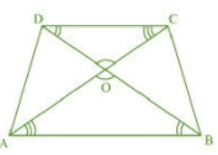
Given: Diagonals of a trapezium ABCD with AB || DC intersect each other at the point O.
AB = 2 CD ( Given )
In $\triangle AOB\, and\, \triangle COD,$
$\angle COD=\angle AOB$ (vertically opposite angles )
$\angle OCD=\angle OAB$ (Alternate angles)
$\angle ODC=\angle OBA$ (Alternate angles)
$\therefore \triangle AOB\, \sim \, \triangle COD$ (AAA similarity)
$\frac{ar(\triangle AOB)}{ar(\triangle COD)}=\frac{AB^2}{CD^2}$
$\frac{ar(\triangle AOB)}{ar(\triangle COD)}=\frac{(2CD)^2}{CD^2}$
$\frac{ar(\triangle AOB)}{ar(\triangle COD)}=\frac{4.CD^2}{CD^2}$
$\Rightarrow \frac{ar(\triangle AOB)}{ar(\triangle COD)}=\frac{4}{1}$
$\Rightarrow ar(\triangle AOB)=ar(\triangle COD)=4:1$
Q3 In Fig. 6.44, ABC and DBC are two triangles on the same base BC. If AD intersects BC at O, show that $\frac{ar (ABC)}{ar ( DBC )} = \frac{AO}{DO}$
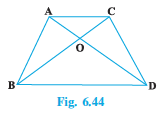
Answer:
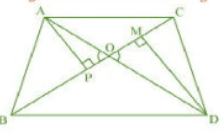
Let DM and AP be perpendicular on BC.
$area\,\,of\,\,triangle=\frac{1}{2}\times base\times perpendicular$
$\frac{ar(\triangle ABC)}{ar(\triangle BCD)}=\frac{\frac{1}{2}\times BC\times AP}{\frac{1}{2}\times BC\times MD}$
In $\triangle APO\, and\, \triangle DMO,$
$\angle APO=\angle DMO$ (Each $90 ^\circ$ )
$\angle AOP=\angle MOD$ (Vertically opposite angles)
$\triangle APO\, \sim \, \triangle DMO,$ (AA similarity)
$\frac{AP}{DM}=\frac{AO}{DO}$
Since
$\frac{ar(\triangle ABC)}{ar(\triangle BCD)}=\frac{\frac{1}{2}\times BC\times AP}{\frac{1}{2}\times BC\times MD}$
$\Rightarrow \frac{ar(\triangle ABC)}{ar(\triangle BCD)}=\frac{AP}{ MD}=\frac{AO}{DO}$
Q4 If the areas of two similar triangles are equal, prove that they are congruent.
Answer:
Let $\triangle ABC\, \sim \, \triangle DEF,$ , therefore,
$ar(\triangle ABC\,) = \,ar( \triangle DEF)$ (Given )
$\frac{ar(\triangle ABC)}{ar(\triangle DEF)}=\frac{AB^2}{DE^2}=\frac{BC^2}{EF^2}=\frac{AC^2}{DF^2}................................1$
$\therefore \frac{ar(\triangle ABC)}{ar(\triangle DEF)}=1$
$\Rightarrow \frac{AB^2}{DE^2}=\frac{BC^2}{EF^2}=\frac{AC^2}{DF^2}=1$
$AB=DE$
$BC=EF$
$AC=DF$
$\triangle ABC\, \cong \, \triangle DEF$ (SSS )
Answer:
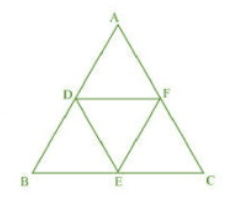
D, E, and F are respectively the mid-points of sides AB, BC and CA of $\Delta ABC$ . ( Given )
$DE=\frac{1}{2}AC$ and DE||AC
In $\Delta BED \: \:and \: \: \Delta ABC$ ,
$\angle BED=\angle BCA$ (corresponding angles )
$\angle BDE=\angle BAC$ (corresponding angles )
$\Delta BED \: \:\sim \: \: \Delta ABC$ (By AA)
$\frac{ar(\triangle BED)}{ar(\triangle ABC)}=\frac{DE^2}{AC^2}$
$\Rightarrow \frac{ar(\triangle BED)}{ar(\triangle ABC)}=\frac{(\frac{1}{2}AC)^2}{AC^2}$
$\Rightarrow \frac{ar(\triangle BED)}{ar(\triangle ABC)}=\frac{1}{4}$
$\Rightarrow ar(\triangle BED)=\frac{1}{4}\times ar(\triangle ABC)$
Let ${ar(\triangle ABC)$ be x.
$\Rightarrow ar(\triangle BED)=\frac{1}{4}\times x$
Similarly,
$\Rightarrow ar(\triangle CEF)=\frac{1}{4}\times x$ and $\Rightarrow ar(\triangle ADF)=\frac{1}{4}\times x$
$ar(\triangle ABC)=ar(\triangle ADF)+ar(\triangle BED)+ar(\triangle CEF)+ar(\triangle DEF)$
$\Rightarrow x=\frac{x}{4}+\frac{x}{4}+\frac{x}{4}+ar(\triangle DEF)$
$\Rightarrow x=\frac{3x}{4}+ar(\triangle DEF)$
$\Rightarrow x-\frac{3x}{4}=ar(\triangle DEF)$
$\Rightarrow \frac{4x-3x}{4}=ar(\triangle DEF)$
$\Rightarrow \frac{x}{4}=ar(\triangle DEF)$
$\frac{ar(\triangle DEF)}{ar(\triangle ABC)}=\frac{\frac{x}{4}}{x}$
$\Rightarrow \frac{ar(\triangle DEF)}{ar(\triangle ABC)}=\frac{1}{4}$
Answer:
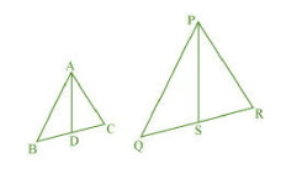
Let AD and PS be medians of both similar triangles.
$\triangle ABC\sim \triangle PQR$
$\frac{AB}{PQ}=\frac{BC}{QR}=\frac{AC}{PR}............................1$
$\angle A=\angle P,\angle B=\angle Q,\angle \angle C=\angle R..................2$
$BD=CD=\frac{1}{2}BC\, \, and\, QS=SR=\frac{1}{2}QR$
Purring these value in 1,
$\frac{AB}{PQ}=\frac{BD}{QS}=\frac{AC}{PR}..........................3$
In $\triangle ABD\, and\, \triangle PQS,$
$\angle B=\angle Q$ (proved above)
$\frac{AB}{PQ}=\frac{BD}{QS}$ (proved above)
$\triangle ABD\, \sim \triangle PQS$ (SAS )
Therefore,
$\frac{AB}{PQ}=\frac{BD}{QS}=\frac{AD}{PS}................4$
$\frac{ar(\triangle ABC)}{ar(\triangle PQR)}=\frac{AB^2}{PQ^2}=\frac{BC^2}{QR^2}=\frac{AC^2}{PR^2}$
From 1 and 4, we get
$\frac{AB}{PQ}=\frac{BC}{QR}=\frac{AC}{PR}=\frac{AD}{PS}$
$\frac{ar(\triangle ABC)}{ar(\triangle PQR)}=\frac{AD^2}{PS^2}$
Answer:
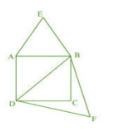
Let ABCD be a square of side units.
Therefore, diagonal = $\sqrt{2}a$
Triangles form on the side and diagonal are $\triangle$ ABE and $\triangle$ DEF, respectively.
Length of each side of triangle ABE = a units
Length of each side of triangle DEF = $\sqrt{2}a$ units
Both the triangles are equilateral triangles with each angle of $60 ^\circ$ .
$\triangle ABE\sim \triangle DBF$ ( By AAA)
Using area theorem,
$\frac{ar(\triangle ABC)}{ar(\triangle DBF)}=(\frac{a}{\sqrt{2}a})^2=\frac{1}{2}$
(A) 2: 1 (B) 1: 2 (C) 4 : 1 (D) 1: 4
Answer:
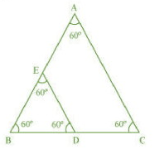
Given: ABC and BDE are two equilateral triangles such that D is the mid-point of BC.
All angles of the triangle are $60 ^\circ$ .
$\triangle$ ABC $\sim \triangle$ BDE (By AAA)
Let AB=BC=CA = x
then EB=BD=ED= $\frac{x}{2}$
$\frac{ar(\triangle ABC)}{ar(\triangle BDE)}=(\frac{x}{\frac{x}{2}})^2=\frac{4}{1}$
Option C is correct.
Q9 Sides of two similar triangles are in the ratio 4: 9. Areas of these triangles are in the ratio
(A) 2 : 3 (B) 4: 9 (C) 81: 16 (D) 16: 81
Answer:
Sides of two similar triangles are in the ratio 4: 9.
Let triangles be ABC and DEF.
We know that
$\frac{ar(\triangle ABC)}{ar(\triangle DEF)}=\frac{AB^2}{DE^2}=\frac{4^2}{9^2}=\frac{16}{81}$
Option D is correct.
More About NCERT Solutions for Class 10 Maths Exercise 6.4
Class 10 Maths chapter 6 exercise 6.4: Most of the questions are based on the ratio of areas of similar triangles in exercise 6.4 Class 10 Maths, but we should be also aware of some basic geometry which helps to solve problems of NCERT solutions for Class 10 Maths exercise 6.4. We should know the properties of the trapezium and the criterion of similarity of triangles. Questions given in the Exercise 6.4 Class 10 Maths are very important for the board exam. Students can also access Triangles Class 10 Notes here and use them for quickly revision of the concepts related to Triangles.
Benefits of NCERT Solutions for Class 10 Maths Exercise 6.4
- Class 10 NCERT solutions Math is thought to be the best material for problem-solving Class 10 Maths chapter 6 exercise 6.4.
- NCERT Class 10 Maths chapter 6 exercise 6.4, All questions are updated from Class 10 Maths chapter 6 exercise 6.4 and contain all crucial questions from test pov.
- Exercise 6.4 Class 10 Maths, is founded on irrational numbers and the Fundamental Theorem of Arithmetic, both of which are key concepts in the chapter.
Also, See
NCERT Solutions of Class 10 Subject Wise
Subject Wise NCERT Exemplar Solutions
Frequently Asked Questions (FAQs)
Q: Do Similar triangles have same areas?
A:
No, it is not always true but it is proved in NCERT solutions for Class 10 Maths 1 exercise 6.4 that ratio of areas of two similar triangles is equal to the square of ratio of corresponding sides of that triangles.
Q: Which criterion of similarity of triangle is used for right angled triangle?
A:
RHS rule is used to prove similarity
Q: If two similar triangles have same area, are they congruent?
A:
Yes, by using theorem 6.6 given in NCERT solutions for Class 10 Maths 1 exercise 6.4, we can prove this.
Q: What is the relation between the ratio of areas of similar triangles and their sides?
A:
Ratio of areas of similar triangles is equal to the ratio of square of corresponding sides of that triangles.
Sides of similar triangles are in ratio 25:36, find the ratio of areas of triangle.
Ratio is 625:1296.
Q: Are two triangles similar if they have two corresponding equal angles?
A:
Yes, they are similar by AAA rule.
Q: What do you understand by ASA rule?
A:
Two triangles are congruent if two angles and the included side of one triangle are congruent with two angles and the included side of another triangle.
Articles
Related Stories
|
Upcoming School Exams

Certifications By Top Providers
Explore Top Universities Across Globe
Questions related to CBSE Class 10th
On Question asked by student community
Have a question related to CBSE Class 10th ?
HELLO,
If you want admission to 9th grade under the CBSE board in Andhra Pradesh , visit nearby CBSE affiliated schools during the admission period that is generally from January to April or you can check the official websites of the schools in which you are interested for admission if
Hello,
From the below website, you can get the CBSE Maths Sample paper of class 10.
https://school.careers360.com/boards/cbse/cbse-class-10-sample-papers-2025-26
Visit the below website to obtain the previous year question papers of class 10 CBSE.
https://school.careers360.com/boards/cbse/cbse-previous-year-question-papers-class-10
By solving both sample papers and previous year question papers, you can score well in your examination.
Hello,
From the below website, you can get the sample papers of CBSE class 10 Hindi subject.
https://school.careers360.com/boards/cbse/cbse-class-10-sample-papers-2025-26
You'll also get sample papers of other subjects. Refer them to prepare well.
Hello,
If you're from Karnataka Board, then visit the below website to get the key answers of Social Science question paper of SA 1 of class 10.
https://school.careers360.com/boards/kseeb/karnataka-sslc-mid-term-exam-question-paper-2025-26
Let us know if you're from a different board.
Hello,
Since you applied over a month and a half ago and haven't received your 10th-grade certificate, the best course of action is to check the status of your application on the official website. If that doesn't yield results, you should contact your school and the relevant education board's regional
Colleges After 12th

Applications for Admissions are open.
This ebook serves as a valuable study guide for NEET 2025 exam.
NEET Previous 10 Year Questions
Get nowThis e-book offers NEET PYQ and serves as an indispensable NEET study material.
JEE Main Important Physics formulas
Get nowAs per latest syllabus. Physics formulas, equations, & laws of class 11 & 12th chapters
JEE Main Important Chemistry formulas
Get nowAs per latest syllabus. Chemistry formulas, equations, & laws of class 11 & 12th chapters
JEE Main high scoring chapters and topics
Get nowAs per latest 2024 syllabus. Study 40% syllabus and score upto 100% marks in JEE
JEE Main Important Mathematics Formulas
Get nowAs per latest syllabus. Maths formulas, equations, & theorems of class 11 & 12th chapters
CBSE Class 10th Notifications
Never miss CBSE Class 10th update
Get timely CBSE Class 10th updates directly to your inbox. Stay informed!