


NCERT Solutions for Exercise 7.3 Class 10 Maths Chapter 7 - Coordinate Geometry
NCERT Solutions for Class 10 Maths exercise 7.3 deals with the concept of the area of the triangle. A triangle is nothing but a polygon with three edges and three vertices. In a two-dimensional plane, the area of a triangle is the space that it covers, and its area is equal to half the product of its base and height. Coordinate geometry is the study of geometry using coordinate points. In coordinate geometry, the area of the triangle can be calculated by the three vertices of the triangle which are given in the coordinate plane. In exercise 7.3 Class 10 Maths.
This Story also Contains
- Coordinate Geometry Class 10 Chapter 7 Exercise: 7.1
- More About NCERT Solutions for Class 10 Maths Exercise 7.3
- Benefits of NCERT Solutions for Class 10 Maths Exercise 7.3
- NCERT Solutions Subject Wise
- Subject Wise NCERT Exemplar Solutions
Actually, the area of the triangle formula is calculated using heron's formula. We can also calculate the area of a triangle using the determinant method. Also as the area of the triangle can never be negative, we must take the absolute value. NCERT solutions for Class 10 Maths chapter 7 exercise 7.3 consists of 5 questions in which three are easy and two are moderate and all the questions are based on calculating the area of a triangle. The concepts associated with the answer of coordinate geometry are well explained in NCERT book Class 10 Maths chapter 7 exercise 7.3. Alongside NCERT syllabus Class 10 Maths chapter 7 exercise 7.3 the subsequent exercises also are present.
Coordinate Geometry Class 10 Chapter 7 Exercise: 7.1
Q 1 (i) Find the area of the triangle whose vertices are : (2, 3), (–1, 0), (2, – 4)
Answer:
As we know, the area of a triangle with vertices (x1,x2) ,(y1, y2) and (z1 z2 ) is given by :
$A= \frac{1}{2}(x_1(y_2-y_3)+x_2(y_3-y_1)+x_3(y_1-y_2))$
So Area of a triangle whose vertices are(2, 3), (–1, 0)and (2, – 4) is
$A= \frac{1}{2}[2(0-(-4))+(-1)(-4-3)+2(3-0)]$
$A= \frac{1}{2}[8+7+6]$
$A= \frac{1}{2}[21]$
$A= \frac{21}{2}$
$A= 10.5\:unit^2$
Hence, the area of the triangle is 10.5 per unit square.
Q1 (ii) Find the area of the triangle whose vertices are (–5, –1), (3, –5), (5, 2)
Answer:
From the figure:
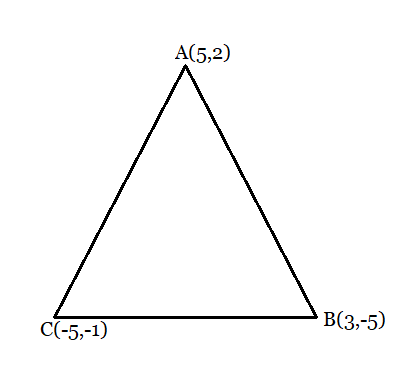
Area of the triangle is given by:
$Area = \frac{1}{2}\left [ x_{1}(y_{2}-y_{3})+x_{2}(y_{3}-y_{1})+x_{3}(y_{1}-y_{2}) \right ]$
Substituting the values in the above equation, we obtain
$Area = \frac{1}{2}\left [ (-5)((-5)-(-2))+3(2-(1))+5(-1-(-5)) \right ]$
$= \frac{1}{2}\left [ 35+9+20 \right ] = 32 \ square\ units.$
Answer:
The points (7, –2), (5, 1), (3, k) are collinear if the area of the triangle formed by the points will be zero.
Area of the triangle is given by:
$Area = \frac{1}{2}\left [ x_{1}(y_{2}-y_{3})+x_{2}(y_{3}-y_{1})+x_{3}(y_{1}-y_{2}) \right ] = 0$
Substituting the values in the above equation, we obtain
$\frac{1}{2}\left [ 7(1-k)+5(k-(-2))+3(-2-1) \right ] = 0$
$\left [ 7-7k+5k+10-9 \right ] = 0$
$\Rightarrow -2k+8 = 0$
$\Rightarrow k = 4$
Hence, the points are collinear for k=4 .
Answer:
The points (8,1), (k, -4), (2,-5) are collinear if the area of the triangle formed by these points will be zero.
Area of the triangle is given by:
$Area = \frac{1}{2}\left [ x_{1}(y_{2}-y_{3})+x_{2}(y_{3}-y_{1})+x_{3}(y_{1}-y_{2}) \right ] = 0$
Substituting the values in the above equation, we obtain
$\frac{1}{2}\left [ 8(-4-(-5))+k((-5)-1)+2(1-(-4)) \right ] = 0$
$\Rightarrow 8-6k+10 = 0$
$\Rightarrow 6k = 18$
$\Rightarrow k = 3$
Hence, the points are collinear for k = 3 .
Answer:
From the figure:
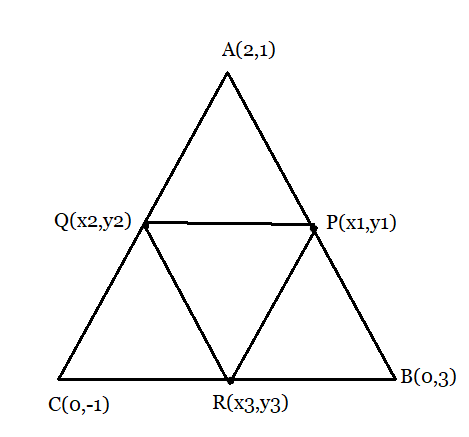
The coordinates of the point P, Q, and R are:
Point P is the midpoint of side AB, hence the coordinates of P are :
$P(x_{1},y_{1}) = \left (\frac{0+2}{2}, \frac{3+1}{2} \right ) = \left (1, 2 \right )$
Point Q is the midpoint of side AC, hence the coordinates of Q are :
$Q(x_{2},y_{2}) = \left (\frac{2+0}{2}, \frac{1-1}{2} \right ) = \left (1, 0 \right )$
Point R is the midpoint of side BC, hence the coordinates of R are :
$R(x_{3},y_{3}) = \left (\frac{0+0}{2}, \frac{-1+3}{2} \right ) = \left (0, 1 \right )$
Hence, the area of the triangle formed by the midpoints PQR will be,
$Area_{(PQR)} = \frac{1}{2}\left [ x_{1}(y_{2}-y_{3})+x_{2}(y_{3}-y_{1})+x_{3}(y_{1}-y_{2}) \right ]$
$= \frac{1}{2}\left [ (2-1)+1(1-0)+0(0-2) \right ]$
$=\frac{1}{2}(1+1) = 1\ square\ units.$
And the area formed by the triangle ABC will be:
$Area_{(ABC)} = \frac{1}{2}\left [ 0(1-3)+2(3-(-1))+0(-1-1) \right ]$
$= \frac{1}{2}\left [ 8 \right ] = 4\ square\ units.$
Thus, the ratio of Area of $\triangle PQR$ to the Area of $\triangle ABC$ will be $1:4$ .
Answer:
From the figure:
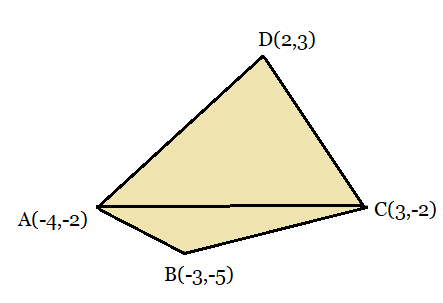
The coordinates are $A(-4,-2),\ B(-3,-5),\ C(3,-2)\ and\ D(2,3)$
Divide the quadrilateral into 2 parts of triangles.
Then the area will be, $ABC + ADC$
Area of the triangle formed by ABC will be,
$Area_{(ABC)} = \frac{1}{2}\left [ (-4)((-5)-(-2))+(-3)((-2)-(-2))+3((-2)-(-2)) \right ]$ $= \frac{1}{2}\left [ 12+0+9 \right ] = \frac{21}{2}\ Square\ units.$
Area of the triangle formed by ADC will be,
$Area_{(ADC)} = \frac{1}{2}\left [ (-4)((-2)-(-3))+3(3-(-2))+2((-2)-(-2)) \right ]$ $= \frac{1}{2}\left [ 20+15+0 \right ] = \frac{35}{2}\ Square\ units.$
Therefore, the area of the quadrilateral will be:
$= \frac{21}{2}+\frac{35}{2} = 28\ square\ units.$
Alternatively,
The points A and C are in the same ordinates.
Hence, the length of base AC will be $(3-(-4)) = 7\ units.$
Therefore,
Area of triangle ABC:
$= \frac{1}{2} \times (Base) \times (Height) = \frac{1}{2}\times(7)(3)$
Area of triangle ADC:
$= \frac{1}{2} \times (Base) \times (Height) = \frac{1}{2}\times(7)(5)$
Therefore, the area will be, $\frac{1}{2}\times(7)\times(5+3) =28\ square\ units.$
Answer:
From the figure:
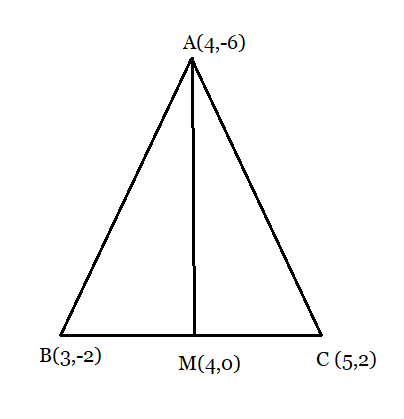
The coordinates of midpoint M of side BC is:
$M = \left ( \frac{3+5}{2}, \frac{-2+2}{2} \right ) = \left ( 4,0 \right )$
Now, calculating the areas of the triangle ABM and ACM :
Area of triangle, ABM:
$Area_{(ABM)} = \frac{1}{2}\left [ 4((-2)-0)+3(0-(-6))+4((-6)-(-2)) \right ]$
$= \frac{1}{2}\left [ -8+18-16 \right ] = 3\ Square\ units.$
Area of triangle, ACM:
$Area_{(ACM)} = \frac{1}{2}\left [ 4(0-(-2))+4(2-(-6))+5((-6)-0) \right ]$
$= \frac{1}{2}\left [ -8+32-30 \right ] = -3\ Square\ units.$
However, the area cannot be negative, Therefore, area of $\triangle ACM$ is 3 square units.
Clearly, the median AM divided the $\triangle ABC$ in two equal areas.
More About NCERT Solutions for Class 10 Maths Exercise 7.3
The NCERT Solutions for Class 10 Maths exercise 7.3 also focused on the collinearity and area of the quadrilateral. Exercise 7.3 Class 10 Maths consists of a question based on calculating the area of a triangle and collinearity of three points. Geometrically, two or more points are said to be collinear, if they lie on the same line. Three points are said to be collinear if the area of the triangle is zero. We can also find the area of the quadrilateral by using the area of the triangle formula. Quadrilaterals can be divided into triangular regions which have no common area. Then by using the area of the triangle formula, we can find the area of the two triangles. Then by adding both, we get the area of the quadrilateral. Also, the area of the quadrilateral is never negative as the area of the quadrilateral is positive. Usage of midpoint formula also covered in exercise 7.3 Class 10 Maths.
Also Read| Coordinate Geometry Class 10 Notes
Confused between CGPA and Percentage?
Get your results instantly with our calculator!
Benefits of NCERT Solutions for Class 10 Maths Exercise 7.3
• NCERT solutions for Class 10 Maths exercise 7.3 is one of the most scoring exercises, as the questions are simple to solve using the given formula.
• Exercise 7.3 Class 10 Maths will encourage us to use real-life references to understand concepts of the area of triangle and collinearity of points.
• By fathoming the NCERT solution for Class 10 Maths chapter 7 exercise 7.3 , understudies can achieve a great score in term exams as well as in competitive examinations like the Joint Entrance Exam Main (JEE Main).
Also, see-
NCERT Solutions Subject Wise
Subject Wise NCERT Exemplar Solutions
Frequently Asked Questions (FAQs)
A Triangle is a polygon with three edges and vertices.
The statement is false because the area of the triangle is never negative.
The study of geometry using coordinate points is known as coordinate geometry.
Three points are said to be collinear if the area of the triangle is zero.
Non-linear points are the points that are not possible to draw a straight line through three or more points.
Two or more points are considered to be collinear if they lie on the same line, according to NCERT solutions for Class 10 Maths chapter 7 exercise 7.3.
In NCERT solutions for Class 10 Maths chapter 7 exercise 7.3 , are 5 problems, all of which are centred on calculating the area of a triangle.

Questions related to CBSE Class 10th
On Question asked by student community
Hey there,
For +1 Medical (PCB) admission, your son should apply to government or private senior secondary schools after the Class 10 CBSE results are declared. Admission is usually based on Class 10 marks, though some schools may conduct an entrance test or interview. Please mention your city/state for suitable
Hello Arun,
The CBSE Class 10 mid-term exam has yet to happen. In the meantime, please refer to the previous year's question paper:
https://school.careers360.com/boards/cbse/cbse-class-10-mid-term-exam-question-paper-answer-key-2025-26
Hello Dear Student,
You can get directly find, check, get more information here:
- https://news.careers360.com/cbse-10th-second-board-result-2026-date-time-live-when-where-how-to-check-scorecard-link-umang-digilocker-cbseresults-nic-in-news
- https://news.careers360.com/cbse-class-10-second-board-result-2026-live-phase-2-marksheet-download-link-cbseresults-nic-in-merit-toppers-digilocker-updates
Hope it helps!
Hello Student,
If you are asking how to download the migration certificate for Class 10 Karnataka Board, here is how to do it -
You will have to log in to the DigiLocker app or website using your Aadhaar card number and the registered mobile number for the OTP.
You