
NCERT Solutions for Exercise 7.4 Class 10 Maths Chapter 7 - Coordinate Geometry
Upcoming Event
CBSE Class 10th Exam Date:17 Feb' 26 - 17 Feb' 26
NCERT Solutions for Class 10 Maths exercise 7.4 is the final and optional exercise in this chapter, and it covers all of the concepts from the entire chapter, including the distance formula, section formula, and triangle area. Coordinate Geometry is the study of geometry using coordinate points. The distance formula used to find the distance between two points in a two-dimensional plane is known as the Euclidean distance formula. The section formula is used to get the coordinates of the point that splits a line segment into a ratio either externally or internally. We can utilize the section when a point divides a line segment in some ratio either externally or internally.
This Story also Contains
- Coordinate Geometry Class 10 Chapter 7 Exercise: 7.1
- More About NCERT Solutions for Class 10 Maths Exercise 7.4:
- Benefits of NCERT Solutions for Class 10 Maths Exercise 7.4 :
NCERT solutions for Class 10 Maths chapter 7 exercise 7.4 consists of 8 questions in which 6 of them are long answer questions, 1 is a practical based question and the remaining 1 is a reasoning question. In NCERT book Class 10 Maths chapter 7 exercise 7.4, the ideas linked to the solution of coordinate geometry are well discussed. The following activities are included along with NCERT syllabus Class 10 Maths chapter 7 exercise 7.4.
Coordinate Geometry Class 10 Chapter 7 Exercise: 7.1
Answer:
Let the line divide the line segment AB in the ratio $k:1$ at point C.
Then, the coordinates of point C will be:
$C(x,y) = \left ( \frac{3k+2}{k+1},\frac{7k-2}{k+1} \right )$
Point C will also satisfy the given line equation $2x + y - 4 = 0$ , hence we have
$\Rightarrow 2\left ( \frac{3k+2}{k+1} \right )+\left (\frac{7k-2}{k+1} \right ) - 4 = 0$
$\Rightarrow \frac{6k+4+7k-2-4k-4}{k+1} = 0$
$\Rightarrow 9k-2 = 0$
$\Rightarrow k=\frac{2}{9}$
Therefore, the ratio in which the line $2x + y - 4 = 0$ divides the line segment joining the points $A(2,-2)$ and $B(3,7)$ is $2:9$ internally.
Q2 Find a relation between x and y if the points (x, y), (1, 2) and (7, 0) are collinear.
Answer:
If the points $(x, y), (1, 2)\ and\ (7, 0)$ are collinear then, the area formed by these points will be zero.
The area of the triangle is given by,
$Area = \frac{1}{2}\left [ x_{1}(y_{2}-y_{3})+x_{2}(y_{3}-y_{1})+x_{3}(y_{1}-y_{2}) \right ] = 0$
Substituting the values in the above equation, we have
$Area = \frac{1}{2}\left [ x(2-0)+1(0-y)+7(y-2) \right ]= 0$
$\Rightarrow 2x-y+7y-14= 0$
Or,
$\Rightarrow x+3y-7= 0$
Hence, the required relation between x and y is $x+3y-7= 0$ .
Q3 Find the center of a circle passing through the points (6, – 6), (3, – 7) and (3, 3).
Answer:
From the figure:
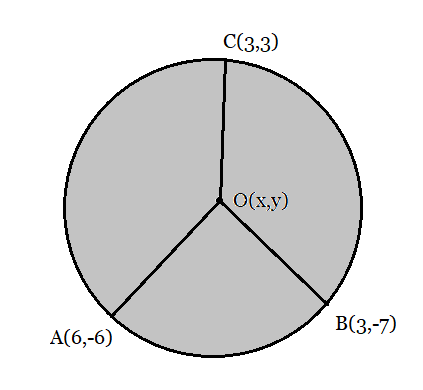
Let the center point be $O(x,y)$ .
Then the radii of the circle $OA,\ OB,\ and\ OC$ are equal.
The distance OA:
$OA = \sqrt{(x-6)^2+(y+6)^2}$
The distance OB:
$OB = \sqrt{(x-3)^2+(y+7)^2}$
The distance OC:
$OC = \sqrt{(x-3)^2+(y-3)^2}$
Equating the radii of the same circle.
When equating, $OA = OB$
$\sqrt{(x-6)^2+(y+6)^2}= \sqrt{(x-3)^2+(y+7)^2}$
Squaring both sides and applying $a^2-b^2 = (a+b)(a-b)$
$\Rightarrow (x-6+x-3)(x-6-x+3)+(y+6+y+7)(y+6-y-7) = 0$
$\Rightarrow (2x-9)(-3) + (2y+13)(-1) = 0$
$\Rightarrow -6x+27-2y-13 = 0$ or
$\Rightarrow 3x+y -7= 0$ ...................................(1)
When equating, $OA = OC$
$\sqrt{(x-6)^2+(y+6)^2}= \sqrt{(x-3)^2+(y-3)^2}$
Squaring both sides and applying $a^2-b^2 = (a+b)(a-b)$
$\Rightarrow (x-6+x-3)(x-6-x+3)+(y+6+y-3)(y+6-y+3) = 0$
$\Rightarrow (2x-9)(-3) + (2y+3)(9) = 0$
$\Rightarrow -3x+9y+27 = 0$ ...................................(2)
Now, adding the equations (1) and (2), we get
$\Rightarrow 10y = -20$
$\Rightarrow y = -2$ .
From equation (1), we get
$\Rightarrow 3x-2 = 7$
$\Rightarrow 3x =9$
$\Rightarrow x =3$
Therefore, the centre of the circle is $(3,-2)$ .
Answer:
From the figure:
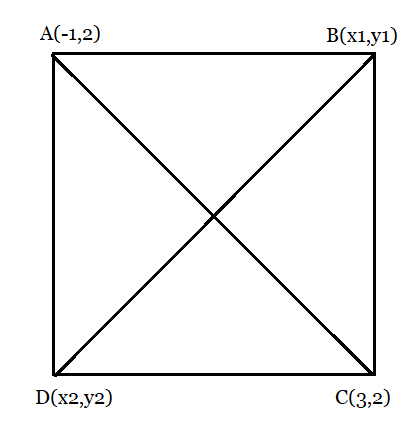
We know that the sides of a square are equal to each other.
Therefore, AB = BC
So,
$\sqrt{(x-1)^2+(y-2)^2} = \sqrt{(x-3)^2+(y-2)^2}$
Squaring both sides, we obtain
$\implies (x-1)^2+(y-2)^2 = (x-3)^2+(y-2)^2$
Now, doing $\left ( a^2-b^2 = (a+b)(a-b) \right )$
We get
$\implies (x-1+x-3)(x-1-x+3) = 0$
Hence $x = 2$ .
Applying the Pythagoras theorem to find out the value of y.
$AB^2+BC^2 = AC^2$
$(\sqrt{(2-1)^2+(y-2)^2})^2 + (\sqrt{(2-3)^2+(y-2)^2})^2 = (\sqrt{(3+1)^2+(2-2)^2})^2$
$\Rightarrow \left (\sqrt{1+(y-2)^2} \right )^2 + \left (\sqrt{1+(y-2)^2} \right )^2 = \left (\sqrt{16} \right )^2$
$\Rightarrow (y-2)^2 = 7$
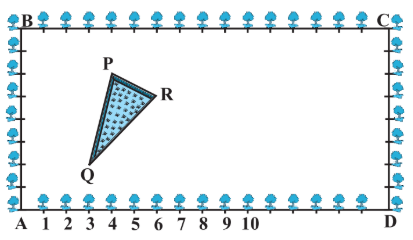
Answer:
Taking A as origin then, the coordinates of P, Q, and R can be found by observation:
Coordinates of point P is $(4,6).$
Coordinates of point Q is $(3,2).$
Coordinates of point R is $(6,5).$
The area of the triangle, in this case, will be:
$Area =\frac{1}{2}\left [ x_{1}(y_{2}-y_{3})+x_{2}(y_{3}-y_{1})+x_{3}(y_{1}-y_{2}) \right ]$
$=\frac{1}{2}\left [ 4(2-5)+3(5-6)+6(6-2) \right ]$
$=\frac{1}{2}\left [ -12-3+24\right ] = \frac{9}{2}\ Square\ units.$
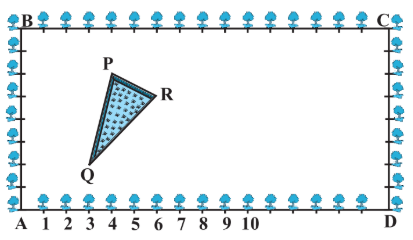
Answer:
Taking C as origin, then CB will be x-axis and CD be y-axis.
The coordinates fo the vertices P, Q, and R are: $(12,2),\ (13,6),\ (10,3).$ respectively.
The area of the triangle, in this case, will be:
$Area =\frac{1}{2}\left [ x_{1}(y_{2}-y_{3})+x_{2}(y_{3}-y_{1})+x_{3}(y_{1}-y_{2}) \right ]$
$=\frac{1}{2}\left [ 12(6-3)+13(3-2)+10(2-6) \right ]$
$=\frac{1}{2}\left [ 36-13+40 \right ] = \frac{9}{2}\ Square\ units.$
It can be observed that in both cases the area is the same so, it means that the area of any figure does not depend on the reference which you have taken.
Answer:
From the figure:
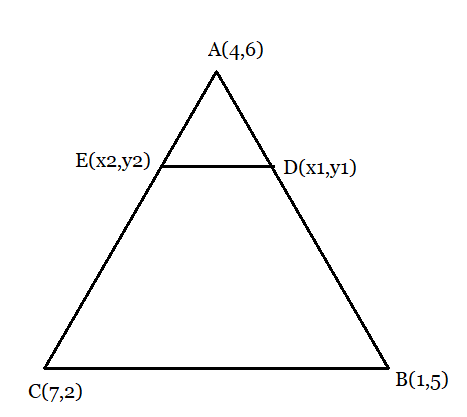
Given ratio:
$\frac{AD }{AB} = \frac{AE }{AC } = \frac{1}{4}$
Therefore, D and E are two points on side AB and AC respectively, such that they divide side AB an AC in the ratio of $1:3$ .
Section formula:
$P(x,y)= \left (\frac{m_{1}x_{2}+m_{2}x_{1}}{m_{1}+m_{2}} , \frac{m_{1}y_{2}+m_{2}y_{1}}{m_{1}+m_{2}} \right )$
Then, coordinates of point D:
$D(x_{1},y_{1})= \left (\frac{1\times1+3\times 4}{1+3} , \frac{1\times 5+3\times 6}{1+3} \right )$
Coordinates of point E:
$E(x_{2},y_{2})= \left (\frac{1\times7+3\times 4}{1+3} , \frac{1\times 2+3\times 6}{1+3} \right )$
$= \left ( \frac{19}{4}, \frac{20}{4} \right )$
Then, the area of a triangle:
$= \frac{1}{2}\left [ x_{1}(y_{2}-y_{3})+x_{2}(y_{3}-y_{1})+x_{3}(y_{1}-y_{2}) \right ]$
Substituting the values in the above equation,
$Area\ of\ \triangle ADE = \frac{1}{2}\left [ 4\left ( \frac{23}{4} - \frac{20}{4}\right )+\frac{13}{4}\left ( \frac{20}{4} - 6 \right )+\frac{19}{4}\left (6-\frac{23}{4} \right )\right ]$ $= \frac{1}{2}\left [ 3-\frac{13}{4} +\frac{19}{16}\right ] = \frac{1}{2}\left [ \frac{48-52+19}{16} \right ] = \frac{15}{32}\ square\ units.$
$Area\ of\ \triangle ABC = \frac{1}{2}\left [ 4(5-2)+1(2-6)+7(6-5) \right ]$
$= \frac{1}{2}\left [ 12-4+7 \right ] = \frac{15}{2}\ Square\ units.$
Hence the ratio between the areas of $\triangle ADE$ and $\triangle ABC$ is $1:16.$
Answer:
From the figure:
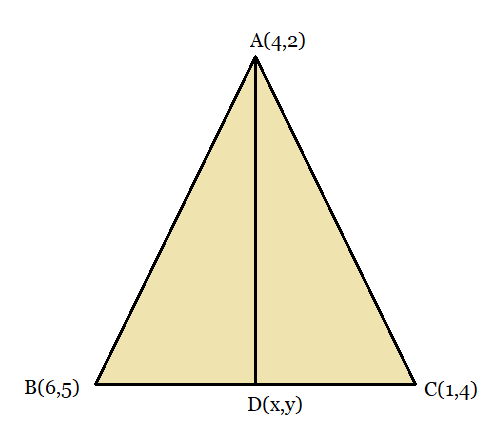
Let AD be the median of the triangle
Then, D is the mid-point of BC
Coordinates of Point D:
$\left ( \frac{6+1}{2},\frac{5+4}{2} \right ) = \left ( \frac{7}{2}, \frac{9}{2} \right )$
Answer:
From the figure,
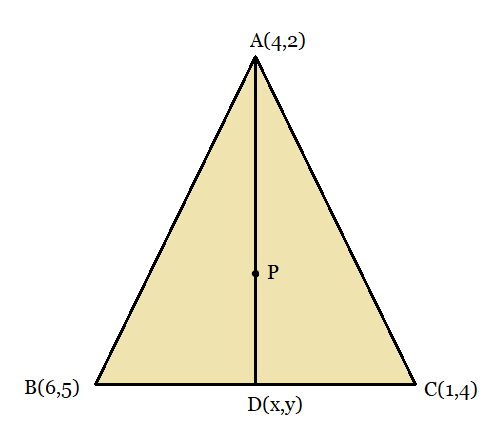
The point P divides the median AD in the ratio, AP: PD = 2: 1
Hence using the section formula,
$P(x,y)= \left (\frac{m_{1}x_{2}+m_{2}x_{1}}{m_{1}+m_{2}} , \frac{m_{1}y_{2}+m_{2}y_{1}}{m_{1}+m_{2}} \right )$
$P(x,y)= \left (\frac{2\times\frac{7}{2}+1\times4}{2+1} , \frac{2\times\frac{9}{2}+1\times2}{2+1} \right ) = \left ( \frac{11}{3}, \frac{11}{3} \right )$
Answer:
From the figure,
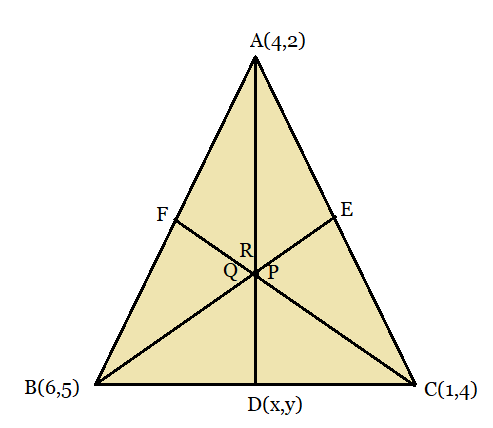
$\Rightarrow$ The point Q divides the median BE in the ratio, BQ : QE = 2 : 1
Hence using the section formula,
$Q(x,y)= \left (\frac{m_{1}x_{2}+m_{2}x_{1}}{m_{1}+m_{2}} , \frac{m_{1}y_{2}+m_{2}y_{1}}{m_{1}+m_{2}} \right )$
$Q(x,y)= \left (\frac{2\times\frac{5}{2}+1\times6}{2+1} , \frac{2\times3+1\times5}{2+1} \right ) = \left ( \frac{11}{3}, \frac{11}{3} \right )$
$\Rightarrow$ The point R divides the median CF in the ratio, CR: RF = 2: 1
Hence using the section formula,
$R(x,y)= \left (\frac{m_{1}x_{2}+m_{2}x_{1}}{m_{1}+m_{2}} , \frac{m_{1}y_{2}+m_{2}y_{1}}{m_{1}+m_{2}} \right )$
$R(x,y)= \left (\frac{2\times 5+1\times1}{2+1} , \frac{2\times\frac{7}{2}+1\times4}{2+1} \right ) = \left ( \frac{11}{3}, \frac{11}{3} \right )$
Q7 (iv) Let A (4, 2), B(6, 5) and C(1, 4) be the vertices of D ABC. What do you observe?
Answer:
We observed that the coordinates of P, Q, and R are the same. Therefore, all these are representing the same point on the plane. i.e., the centroid of the triangle.
Answer:
From the figure, 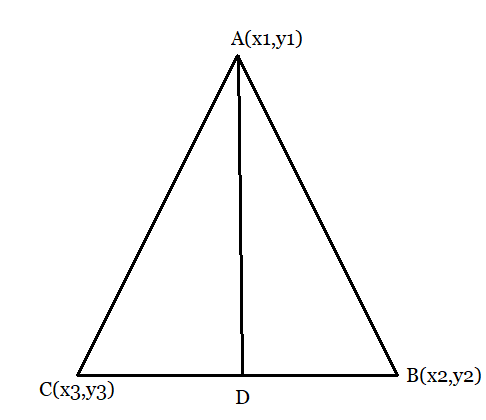
Let the median be AD which divides the side BC into two equal parts.
Therefore, D is the mid-point of side BC.
Coordinates of D:
$= \left ( \frac{x_{2}+x_{3}}{2}, \frac{y_{2}+y_{3}}{2} \right )$
Let the centroid of this triangle be O.
Then, point O divides the side AD in a ratio 2:1.
Coordinates of O:
$= \left ( \frac{2\times\frac{x_{2}+x_{3}}{2}+1\times x_{1}}{2+1}, \frac{2\times\frac{y_{2}+y_{3}}{2}+1\times y_{1} }{2+1} \right )$
$= \left ( \frac{x_{1}+x_{2}+x_{3}}{3}, \frac{y_{1}+y_{2}+y_{3}}{3} \right )$
Answer:
From the figure:
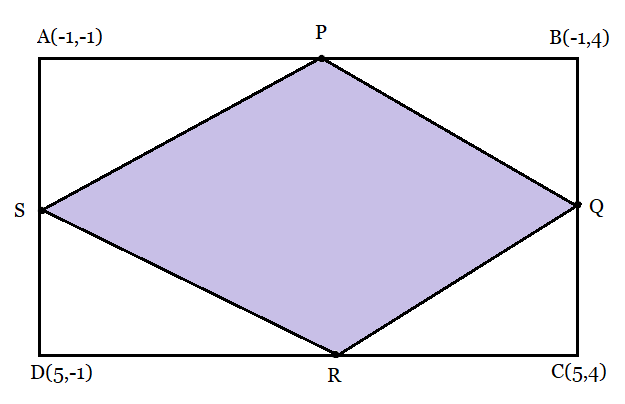
P is the mid-point of side AB.
Therefore, the coordinates of P are, $\left ( \frac{-1-1}{2}, \frac{-1+4}{2} \right ) = \left ( -1, \frac{3}{2} \right )$
Similarly, the coordinates of Q, R and S are: $\left ( 2,4 \right ),\ \left ( 5, \frac{3}{2} \right ),\ and\ \left ( 2,-1 \right )$ respectively.
The distance between the points P and Q:
$PQ = \sqrt{(-1-2)^2+\left ( \frac{3}{2} -4 \right )^2} = \sqrt{9+\frac{25}{4}} = \sqrt{\frac{61}{4}}$
and the distance between the points Q and R:
$QR = \sqrt{(2-5)^2+\left ( 4-\frac{3}{2} \right )^2} = \sqrt{9+\frac{25}{4}} = \sqrt{\frac{61}{4}}$
Distance between points R and S:
$RS = \sqrt{(5-2)^2+\left ( \frac{3}{2}+1 \right )^2} = \sqrt{9+\frac{25}{4}} = \sqrt{\frac{61}{4}}$
Distance between points S and P:
$SP = \sqrt{(2+1)^2+\left ( -1-\frac{3}{2} \right )^2} = \sqrt{9+\frac{25}{4}} = \sqrt{\frac{61}{4}}$
Distance between points P and R the diagonal length:
$PR = \sqrt{(-1-5)^2+\left ( \frac{3}{2}-\frac{3}{2} \right )^2} = 6$
Distance between points Q and S the diagonal length:
$QS = \sqrt{(2-2)^2+\left ( 4+1 \right )^2} = 5$
Hence, it can be observed that all sides have equal lengths. However, the diagonals are of different lengths.
Therefore, PQRS is a rhombus.
More About NCERT Solutions for Class 10 Maths Exercise 7.4:
The midpoint and area of the quadrilateral were also covered in the NCERT solutions for Class 10 Maths exercise 7.4. The questions in exercise 7.3 Class 10 Maths are based on concepts such as the distance formula, section formula, and triangle area. When a point P(x,y) divides the line segment into two segments, with marked points as A(x1,y1) and B(x2,y2) the method used to find the coordinates of that point is known as the section formula that is covered in the Class 10 Maths chapter 7 exercise 7.4.
Also Read| Coordinate Geometry Class 10 Notes
Benefits of NCERT Solutions for Class 10 Maths Exercise 7.4 :
• NCERT solutions for Class 10 Maths exercise 7.4 are carefully drafted to assist the student in scoring good marks in the examination. That's why any student can easily score the highest possible marks in the final exam.
• From exercise 7.4 Class 10 Maths we can easily understand the pattern of questions that can be asked in term exams from this chapter and also know the marks weightage of the chapter. From that, they can prepare themselves accordingly for the final examination.
• NCERT solution for Class 10 Maths chapter 7 exercise 7.4 exercises, will be helpful in the further exercise of chapter 10.
Articles
Related Stories
|
Upcoming School Exams

Certifications By Top Providers
Explore Top Universities Across Globe
Questions related to CBSE Class 10th
On Question asked by student community
Have a question related to CBSE Class 10th ?
HELLO,
If you want admission to 9th grade under the CBSE board in Andhra Pradesh , visit nearby CBSE affiliated schools during the admission period that is generally from January to April or you can check the official websites of the schools in which you are interested for admission if
Hello,
From the below website, you can get the CBSE Maths Sample paper of class 10.
https://school.careers360.com/boards/cbse/cbse-class-10-sample-papers-2025-26
Visit the below website to obtain the previous year question papers of class 10 CBSE.
https://school.careers360.com/boards/cbse/cbse-previous-year-question-papers-class-10
By solving both sample papers and previous year question papers, you can score well in your examination.
Hello,
From the below website, you can get the sample papers of CBSE class 10 Hindi subject.
https://school.careers360.com/boards/cbse/cbse-class-10-sample-papers-2025-26
You'll also get sample papers of other subjects. Refer them to prepare well.
Hello,
If you're from Karnataka Board, then visit the below website to get the key answers of Social Science question paper of SA 1 of class 10.
https://school.careers360.com/boards/kseeb/karnataka-sslc-mid-term-exam-question-paper-2025-26
Let us know if you're from a different board.
Hello,
Since you applied over a month and a half ago and haven't received your 10th-grade certificate, the best course of action is to check the status of your application on the official website. If that doesn't yield results, you should contact your school and the relevant education board's regional
Colleges After 12th

Applications for Admissions are open.
This ebook serves as a valuable study guide for NEET 2025 exam.
NEET Previous 10 Year Questions
Get nowThis e-book offers NEET PYQ and serves as an indispensable NEET study material.
JEE Main Important Physics formulas
Get nowAs per latest syllabus. Physics formulas, equations, & laws of class 11 & 12th chapters
JEE Main Important Chemistry formulas
Get nowAs per latest syllabus. Chemistry formulas, equations, & laws of class 11 & 12th chapters
JEE Main high scoring chapters and topics
Get nowAs per latest 2024 syllabus. Study 40% syllabus and score upto 100% marks in JEE
JEE Main Important Mathematics Formulas
Get nowAs per latest syllabus. Maths formulas, equations, & theorems of class 11 & 12th chapters
CBSE Class 10th Notifications
Never miss CBSE Class 10th update
Get timely CBSE Class 10th updates directly to your inbox. Stay informed!