University of Liverpool, Bengaluru Campus
Study at a world-renowned UK university in India | Admissions open for UG & PG programs.


Integrals play a significant role in mathematics. Have you ever thought about how to find the area under a curve, the distance travelled by an object accelerating throughout the distance, or even just the total amount of a quantity accumulated over time? Integrals can be used to find the solution to those types of continuous problems. Within the scope of Class 12 Mathematics, integration is introduced as the anti-derivative, or reverse differentiation, ultimately giving us the ability to retrieve a function from its derivative. In addition, this chapter regarding integration has indefinite integrals, which implies that such a family is represented by an arbitrary constant $\left(\int f(x) d x=F(x)+C\right)$.
This Story also Contains
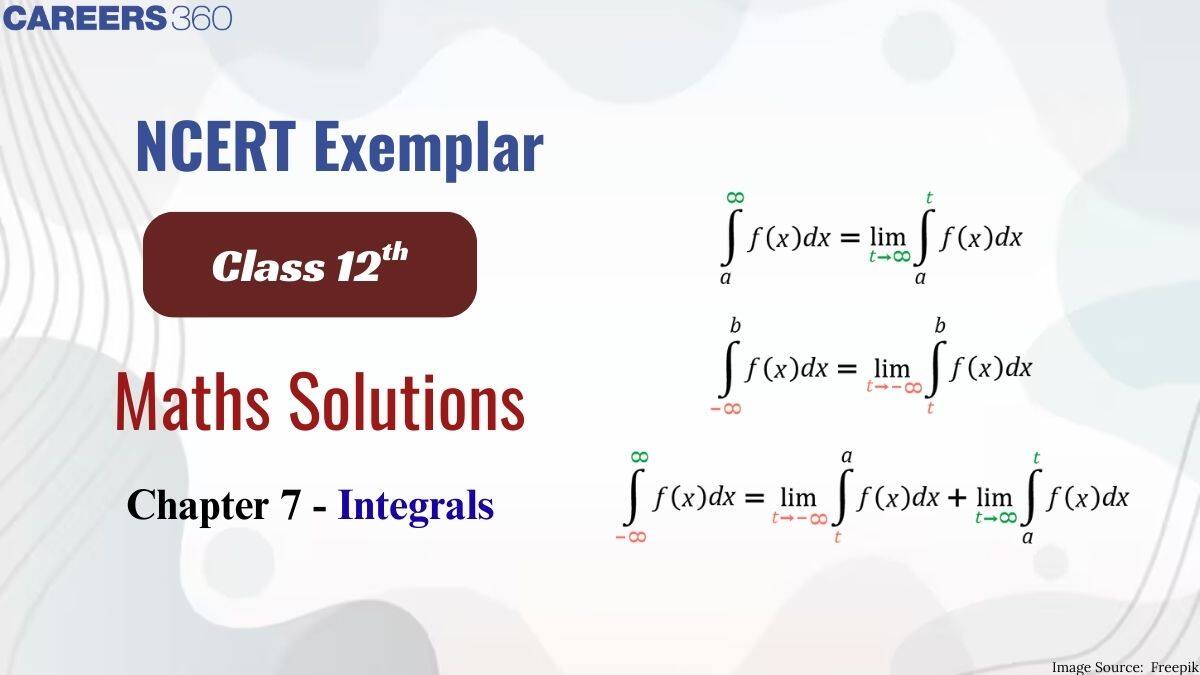
To become proficient in this subject, students should work through the NCERT Solutions for Class 12 Maths, which include clear explanations and very easy-to-follow methods for solving integral problems. The NCERT Solutions encompass a breadth of exercises, such as properties of integrals, applications of integration in physics and engineering, as well as the Fundamental Theorem of Calculus, which connects differentiation and integration. The conceptual understanding and work are preparation for the board exam and competitive examinations, like JEE and NEET.
Also, read,
| Class 12 Maths Chapter 7 Exemplar Solutions Exercise: 7.3 Page number: 163-169 Total questions: 63 |
Question 1:
Verify the following:
$\int \frac{2 x-1}{2 x+3} d x=x-\log \left|(2 x+3)^{2}\right|+C$
Answer:
$\begin{aligned} &\text { To Verify; }\\ &\int \frac{2 x-1}{2 x+3} d x=x-\log \left|(2 x+3)^{2}\right|+C\\ &\text { LHS: } \int \frac{2 x-1}{2 x+3} d x\\ &=\int \frac{2 x+3-4}{2 x+3} d x\\ &=\int \mathrm{dx}-\int \frac{4}{2 \mathrm{x}+3} \mathrm{dx} \end{aligned}$
Let t = 2x + 3
$\\ \Rightarrow \mathrm{dx}=\frac{\mathrm{dt}}{2} \\ =\int \mathrm{dx}-4 \int \frac{ \mathrm{dt}}{\mathrm{2t}} \\ =\mathrm{x}-2 \log |\mathrm{t}|+\mathrm{C} \\ [\because \int \mathrm{dx}=\mathrm{x} \text { and } \left.\int \frac{1}{\mathrm{x}} \mathrm{dx}=\log |\mathrm{x}|\right] \\ $
$=\mathrm{x}-\log \left|(2 \mathrm{x}+3)^{2}\right|+\mathrm{C}=\mathrm{RHS} \\ \left[\because 2 \log |\mathrm{x}|=\log \left|\mathrm{x}^{2}\right|\right]$
Hence Verified
Question 2
Verify the following:
$\int \frac{2 x+3}{x^{2}+3 x} d x=\log \left|x^{2}+3 x\right|+C$
Answer:
To Verify;
$
\begin{aligned}
& \int \frac{2 x+3}{x^2+3 x} d x=\log \left|x^2+3 x\right|+C \\
& \text { LHS }=\int \frac{2 \mathrm{x}+3}{\mathrm{x}^2+3 \mathrm{x}} \mathrm{dx} \text { Let; } t=x^2+3 x \\
& \Rightarrow d t=2 x+3 \\
& =\int \frac{d t}{t}=\log |t|+C \\
& {\left[\because \int \frac{1}{x} d x=\log |x|\right]} \\
& \Rightarrow \log \left|x^2+3 x\right|+C=\text { RHS } \\
& {\left[\because t=x^2+3 x\right]}
\end{aligned}
$
Question 3
Evaluate the following:
$\int \frac{\left(x^{2}+2\right) d x}{x+1}$
Answer:
Given; $\int \frac{\left(x^{2}+2\right) d x}{x+1}$
Let t = x + 1
$\\\Rightarrow dx = dt \\ =\int \frac{\left((\mathrm{t}-1)^{2}+2\right)}{\mathrm{t}} \mathrm{dt} \\$
$ =\int \frac{\mathrm{t}^{2}-2 \mathrm{t}+1+2}{\mathrm{t}} \mathrm{dt} \\ $
$=\int(\mathrm{t}) \mathrm{dt}-\int 2 \mathrm{dt}+\int \frac{3}{\mathrm{t}} \mathrm{dt} \\$
$[ \because \int \mathrm{x}^{\mathrm{n}} \mathrm{dx}=\frac{\mathrm{x}^{\mathrm{n}+1}}{\mathrm{n}+1} \text { and } \left.\int \frac{1}{\mathrm{x}} \mathrm{dx}=\log |\mathrm{x}|\right]$
$\\ =\frac{t^{2}}{2}-2 t+3 \log |t|+C \\ $
$=\frac{t^{2}}{2}-2 t+\log \left|t^{3}\right|+C \\ $
$=\frac{(x+1)^{2}}{2}-2(x+1)+\log \left|(x+1)^{3}\right|+C$
Question 4
Evaluate the following:
$\int \frac{e^{6 \log x}-e^{5 \log x}}{e^{4 \log x}-e^{3 \log x}} d x$
Answer:
Given; $\int \frac{e^{6 \log x}-e^{5 \log x}}{e^{4 \log x}-e^{3 \log x}} d x$
As we know, $n log x = log x^n$
$\begin{aligned} &=\int \frac{e^{\log x^{6}}-e^{\log x^{5}}}{e^{\log x^{4}}-e^{\log x^{2}}} d x\\ &=\int \frac{x^{6}-x^{5}}{x^{4}-x^{3}} d x\\ &\text { Take } x^{3} \text { common out of numerator and denominator to get, }\\ &=\int \frac{x^{3}\left(x^{3}-x^{2}\right)}{x^{3}(x-1)} d x\\ &=\int \frac{\left(x^{3}-x^{2}\right)}{(x-1)} d x \end{aligned}$
$\begin{aligned} &=\int \frac{x^{2}(x-1)}{(x-1)} d x\\ &=\int x^{2} d x\\ &\because \int x^{n} d x=\frac{x^{n+1}}{n+1}\\ &\text { So, }\\ &=\frac{x^{3}}{3}+c \end{aligned}$
Question 5
Evaluate the following:
$\int \frac{(1+\cos x)}{x+\sin x} d x$
Answer:
Given; $\int \frac{(1+\cos x)}{x+\sin x} d x$
Let t = x + sin x
$\\\Rightarrow dt = (1 + cos x) dx \\ =\int \frac{1}{t} d t \\ =\log |t|+C \\ =\log |x+\sin x|+C$
Question 6
Evaluate the following:
$\int \frac{d x}{1+\cos x}$
Answer:
Given; $\int \frac{d x}{1+\cos x}$
$\\ =\int \frac{(1-\cos x)}{(1+\cos x)(1-\cos x)} d x \\ =\int \frac{1-\cos x}{1-\cos ^{2} x} d x \\$
$ =\int \frac{1-\cos x}{\sin ^{2} x} d x \\ {\left[\frac{1}{\sin ^{2} x}=\operatorname{cosec}^{2} x \text { and } \frac{\cos x}{\sin ^{2} x}=\operatorname{cosec} x \cot x\right]}$
$\\\begin{aligned} &=\int\left(\operatorname{cosec}^{2} x-\operatorname{cosec} x \cot x\right) d x\\ &\text { As we know, }\\ &\int \operatorname{cosec} x \cot x d x=-\operatorname{cosec} x+c\\ &\int \operatorname{cosec}^{2} x d x=-\cot x+c\\ &=\operatorname{cosec} x-\cot x+C \end{aligned}\\$
Question 7
Evaluate the following:
$\int \tan ^{2} x \sec ^{4} x d x$
Answer:
$\begin{aligned} & \text { Given; } \int \tan ^2 x \sec ^4 x d x=\int \tan ^2 x \sec ^2 x\left(1+\tan ^2 x\right) d x \\ & \text { Let } \tan \mathrm{x}=\mathrm{y} \\ & \Rightarrow \sec ^2 x d x=d y \\ & =\int\left(y^2+y^4\right) d y\end{aligned}$
$\\ =\frac{y^{3}}{3}+\frac{y^{5}}{5}+C $
$ =\frac{\tan ^{3} x}{3}+\frac{\tan ^{5} x}{5}+C$
Question 8
Evaluate the following:
$\int \frac{\sin x+\cos x}{\sqrt{1+\sin 2 x}} d x$
Answer:
Given; $\int \frac{\sin x+\cos x}{\sqrt{1+\sin 2 x}} d x$
$\\ =\int{c} \sin x+\cos x \\ \sqrt{\sin ^{2} x+\cos ^{2} x+2 \sin x \cos x} \\$
$ =\int \frac{\sin x+\cos x}{\sqrt{(\sin x+\cos x)^{2}}} d x $
$ {\left[\because \sin 2 x=2 \sin x \cos x \text { and } \sin ^{2} x+\cos ^{2} x=1\right]} $
$ =\int 1 \mathrm{dx} $
$ =x+C$
Question 9
Evaluate the following:
$\int \sqrt{1+\sin x} d x$
Answer:
Given; $\int \sqrt{1+\sin x} d x$
$\\ =\int \sqrt{\sin ^{2} \frac{x}{2}+\cos ^{2} \frac{x}{2}+2 \sin \frac{x}{2} \cos \frac{x}{2}} d x $
$ {\left[\because \sin 2 x=2 \sin x \cos x \text { and } \sin ^{2} x+\cos ^{2} x=1\right]} \\ $
$=\int \sqrt{\left(\sin \frac{x}{2}+\cos \frac{x}{2}\right)^{2}} d x $
$ =\int\left(\sin \frac{x}{2}+\cos \frac{x}{2}\right) d x $
$ =2 \sin \frac{x}{2}-2 \cos \frac{x}{2}+c$
Question 10
Evaluate the following:
$\int \frac{x}{\sqrt{x}+1} d x \: \: \: (Hint: Put \sqrt{x} = z)$
Answer:
Given;
Let $z = \sqrt{x}$
$
\begin{aligned}
& \Rightarrow x=z^2 \\
& \Rightarrow d x=2 z d z \\
& =\int \frac{z^2}{z+1} 2 z d z \\
& =2 \int \frac{\mathrm{z}^3}{\mathrm{z}+1} \mathrm{~d} z
\end{aligned}
$
Let; $t=z+1$
i.e. $t=\sqrt{x}+1$
$\Rightarrow d t=\mathrm{dz}$
$\\ =2 \int \frac{(\mathrm{t}-1)^{3}}{\mathrm{t}} \mathrm{dt}$
$ =2 \int \frac{\mathrm{t}^{3}-3 \mathrm{t}^{2}+3 \mathrm{t}-1}{\mathrm{t}} \mathrm{dt} $
$ =2 \int\left(\mathrm{t}^{2}-3 \mathrm{t}+3-\frac{1}{\mathrm{t}}\right) \mathrm{dt} \\$
$[ \because \int \mathrm{x}^{\mathrm{n}} \mathrm{dx}=\frac{\mathrm{x}^{\mathrm{n}+1}}{\mathrm{n}+1} \text { and } \left.\int \frac{1}{\mathrm{x}} \mathrm{dx}=\log |\mathrm{x}|\right] \\$
$\\ =\frac{2 t^{3}}{3}-3 t^{2}+3 t-\log |t|+C \\$
$ =\frac{2(\sqrt{x}+1)^{3}}{3}-3(\sqrt{x}+1)^{2}+3(\sqrt{x}+1)-\log |\sqrt{x}+1|+C$
Question 11
Evaluate the following:
$\int \sqrt{\frac{a+x}{a-x}}$
Answer:
Given, $\int \sqrt{\frac{a+x}{a-x}}$
$\\ =\int \frac{\sqrt{a+x}}{\sqrt{a-x}} \times \frac{\sqrt{a+x}}{\sqrt{a+x}} d x \\ =\int \frac{a+x}{\sqrt{a^{2}-x^{2}}} d x \\ =a \int \frac{1}{\sqrt{a^{2}-x^{2}}} d x-\frac{1}{2} \int \frac{-2 x}{\sqrt{a^{2}-x^{2}}} d x$
$\\ \begin{aligned} &\text { Let } t=a^{2}-x^{2}\\ & \Rightarrow-2x \mathrm{dx}=\mathrm{dt}\\ &=\mathrm{a} \sin \left(\frac{\mathrm{x}}{\mathrm{a}}\right)-\frac{1}{2} \int \frac{1}{\sqrt{\mathrm{t}}} \mathrm{dt}\\ &\left[\because \int \frac{d x}{\sqrt{a^{2}-x^{2}}}=\sin ^{-1} \frac{x}{a}\right]_{\text {and }}\left[\int \frac{1}{\sqrt{x}} d x=2 \sqrt{x}\right]\\ &=a \sin \left(\frac{x}{a}\right)-\frac{1}{2} \times 2 \sqrt{t}\\ &=a \sin \left(\frac{x}{a}\right)-\sqrt{a^{2}-x^{2}}+c \end{aligned}$
Question 12
Evaluate the following:
$\int \frac{x^{\frac{1}{2}}}{1+x^{\frac{3}{4}}} d x$ (Hint : Put x = z4)
Answer:
$\begin{aligned} &\text { Given}\\ &\int \frac{x^{\frac{1}{2}}}{1+x^{\frac{3}{4}}} d x\\ &\text { Let } x=z^{4}\\ &\Rightarrow \mathrm{dx}=4 \mathrm{z}^{3} \mathrm{dz}\\ &=\int \frac{\mathrm{z}^{2}}{1+\mathrm{z}^{3}} 4 \mathrm{z}^{3} \mathrm{~d} z\\ &=4 \int \frac{\mathrm{z}^{5}}{1+\mathrm{z}^{3}} \mathrm{~d} \mathrm{z}\\ &=\frac{4}{3} \int \frac{\mathrm{z}^{3}}{1+\mathrm{z}^{3}} 3 \mathrm{z}^{2} \mathrm{~d} \mathrm{z} \end{aligned}$
$\\ \begin{aligned} &\text { Let } t=1+z^{3}\left[\begin{array}{l} \left.1 . e . t=1+x^{3 / 4}\right] \end{array}\right.\\ &\Rightarrow \mathrm{dt}=3 \mathrm{z}^{2} \mathrm{~d} z\\ &=\frac{4}{3} \int \frac{t-1}{t} d t \end{aligned}$
$\\ =\frac{4}{3} \int \mathrm{dt}-\frac{4}{3} \int \frac{1}{\mathrm{t}} \mathrm{dt} \\ =\frac{4}{3}[\mathrm{t}-\log |\mathrm{t}|]+\mathrm{C} \\ =\frac{4}{3}\left[\left(1+\mathrm{x}^{\frac{3}{4}}\right)-\log \left|1+\mathrm{x}^{\frac{3}{4}}\right|\right]+\mathrm{C}$
Question 13
Answer:
$\\ \begin{aligned} &\text { Given; }\\ &\int \frac{\sqrt{1+x^{2}}}{x^{4}} d x\\ &\text { Let } x=\tan y\\ &\Rightarrow \mathrm{dx}=\sec ^{2} \mathrm{y} \mathrm{dx} \end{aligned}$
$\\ =\int \frac{\sqrt{1+\tan ^{2} y}}{\tan ^{4} y} \sec ^{2} y d y \\$
$ =\int \sec y \times \frac{\cos ^{4} y}{\sin ^{4} y} \times \sec ^{2} y d y \\ $
$=\int \frac{\cos y}{\sin ^{4} y} d y \\$
$ \text { Let } t=\sin y$
$\Rightarrow dt = cos y dy$
$\\ =\int \frac{\mathrm{dt}}{\mathrm{t}^{4}}=-\frac{1}{3 \mathrm{t}^{3}}+\mathrm{C} \\ =-\frac{1}{3 \sin ^{3} \mathrm{y}} \\ =-\frac{1}{3 \sin ^{3}\left(\sin ^{-1} \frac{\mathrm{x}}{\sqrt{\mathrm{x}^{2}+1}}\right)} \\ =-\frac{\left(\mathrm{x}^{2}+1\right)^{\frac{3}{2}}}{3 \mathrm{x}^{3}}$
Question 14
Evaluate the following:
$\int \frac{d x}{\sqrt{16-9 x^{2}}}$
Answer:
$\\ \begin{aligned} &\text { Given; }\\ &\int \frac{\mathrm{dx}}{\sqrt{16-9 \mathrm{x}^{2}}}\\ &=\int \frac{d x}{\sqrt{4^{2}-(3 x)^{2}}}\\ &\left[\because \int \frac{d x}{\sqrt{a^{2}-x^{2}}}=\sin ^{-1} \frac{x}{a}\right]\\ &=\frac{1}{3} \sin ^{-1} \frac{3 x}{4}+C \end{aligned}$
Question 15
Evaluate the following:
$\\ \int \frac{\mathrm{dt}}{\sqrt{3 \mathrm{t}-2 \mathrm{t}^{2}}}$
Answer:
$\\ \begin{aligned} &\text { Given }\\ &\int \frac{\mathrm{dt}}{\sqrt{3 t-2 t^{2}}}\\ &=\int \frac{\mathrm{dt}}{\sqrt{\left(\frac{3}{2 \sqrt{2}}\right)^{2}-\left(\frac{3}{2 \sqrt{2}}\right)^{2}+2 \times \sqrt{2} t \times \frac{3}{2 \sqrt{2}}-(\sqrt{2} t)^{2}}} \end{aligned}$
$\\ =\int \frac{d t}{\sqrt{\left(\frac{3}{2 \sqrt{2}}\right)^{2}-\left(\sqrt{2} t-\frac{3}{2 \sqrt{2}}\right)^{2}}} \\ =2 \sqrt{2} \int \frac{d t}{\sqrt{3^{2}-(4 t-3)^{2}}} \\$$ [\left.\because \int \frac{d x}{\sqrt{a^{2}-x^{2}}}=\sin ^{-1} \frac{x}{a}\right] \\$
$ =\frac{1}{\sqrt{2}} \sin ^{-1} \frac{4 t-3}{3}+C$
Question 16
Evaluate the following:
$\int \frac{3 x-1}{\sqrt{x^{2}+9}} d x$
Answer:
$\\ \text { Given; } \frac{3 x-1}{\sqrt{x^{2}+9}} d x \\$
$ =\int \frac{3 x}{\sqrt{x^{2}+3^{2}}} d x-\int \frac{1}{\sqrt{x^{2}+3^{2}}} d x \\$
$ \text { [Let; } x^{2}+9=y \Rightarrow \left.2 x d x=d y\right] \\$
$ =\frac{3}{2} \int \frac{d y}{\sqrt{y}}-\log \left|x+\sqrt{x^{2}+3^{2}}\right|+c \\ $
$=3 \sqrt{x^{2}+9}-\log \left|x+\sqrt{x^{2}+9}\right|+C$
Question 17
Evaluate the following:
$\int \sqrt{5-2 x+x^{2} }d x$
Answer:
$\\ \text { Given; } \int \sqrt{5-2 x+x^{2}} d x \\$
$ =\int \sqrt{(x-1)^{2}+2^{2}} \\$
$ {\left[\because \int \sqrt{x^{2}+a^{2}}=\frac{x}{2} \sqrt{x^{2}+a^{2}}+\frac{a^{2}}{2} \log \left|x+\sqrt{x^{2}+a^{2}}\right|\right.} \\$
$ =\frac{x-1}{2} \sqrt{5-2 x+x^{2}}+2 \log \left|(x+1)+\sqrt{5-2 x+x^{2}}\right|+C$
Question 18
Evaluate the following:
$\int \frac{x}{x^{4}-1} d x$
Answer:
$\\ \text { Given; } \int \frac{x}{x^{4}-1} d x \\$
$ \text { [Let; } t=x^{2}\ \Rightarrow \left.d t=2 x d x\right] \\$
$ =\int \frac{1}{\left(t^{2}-1\right)} \frac{d t}{2}$
$\\ =\frac{1}{2} \int \frac{1}{(t+1)(t-1)} d t \\ =\frac{1}{2} \int \frac{1}{2}\left[\frac{1}{(t-1)}-\frac{1}{(t+1)}\right] d t \\ $${[\because \int \frac{1}{x} d x}={\log |x|}]$
$=\frac{1}{4}(\log |t-1|-\log |t+1|)+C$$\\ {\left[\because \log a-\log b=\log \frac{a}{b}\right]} \\ $
$=\frac{1}{4} \log \left|\frac{t-1}{t+1}\right|+c \\ =\frac{1}{4} \log \left|\frac{x^{2}-1}{x^{2}+1}\right|+c$
Question 19
Evaluate the following:
$\int \frac{x^{2}}{1-x^{4}} d x \text { put } x^{2}=t$
Answer:
Given: $\int \frac{x^{2}}{1-x^{4}} d x$
$\\ =\int \frac{1}{2}\left[\frac{2 x^{2}}{\left(1+x^{2}\right)\left(1-x^{2}\right)} d x\right] \\ =\int \frac{1}{2}\left[\frac{x^{2}+x^{2}-1+1}{\left(1+x^{2}\right)\left(1-x^{2}\right)} d x\right] \\ $
$=\int \frac{1}{2}\left[\frac{\left(1+x^{2}\right)-\left(1-x^{2}\right)}{\left(1+x^{2}\right)\left(1-x^{2}\right)} d x\right] \\ $
$=\int \frac{1}{2}\left[\frac{\left(1+x^{2}\right)}{\left(1+x^{2}\right)\left(1-x^{2}\right)} d x-\frac{\left(1-x^{2}\right)}{\left(1+x^{2}\right)\left(1-x^{2}\right)} d x\right]$
$=\int \frac{1}{2}\left[\frac{1}{\left(1-x^{2}\right)} d x-\frac{1}{\left(1+x^{2}\right)} d x\right]$
As we know,
$\\ \int \frac{1}{\left(a^{2}-x^{2}\right)} d x=\frac{1}{2 a} \log \frac{a+x}{a-x} \\$
$ \int \frac{1}{\left(a^{2}+x^{2}\right)} d x=\frac{1}{a} \tan ^{-1} \frac{x}{a} \\$
$ =\frac{1}{2} \times \frac{1}{2} \log \frac{1+x}{1-x}-\frac{1}{2} \tan ^{-1} x+c \\ =\frac{1}{4} \log \frac{1+x}{1-x}-\frac{1}{2} \tan ^{-1} x+c$
Question 20
Evaluate the following:
$\int \sqrt{2 a x-x^{2}} d x$
Answer:
$\\ \text { Given; } \int \sqrt{2 a x-x^{2}} d x \\ =\int \sqrt{a^{2}-a^{2}+2 a x-x^{2}} d x \\$
$ =\int \sqrt{a^{2}-(x-a)^{2}} d x \\$
$ =\frac{(x-a)}{2} \sqrt{2 a x-x^{2}}+\frac{a^{2}}{2} \sin ^{-1} \frac{x-a}{a}+c$
Question 21
Evaluate the following:
$\\ \int \frac{\sin ^{-1} x}{\left(1-x^{2}\right)^{\frac{3}{2}}} d x$
Answer:
$\\ \begin{aligned}&\text { Given; }\\ &\int \frac{\sin ^{-1} x}{\left(1-x^{2}\right)^{\frac{3}{2}}} d x\\ &\begin{array}{l} \begin{array}{c} \text { Let; } t=\sin ^{-1} x \\ x=\sin t \\ \Rightarrow d t=\frac{1}{\sqrt{1-x^{2}}} d x \end{array} \\ \Rightarrow \int \frac{\sin ^{-1} x}{\left(1-x^{2}\right) \sqrt{\left(1-x^{2}\right)}} d x \\ =\int \frac{t}{\left(1-\sin ^{2} t\right)} d t \\ =\int \frac{t}{\cos ^{2} t} d t \end{array} \end{aligned}$
$\\ =\int t \sec ^{2} t d t\\$
Apply integration by parts
$ \left[\int f(x) \cdot g(x) d x=f(x) \int g(x) d x-\int \frac{d}{d x} f(x)\left[\int g(x) d x\right] d x\right]$
$\\ =\mathrm{t} \int \sec ^{2} \mathrm{t} \mathrm{dt}-\int \frac{\mathrm{d}}{\mathrm{dt}}(\mathrm{t})\left[\int \sec ^{2} \mathrm{t} \mathrm{dt}\right] \mathrm{dt} \\$
$ =\mathrm{t} \operatorname{tant}-\int \mathrm{tant} \mathrm{dt} \\ =\mathrm{t} \operatorname{tant}+\int \frac{-\sin \mathrm{t}}{\cos t} \mathrm{dt} \\ $
$=\mathrm{t} \operatorname{tant}+\log |\cos t|+\mathrm{C} \\ =\frac{\mathrm{x} \sin ^{-1} \mathrm{x}}{\sqrt{1-\mathrm{x}^{2}}}+\log \left|\sqrt{1-\mathrm{x}^{2}}\right|+\mathrm{C}$
Question 22
Evaluate the following:
$\int \frac{(\cos 5 x+\cos 4 x)}{1-2 \cos 3 x} d x$
Answer:
$\\ \text { Given; } \int \frac{(\cos 5 x+\cos 4 x)}{1-2 \cos 3 x} \mathrm{dx} \\ {\left[\cos a+\cos b=2 \cos \frac{1}{2}(a+b) \cos \frac{1}{2}(a-b)\right]} \\$
$ =\int \frac{2 \cos \frac{9 x}{2} \cos \frac{x}{2}}{1-2 \cos 3 x} d x \\ =\int \frac{2 \cos \frac{9 x}{2} \cos \frac{x}{2} \cos \frac{3 x}{2}}{(1-2 \cos 3 x) \cos \frac{3 x}{2}} d x \\ $
$=\int \frac{2 \cos \frac{9 x}{2} \cos \frac{x}{2} \cos \frac{3 x}{2}}{\cos \frac{3 x}{2}-2 \cos 3 x \cos \frac{3 x}{2}} d x$
$\\ {[\because 2 \cos a \cos b=\cos (a+b)+\cos (a-b)]} \\ $
$=\int \frac{2 \cos \frac{9 x}{2} \cos \frac{x}{2} \cos \frac{3 x}{2}}{\cos \frac{3 x}{2}-\cos \frac{9 x}{2}-\cos \frac{3 x}{2}} d x \\ =\int-2 \cos \frac{3 x}{2} \cos \frac{x}{2} d x \\$
$ =\int-\cos 2 x-\cos x d x \\ =-\frac{\sin 2 x}{2}-\sin x+C$
Question 23
Evaluate the following:
$\int \frac{\sin ^{6} x+\cos ^{6} x}{\sin ^{2} x \cos ^{2} x} d x$
Answer:
$\\ \text { Given; } \int \frac{\sin ^{6} x+\cos ^{6} x}{\sin ^{2} x \cos ^{2} x} \mathrm{dx} \\ $
$=\int \frac{\left(\sin ^{2} x+\cos ^{2} x\right)\left(\sin ^{4} x-\sin ^{2} x \cos ^{2} x+\cos ^{4} x\right)}{\sin ^{2} x \cos ^{2} x} \mathrm{dx} \\$
$ =\int \frac{\left(\sin ^{4} x+\cos ^{4} x-\sin ^{2} x \cos ^{2} x\right)}{\sin ^{2} x \cos ^{2} x} d x \\$
$ =\int \frac{\sin ^{2} x}{\cos ^{2} x}+\frac{\cos ^{2} x}{\sin ^{2} x}-1 d x \\$
$ =\int \tan ^{2} x+\cot ^{2} x-1 d x$
$\\$
$ =\int \sec ^{2} x-1+\operatorname{cosec}^{2} x-1-1 \mathrm{dx} \\ $
$=\tan x-\cot x-3 x+C$
Question 24
Evaluate the following:
$\int \frac{\sqrt{x}}{\sqrt{a^{3}-x^{3}}} d x$
Answer:
$\begin{aligned} &\text { Given; }\\ &\int \frac{\sqrt{x}}{\sqrt{a^{3}-x^{3}}} d x\\ &\left[\text { Let; } t=\frac{x^{\frac{3}{2}}}{a^{\frac{3}{2}}} \Rightarrow d t=\frac{3 \sqrt{x}}{2 a^{\frac{3}{2}}} d x\right]\\ &=\int \frac{2 a^{\frac{3}{2}} \mathrm{dt}}{3 \sqrt{\mathrm{a}^{3}-\mathrm{a}^{3} \mathrm{t}^{2}}}\\ &=\int \frac{2 \mathrm{dt}}{3 \sqrt{1-\mathrm{t}^{2}}}\\ &=\frac{2}{3} \sin ^{-1} t+C=\frac{2}{3} \sin ^{-1}\left(\frac{x^{\frac{3}{2}}}{a^{\frac{3}{2}}}\right)+C \end{aligned}$
Question 25
Evaluate the following:
$\int \frac{\cos x-\cos 2 x}{1-\cos x} d x$
Answer:
Given, $\int \frac{\cos x-\cos 2 x}{1-\cos x} d x$
$\\ =\int \frac{\cos 2 x-\cos x}{\cos x-1} d x \\ $
$=\int \frac{2 \cos ^{2} x-1-\cos x}{\cos x-1} d x \\ $
$=\int \frac{(2 \cos x+1)(\cos x-1)}{\cos x-1} d x \\ =\int(2 \cos x+1) d x \\ =2 \sin x+x+c$
Question 26
Answer:
$\\ \begin{aligned} &\text { Given; }\\ &\int \frac{d x}{x \sqrt{x^{4}-1}}\\ &\text { [Let; } \left.\mathrm{x}^{2}=\sec \theta \Rightarrow 2 \mathrm{xdx}=\sec \theta \tan \theta \mathrm{d} \theta\right]\\ &=\int \frac{\sec \theta \tan \theta}{2 \sec \theta \sqrt{\sec ^{2} \theta-1}} d \theta=\int \frac{\mathrm{d} \theta}{2}\\ &=\frac{\theta}{2}+c\\ &=\frac{\sec ^{-1} x^{2}}{2}+c \end{aligned}$
Question 27
Evaluate the following as limit of sums:
$\int_{0}^{2}\left(x^{2}+3\right) d x$
Answer:
$\\ \text { Given; } \int_{0}^{2}\left(\mathrm{x}^{2}+3\right) \mathrm{d} \mathrm{x} \\$
$ \text { We know } \int_{\mathrm{a}}^{\mathrm{b}} \mathrm{f}(\mathrm{x}) \mathrm{dx}=\lim _{\mathrm{h} \rightarrow \infty} \mathrm{h} \sum_{\mathrm{r}=0}^{\mathrm{n}-1} \mathrm{f}(\mathrm{a}+\mathrm{rh}) \\$
$ \text { Here } \mathrm{a}=0 . \mathrm{b}=2 \\ \mathrm{~h}=\frac{\mathrm{b}-\mathrm{a}}{\mathrm{n}}=\frac{2-0}{\mathrm{n}}=\frac{2}{\mathrm{n}} \\$
$\Rightarrow\mathrm{nh}=2$
$\\ =\operatorname{limh}_{h \rightarrow 0} \sum_{r=0}^{n-1} f(r h) \\ =\lim _{h \rightarrow 0} h \sum_{r=0}^{n-1}\left(3+r^{2} h^{2}\right) \\$
$ =\operatorname{limh}_{h \rightarrow 0} h\left(3 n+h^{2}\left(\frac{(n-1)(n-1+1)(2 n-2+1)}{6}\right)\right.$
$\\ =\operatorname{limh}_{h \rightarrow 0} h\left(3 n+h^{2}\left(\frac{\left(n^{2}-n\right)(2 n-1)}{6}\right)\right. \\ $
$=\operatorname{limh}_{h \rightarrow 0} h\left(3 n+h^{2}\left(\frac{2 n^{3}-3 n^{2}+n}{6}\right)\right. \\ =\lim _{h \rightarrow 0}\left(3 n h+\left(\frac{2 n^{3} h^{3}-3 n^{2} h^{3}+n h^{3}}{6}\right)\right.$
$\\ =\lim _{h \rightarrow 0}\left(3.2+\left(\frac{2.2^{3}-3.2^{2}.h+2 h^{2}}{6}\right)\right. \\ =6+\frac{16}{3} \\ =\frac{26}{3}$
Question 28
Evaluate the following as limit of su
$\int_{0}^{2} \mathrm{e}^{\mathrm{x}} \mathrm{d} \mathrm{x}$
Answer:
$\\ \text { We know } \int_{a}^{b} f(x) d x=\lim _{h \rightarrow \infty} h \sum_{r=0}^{n-1} f(a+r h) \\$
$ \text { Here } a=0, b=2 \\$
$\\ h=\frac{b-a}{n}=\frac{2-0}{n}=\frac{2}{n} \\$
$\Rightarrow h=2$
$\\ =\operatorname{limh}_{h \rightarrow 0} \sum_{r=0}^{n-1} f(r h) \\ =\lim _{h \rightarrow 0} h\left[1+e^{h}+e^{2 h}+\cdots,+e^{(n-1) h}\right] \\ =\lim _{h \rightarrow 0} h\left[\frac{1\left(e^{h}\right)^{n}-1}{e^{h}-1}\right]$
$\\ =\lim _{h \rightarrow 0} h\left[\frac{e^{n h}-1}{e^{h}-1}\right] \\ =\lim _{h \rightarrow 0} h\left[\frac{e^{2}-1}{e^{h}-1}\right] \\ =(e^{2}-1 )\lim _{h \rightarrow 0}\left[\frac{h}{e^{h}-1}\right] \\ =e^{2}-1$
Question 29
Evaluate the following:
$\int_{0}^{1} \frac{d x}{e^{x}+e^{-x}}$
Answer:
$\\ \text { Given; } \int_{0}^{1} \frac{d x}{e^{x}+e^{-x}} \\$
$ =\int_{0}^{1} \frac{e^{x} d x}{e^{2 x}+1} \\ =\int_{1}^{e} \frac{d t}{t^{2}+1} \\ \text { [Let; }.t=e^{x}[\text { when } x=0, t=1 \text { and } x=1, t=e] ]$
$\Rightarrow d t=[e^{x} d x] \\ =\left[\tan ^{-1} t\right]_{1}^{e}$
$=\tan ^{-1} \mathrm{e}-\tan ^{-1} 1=\tan ^{-1} \mathrm{e}-\frac{\pi}{4}$
Question 30
Evaluate the following:
$\int_{0}^{\frac{\pi}{2}} \frac{\tan x d x}{1+m^{2} \tan ^{2} x}$
Answer:
$\\ \text { Given; } \int_{0}^{\frac{\pi}{2}} \frac{\tan x}{1+m^{2} \tan ^{2} x} \mathrm{dx} \\ \text { [Let; } \left.t=\tan x \Rightarrow \mathrm{dt}=\sec ^{2} \mathrm{x} \mathrm{dx}\right] \\ $$\qquad \text { [Let; } \left.\mathrm{u}=\mathrm{t}^{2} \Rightarrow \mathrm{du}=2 \mathrm{tdt}\right] \\ $
$\frac{\mathrm{t}}{1+\mathrm{m}^{2} \mathrm{t}^{2}} \frac{\mathrm{dt}}{\sec ^{2} \mathrm{x}}=\int \frac{\mathrm{t}}{\left(1+\mathrm{m}^{2} \mathrm{t}^{2}\right)} \frac{\mathrm{dt}}{\left(1+\mathrm{t}^{2}\right)} \\ $
$=\int \frac{1}{\left(1+\mathrm{m}^{2} \mathrm{u}\right)(1+\mathrm{u})} \frac{\mathrm{du}}{2}$
By applying partial fractions;
$\\ \frac{1}{\left(1+\mathrm{m}^{2} \mathrm{u}\right)(1+\mathrm{u})}=\frac{\mathrm{A}}{\left(1+\mathrm{m}^{2} \mathrm{u}\right)}+\frac{\mathrm{B}}{(1+\mathrm{u})} \\$
$ 1=\mathrm{A}(1+\mathrm{u})+\mathrm{B}\left(1+\mathrm{m}^{2} \mathrm{u}\right) \\$
$ \mathrm{B}=\frac{1}{1-\mathrm{m}^{2}} \\$
$ \text { When } \mathrm{u}=-1 \\$
$ \text { When } \mathrm{u}=-\frac{1}{\mathrm{~m}^{2}}$
$\\ A=\frac{m^{2}}{m^{2}-1} \\ $
$=\frac{1}{2} \int \frac{m^{2}}{\left(m^{2}-1\right)\left(1+m^{2} u\right)}+\frac{1}{\left(1-m^{2}\right)(1+u)} d u \\ $
$=\frac{1}{2} \times \frac{m^{2}}{m^{2}-1} \times \log \left|1+m^{2} u\right|+\frac{1}{2} \times \frac{1}{1-m^{2}} \times \log |1+u|+C$
$\\ =\frac{1}{2} \times \frac{\mathrm{m}^{2}}{\mathrm{~m}^{2}-1} \times \log \left|1+\mathrm{m}^{2} \tan ^{2} \mathrm{x}\right|+\frac{1}{2} \times \frac{1}{1-\mathrm{m}^{2}} \times \log \left|1+\tan ^{2} \mathrm{x}\right|+\mathrm{C} \\ $
$=\frac{1}{2} \times \frac{\mathrm{m}^{2}}{\mathrm{~m}^{2}-1}\left[\log \left|1+\mathrm{m}^{2} \tan ^{2} \mathrm{x}\right|+\log \left|1+\tan ^{2} \mathrm{x}\right|\right]+\mathrm{C} \\ $
$=\frac{1}{2} \times \frac{\mathrm{m}^{2}}{\mathrm{~m}^{2}-1}\left[\log \mid\left(1+\mathrm{m}^{2} \tan ^{2} \mathrm{x}\right)\left(1+\tan ^{2} \mathrm{x}\right) \|+\mathrm{C}\right. \\$
$ =\frac{1}{2} \times \frac{\mathrm{m}^{2}}{\mathrm{~m}^{2}-1}\left[\log \left|\left(1+\mathrm{m}^{2} \tan ^{2} \mathrm{x}\right) \sec ^{2} \mathrm{x}\right|\right]+\mathrm{C}$
$\\ =\frac{1}{2} \times \frac{\mathrm{m}^{2}}{\mathrm{~m}^{2}-1}\left[\log \mathrm{g}\left(\cos ^{2} \mathrm{x}+\mathrm{m}^{2} \sin ^{2} \mathrm{x}\right) \sec ^{2} \mathrm{x} \|+\mathrm{C}\right. \\$
$ =\frac{\log \left|\left(\mathrm{m}^{2}-1\right) \sin ^{2} \mathrm{x}+1\right|}{2 \mathrm{~m}^{2}-2}+\mathrm{C}$
By applying the given limits 0 to π/2
$\\ =\frac{\log \left|\left(\mathrm{m}^{2}-1\right) \sin ^{2} \frac{\pi}{2}+1\right|}{2 \mathrm{~m}^{2}-2}-\frac{\log \left|\left(\mathrm{m}^{2}-1\right) \sin ^{2} 0+1\right|}{2 \mathrm{~m}^{2}-2} \\ $
$=\frac{\log \left|\left(\mathrm{m}^{2}\right)\right|}{2 \mathrm{~m}^{2}-2}$
Question 31
Evaluate the following:
$\int_{1}^{2} \frac{d x}{\sqrt{(x-1)(2-x)}}$
Answer:
$
\begin{aligned}
& \text { Given } \int_1^2 \frac{d x}{\sqrt{(x-1)(2-x)}} \\
& \Rightarrow_1^2 \frac{\mathrm{dx}}{\sqrt{(x-1)(2-x)}} \\
& =\int_1^2 \frac{d x}{\sqrt{-\left(x^2-3 x+2\right)}}
\end{aligned}
$
Using a perfect square method for the denominator
$\Rightarrow x^2-3 x+2=x^2-3 x+\left(\frac{3}{2}\right)^2-\left(\frac{3}{2}\right)^2+2$
$\\ \begin{aligned} &=\left(x-\frac{3}{2}\right)^{2}-\frac{1}{4}\\ &=\int_{1}^{2} \frac{d x}{\sqrt{\left(\frac{1}{2}\right)^{2}-\left(x-\frac{3}{2}\right)^{2}}}\\ &\text { We know }\\ &\int \frac{\mathrm{dx}}{\sqrt{\mathrm{a}^{2}-\mathrm{x}^{2}}}=\sin ^{-1}\left(\frac{\mathrm{x}}{\mathrm{a}}\right)+\mathrm{C}\\ &=\left[\sin ^{-1}\left(\frac{\left(x-\frac{3}{2}\right)}{\frac{1}{2}}\right)\right]_{1}^{2}=\left[\sin ^{-1}(2 x-3)\right]_{1}^{2} \end{aligned}$
$\\ =\sin ^{-1}(1)-\sin ^{-1}(-1) \\ \text {We know } \sin ^{-1}(-\theta)=-\sin \theta \\ =\frac{\pi}{2}+\frac{\pi}{2} \\ =\pi$
Question 32
Evaluate the following:
$\int_{0}^{1} \frac{\mathrm{xdx}}{\sqrt{1+\mathrm{x}^{2}}}$
Answer:
$\begin{aligned} & \text { Given } \int_0^1 \frac{x d x}{\sqrt{1+x^2}} \\ & \text { Now, put } 1+x^2=t \\ & ⇒2 \mathrm{xdx}=\mathrm{dt} \\ & \text { At x }=0, t=1 \text { and at x }=1, t=2\end{aligned}$
$\\ \Rightarrow \frac{1}{2} \int_{1}^{2} \frac{d t}{\sqrt{t}} \\ =\frac{1}{2}[2 \sqrt{t}]_{1}^{2} \\ =\sqrt{2}-1 \\ \Rightarrow \int_{0}^{1} \frac{x d x}{\sqrt{1+x^{2}}}=\sqrt{2}-1$
Question 33
Evaluate the following:
$\int_{0}^{\pi} x \sin x \cos ^{2} x d x$
Answer:
Using Property
$\\ \int_{2}^{b} f(x) d x=\int_{a}^{b} f(a+b-x) d x \\$
$ \text { Let } I=\int_{0}^{\pi} x \sin x \cos ^{2} x d x \\$
$\Rightarrow\int_{0}^{\pi} x \sin x \cos ^{2} x d x=\int_{0}^{\pi}(\pi-x) \sin (\pi-x) \cos ^{2}(\pi-x) d x \\$
$ \operatorname{ses}(\pi-x)=-\cos x$
$\\ I=\int_{0}^{\pi} \pi \sin x \cos ^{2} x d x-\int_{0}^{\pi} x \sin x \cos ^{2} x d x \\$
$ I=\int_{0}^{\pi} \pi \sin x \cos ^{2} x d x-I \\$
$ {2} I=\int_{0}^{\pi} \pi \sin x \cos ^{2} x d x$
$\\ \begin{aligned} &\Rightarrow \int_{0}^{\pi} \pi \sin x \cos ^{2} x d x=\pi \int_{0}^{\pi} \sin x \cos ^{2} x d x\\ &\text { Now let } \cos x=t\\ &\Rightarrow-\sin x d x-d t\\ &\text { And, at } x=0, t=1\\ &\text { and at } x=\pi, t=-1 \end{aligned}$
$\\ \Rightarrow 2\mathrm{I}=-\pi \int_{1}^{-1} \mathrm{t}^{2} \mathrm{dt}=-\pi\left[\frac{\mathrm{t}^{2}}{3}\right]_{1}^{-1}=\frac{2 \pi}{3} \\$
$ \Rightarrow{2 \mathrm{I}=\frac{2 \pi}{3}} \\ \Rightarrow{\mathrm{I}=\frac{\pi}{3}} \\$
$ \Rightarrow \int _{0}^{\pi} x \sin x \cos ^{2} x \mathrm{dx}=\frac{\pi}{3}$
Question 34
Answer:
$\\ \text { Given } \int_{0}^{\frac{1}{2}} \frac{d x}{\left(1+x^{2}\right) \sqrt{1-x^{2}}} \\ $
$\Rightarrow\text { Let } x=\sin \theta \\$
$\text { At } x=0, \theta=0 \\ \text { and } x=\frac{1}{2}, \theta=\frac{\pi}{6}$
$\\ =\int_{0}^{\frac{1}{2}} \frac{d x}{\left(1+x^{2}\right) \sqrt{1-x^{2}}}=\int_{0}^{\frac{\pi}{6}} \frac{\cos \theta d \theta}{\left(1+\sin ^{2} \theta\right) \sqrt{1-\sin ^{2} \theta}} \\$
$ \text { As } 1-\sin ^{2} \theta=\cos ^{2} \theta \\ =\int_{0}^{\frac{\pi}{6}} \frac{\cos \theta d \theta}{\left(1+\sin ^{2} \theta\right) \sqrt{1-\sin ^{2} \theta}}=\int_{0}^{\frac{\pi}{6}} \frac{\cos \theta d \theta}{\left(1+\sin ^{2} \theta\right) \sqrt{\cos ^{2} \theta}} \\ =\int_{0}^{\frac{\pi}{6}} \frac{\cos \theta d \theta}{\left(1+\sin ^{2} \theta\right) \cos \theta}$
$\\ \begin{aligned} &\Rightarrow\int_{0}^{\frac{\pi}{6}} \frac{d \theta}{\left(1+\sin ^{2} \theta\right)}\\ &\Rightarrow\int_{0}^{\frac{\pi}{6}} \frac{\sec ^{2} \theta \mathrm{d} \theta}{\left(\sec ^{2} \theta+\tan ^{2} \theta\right)}\\ &\Rightarrow\mathrm{As} \sec ^{2} \theta-\tan ^{2} \theta=1\\ &\Rightarrow\int_{0}^{\frac{\pi}{6}} \frac{\sec ^{2} \theta \mathrm{d} \theta}{\left(1+2 \tan ^{2} \theta\right)} \end{aligned}$
$\\ \begin{aligned} &\text { Now put } \tan \theta=t\\ &\Rightarrow\sec ^{2} \theta \mathrm{d} \theta=\mathrm{dt}\\ &\text { At } \theta=0, \mathrm{t}=0\\ &\text { at } \theta=\frac{\pi}{6}, \mathrm{t}=\frac{1}{\sqrt{3}}\\ &=\int_{0}^{\frac{1}{\sqrt{2}}} \frac{d t}{\left(1+2 t^{2}\right)}=\frac{1}{2} \int_{0}^{\frac{1}{\sqrt{2}}} \frac{d t}{\left(\left(\frac{1}{\sqrt{2}}\right)^{2}+t^{2}\right)}\\ &\text{As } \int \frac{d x}{x^{2}+a^{2}}=\frac{1}{2} \tan ^{-1}\left(\frac{x}{a}\right)+c \end{aligned}$
$\\ \Rightarrow\int_{0}^{\frac{1}{\sqrt{2}}} \frac{d t}{\left(\left(\frac{1}{\sqrt{2}}\right)^{2}+t^{2}\right)}=\frac{1}{2}\left[\frac{1}{\frac{1}{\sqrt{2}}} \tan ^{-1}\left(\frac{t}{\frac{1}{\sqrt{2}}}\right)\right]_{0}^{\frac{1}{\sqrt{2}}} \\ =\frac{\sqrt{2}}{2} \tan ^{-1}\left(\frac{\sqrt{2}}{\sqrt{3}}\right) \\$
$\Rightarrow\int_{0}^{\frac{1}{2}} \frac{d x}{\left(1+x^{2}\right) \sqrt{1-x^{2}}}=\frac{1}{\sqrt{2}} \tan ^{-1}\left(\frac{\sqrt{2}}{\sqrt{3}}\right)$
Question 35
Evaluate the following:
$\int \frac{x^{2} d x}{x^{4}-x^{2}-12}$
Answer:
$\\ \text { Given: } \int \frac{x^{2} d x}{x^{4}-x^{2}-12} \\ \text { Put } x^{2}=t \\ $
$=>\frac{x^{2}}{x^{4}-x^{2}-12}=\frac{t}{t^{2}-t-12}$
$\\ \Rightarrow \mathrm{t}^{2}-\mathrm{t}-12=(\mathrm{t}+3)(\mathrm{t}-4) \\$
$ \Rightarrow \frac{\mathrm{t}}{(\mathrm{t}+3)(\mathrm{t}-4)}=$
$\frac{\mathrm{A}}{(\mathrm{t}+3)}+\frac{\mathrm{B}}{(\mathrm{t}-4)} \text { (Concept of partial fraction) } \\$
$ \Rightarrow \mathrm{t}=\mathrm{t}(\mathrm{A}+\mathrm{B})+3 \mathrm{~B}-4 \mathrm{~A}$
On comparing the coefficients of ‘t’, we get
$\\ A=\frac{3}{7} \& B=\frac{4}{7}\\ =\frac{t}{(t+3)(t-4)}=\frac{3}{7(t+3)}+\frac{4}{7(t-4)}\\ $
$\Rightarrow\text { Now put } t=x^{2} \text { back in the above eq. }\\$
$\Rightarrow\frac{x^{2}}{x^{4}-x^{2}-12}=\frac{3}{7\left(x^{2}+3\right)}+\frac{4}{7\left(x^{2}-4\right)} $
$ \Rightarrow\frac{x^{2} d x}{x^{4}-x^{2}-12}=\int\left(\frac{3}{7\left(x^{2}+3\right)}+\frac{4}{7\left(x^{2}-4\right)}\right) d x=\frac{1}{7}\left(\int \frac{3 d x}{\left(x^{2}+3\right)}+\int \frac{4 d x}{\left(x^{2}-4\right)}\right) \\ $
$\Rightarrow\operatorname{Now} \int \frac{d x}{x^{2}-a^{2}}=\frac{1}{2 a} \ln \left(\frac{x-a}{x+a}\right)+c \& \int \frac{d x}{x^{2}+a^{2}}=\frac{1}{a} \tan ^{-1}\left(\frac{x}{a}\right)+c \\$
$ \Rightarrow7\left(\int \frac{3 d x}{\left(x^{2}+3\right)}+\int \frac{4 d x}{\left(x^{2}-4\right)}\right)=\frac{1}{7}\left(\frac{3}{\sqrt{3}} \tan ^{-1}\left(\frac{x}{\sqrt{3}}\right)+\frac{4}{4} \ln \left(\frac{x-2}{x+2}\right)+c\right) \\ $
$\Rightarrow\int \frac{x^{2} d x}{x^{4}-x^{2}-12}=$
$\frac{\sqrt{3}}{7} \tan ^{-1}\left(\frac{x}{\sqrt{3}}\right)+\frac{1}{7} \ln \left(\frac{x-2}{x+2}\right)+c$
Question 36
Evaluate the following:
$\int \frac{x^{2} d x}{\left(x^{2}+a^{2}\right)\left(x^{2}+b^{2}\right)}$
Answer:
$\\ \text { Given } \int \frac{x^{2} d x}{\left(x^{2}+a^{2}\right)\left(x^{2}+b^{2}\right)}\\ \text { Put } x^{2}=t\\ $
$\Rightarrow \frac{x^{2}}{\left(x^{2}+a^{2}\right)\left(x^{2}+b^{2}\right)}=\frac{t}{\left(t+a^{2}\right)\left(t+b^{2}\right)}\\ $
$\Rightarrow \frac{t}{\left(t+a^{2}\right)\left(t+b^{2}\right)}=\frac{A}{\left(t+a^{2}\right)}+\frac{B}{\left(t+b^{2}\right)}(\text { Concept of partial fraction })$
$\Rightarrow t=t(A+B)+a^{2} B+b^{2} A\\ \text { On comparing coefficients of "twe get }\\ $
$\Rightarrow \mathrm{A}=\frac{\mathrm{a}^{2}}{\mathrm{a}^{2}-\mathrm{b}^{2}} \ \mathrm{~B}=\frac{-\mathrm{b}^{2}}{\mathrm{a}^{2}-\mathrm{b}^{2}}$
$\Rightarrow \frac{t}{\left(t+a^{2}\right)\left(t+b^{2}\right)}=\frac{1}{a^{2}-b^{2}}\left(\frac{a^{2}}{\left(t+a^{2}\right)}-\frac{b^{2}}{\left(t+b^{2}\right)}\right)\\ $
$\Rightarrow \text { Now put } t=x^{2} \text { back in the above eq. }\\ $
$\Rightarrow \frac{x^{2}}{\left(x^{2}+a^{2}\right)\left(x^{2}+b^{2}\right)}=\frac{1}{a^{2}-b^{2}}\left(\frac{a^{2}}{\left(x^{2}+a^{2}\right)}-\frac{b^{2}}{\left(x^{2}+b^{2}\right)}\right)\\ $
$\Rightarrow \int \frac{x^{2} d x}{\left(x^{2}+a^{2}\right)\left(x^{2}+b^{2}\right)}=\frac{1}{a^{2}-b^{2}}\left(\int \frac{a^{2} d x}{\left(x^{2}+a^{2}\right)}-\int \frac{b^{2} d x}{\left(x^{2}+b^{2}\right)}\right)\\ $
$\Rightarrow_{\text {Now }} \int \frac{d x}{x^{2}+a^{2}}=\frac{1}{a} \tan ^{-1}\left(\frac{x}{a}\right)+c $
$\\ =\frac{1}{a^{2}-b^{2}}\left(\int \frac{a^{2} d x}{\left(x^{2}+a^{2}\right)}-\int \frac{b^{2} d x}{\left(x^{2}+b^{2}\right)}\right) \\ $
$\Rightarrow=\frac{1}{a^{2}-b^{2}}\left(\frac{a^{2}}{a} \tan ^{-1}\left(\frac{x}{a}\right)+\frac{b^{2}}{b} \tan ^{-1}\left(\frac{x}{b}\right)+c\right) \\$
$ \Rightarrow \int \frac{x^{2} d x}{\left(x^{2}+a^{2}\right)\left(x^{2}+b^{2}\right)}=\frac{1}{a^{2}-b^{2}}\left(a \tan ^{-1}\left(\frac{x}{a}\right)+b \tan ^{-1}\left(\frac{x}{b}\right)\right)+c$
Question 37
Evaluate the following:
$\int_{0}^{\pi} \frac{x}{1+\sin x}$
Answer:
$\\ Given \int_{0}^{\pi} \frac{x d x}{1+\sin x}$
Let $\mathrm{I}=\int_{0}^{\pi} \frac{\mathrm{xdx}}{1+\sin \mathrm{x}}\\$
Now using Property $\int_{a}^{b} f(x) d x$
$=\int_{a}^{b} f(a+b-x) d x$
$=\int_{0}^{\pi} \frac{x d x}{1+\sin x}=\int_{0}^{\pi} \frac{(\pi-x) d x}{1+\sin (\pi-x)}$
$\\ \Rightarrow \int_{0}^{\pi} \frac{x d x}{1+\sin x}=\int_{0}^{\pi} \frac{\pi d x}{1+\sin x}-\int_{0}^{\pi} \frac{x d x}{1+\sin x} \\ \Rightarrow 2 \int_{0}^{\pi} \frac{x d x}{1+\sin x}=2$
$ I=\pi \int_{0}^{\pi} \frac{d x}{1+\sin x} \ldots(1) \\$
$ \Rightarrow \int_{0}^{\pi} \frac{d x}{1+\sin x}=\int_{0}^{\pi} \frac{1}{1+\sin x} \times \frac{1-\sin x}{1-\sin x}=\int_{0}^{\pi} \frac{1-\sin x}{1-\sin ^{2} x} d x \\$
$ \Rightarrow 1-\sin ^{2} x=\cos ^{2} x$
$\\ =\int_{0}^{\pi} \frac{1-\sin x}{1-\sin ^{2} x} d x=\int_{0}^{\pi} \frac{1-\sin x}{\cos ^{2} x} d x=\int_{0}^{\pi} \frac{d x}{\cos ^{2} x}-\int_{0}^{\pi} \frac{\sin x}{\cos ^{2} x} d x \ldots(2) \\$
$ \Rightarrow \int_{0}^{\pi} \frac{d x}{\cos ^{2} x}=\int_{0}^{\pi} \sec ^{2} x d x=[\tan x]_{0}^{\pi}=0 \\$
And $\text { for } \int_{0}^{\pi} \frac{\sin x}{\cos ^{2} x} d x$
$\text { Put } \cos x=t$
$\\ \Rightarrow-\sin x d x=d t\\ $
$\Rightarrow \mathrm{At}^{\mathrm{x}}=0=>\mathrm{t}=1 \text { and } \mathrm{x}=\pi=>\mathrm{t}=-1$
$ =\int_{1}^{-1}-\frac{d t}{t^{2}}=\left[\frac{1}{t}\right]_{1}^{-1}=-2 \ldots$
$\\ 2\mathrm{I}=\pi \int_{0}^{\pi} \frac{\mathrm{d} \mathrm{x}}{1+\sin \mathrm{x}}=$
$\pi\left(\int_{0}^{\pi} \frac{\mathrm{d} \mathrm{x}}{\cos ^{2} \mathrm{x}}-\int_{0}^{\pi} \frac{\sin \mathrm{x}}{\cos ^{2} \mathrm{x}} \mathrm{dx}\right)=\pi(0-(-2))=2 \pi \\ $
$\quad\mathrm{I}=$$\int_{0}^{\pi} \frac{\mathrm{xdx}}{1+\sin \mathrm{x}}=\pi \\$
Question 38
Evaluate the following:
$\int \frac{2 x-1}{(x-1)(x+2)(x-3)} d x$
Answer:
Given:
$\int \frac{2 x-1}{(x-1)(x+2)(x-3)} d x$
Using the concept of partial fractions,
$\Rightarrow \frac{2 x-1}{(x-1)(x+2)(x-3)}=\frac{A}{(x-1)}+\frac{B}{(x+2)}+\frac{C}{(x-3)}$
$\Rightarrow 2 x-1=x^{2}(A+B+C)+x(C-4 B-A)+(3 B-2 C-6 A)$
Comparing coefficients:
$\Rightarrow A+B+C=0 \ldots(1)\\$
$\\ \begin{aligned} &\Rightarrow C-4 B-A=2 \ldots(2)\\ &\Rightarrow 3 B-2 C-6 A=-1 \ldots(3)\\ &\Rightarrow \text { On solving }(1),(2) \text { and }(3) \text { we get }\\ &\Rightarrow A=-\frac{1}{6}, B=-\frac{1}{3} \text { and } C=\frac{1}{2} \end{aligned}$
$\\ =\frac{2 x-1}{(x-1)(x+2)(x-3)}=\frac{-\frac{1}{6}}{(x-1)}+\frac{-\frac{1}{2}}{(x+2)}+\frac{\frac{1}{2}}{(x-3)}$
$ \Rightarrow \int \frac{2 x-1}{(x-1)(x+2)(x-3)} d x=\int \frac{1}{2(x-3)} d x-\int \frac{1}{3(x+2)} d x-\int \frac{1}{6(x-1)} d x$
$\\ =\frac{1}{2} \ln (x-3)-\frac{1}{3} \ln (x+2)-\frac{1}{6} \ln (x-1)+c$
$ \Rightarrow \int \frac{2 x-1}{(x-1)(x+2)(x-3)} d x=\frac{1}{2} \ln (x-3)-\frac{1}{3} \ln (x+2)-\frac{1}{6} \ln (x-1)+c$
Question 39
Answer:
Given: $\int \mathrm{e}^{\tan ^{-1} \mathrm{x}}\left(\frac{1+\mathrm{x}+\mathrm{x}^{2}}{1+\mathrm{x}^{2}}\right) \mathrm{d} \mathrm{x}$
$\\ \text { Put } \tan ^{-1} x=t \\ $
${l} =\frac{d x}{1+x^{2}}=d t $
$ \Rightarrow \int e^{\tan ^{-1} x}\left(\frac{1+x+x^{2}}{1+x^{2}}\right) d x=\int e^{t}\left(1+\tan t+\tan ^{2} t\right) d t \\$
$ \Rightarrow \operatorname{As} \sec ^{2} \theta-\tan ^{2} \theta=1 \\ $
$\Rightarrow \int e^{t}\left(1+\tan t+\tan ^{2} t\right) d t=\int e^{t}\left(1+\tan t+\sec ^{2} t-1\right) d t$
$\\ \Rightarrow \int e^{t}\left(\tan t+\sec ^{2} t\right) d t\\ $
$\text { Now using the property. } \int \mathrm{e}^{\mathrm{x}}\left(\mathrm{f}(\mathrm{x})+\mathrm{f}^{\prime}(\mathrm{x})\right) \mathrm{dx}=\mathrm{e}^{\mathrm{x}} \mathrm{f}(\mathrm{x})\\ $
$\Rightarrow \text { Now in } \int e^{t}\left(\tan t+\sec ^{2} t\right) d t $
$\\=f(t)=\tan t \\ \Rightarrow f^{\prime}(t)=\sec ^{2} x \\ $
$\Rightarrow \int e^{t}\left(\tan t+\sec ^{2} t\right) d t=e^{t} \tan t+C \\$
$ \Rightarrow \int e^{\tan ^{-1} x}\left(\frac{1+x+x^{2}}{1+x^{2}}\right) d x=e^{\tan ^{-1} x} x+C$
Question 40
Evaluate the following:
$\int \sin ^{-1} \sqrt{\frac{x}{a+x}} d x$ (Hint: Put x = a tan2 θ)
Answer:
Given: $\int \sin ^{-1} \sqrt{\frac{x}{a+x}} d x$
$\\ \Rightarrow \text { Put } x=a \tan ^{2} \theta$
$ \Rightarrow \mathrm{dx}=2 \mathrm{a} \tan \theta \sec ^{2} \theta \mathrm{d} \theta$
$ \int \sin ^{-1} \sqrt{\frac{x}{a+x}} d x=$$\int \sin ^{-1} \sqrt{\frac{a \tan ^{2} \theta}{a+a \tan ^{2} \theta}} 2 a \tan \theta \sec ^{2} \theta d \theta $
$\\ \Rightarrow \mathrm{As} \sec ^{2} \theta-\tan ^{2} \theta=1 \\$
$ =\int \sin ^{-1} \sqrt{\frac{a \tan ^{2} \theta}{a\left(1+\tan ^{2} \theta\right)}} 2 \mathrm{a} \tan \theta \sec ^{2} \theta \mathrm{d} \theta $
$ \Rightarrow \int \sin ^{-1} \sqrt{\frac{\tan ^{2} \theta}{\sec ^{2} \theta}} 2 \mathrm{a} \tan \theta \sec ^{2} \theta \mathrm{d} \theta$
$=\int \sin ^{-1} \sqrt{\sin ^{2} \theta} 2 \mathrm{a} \tan \theta \sec ^{2} \theta \mathrm{d} \theta \\ $
$\Rightarrow 2 \mathrm{a} \int \theta \tan \theta \sec ^{2} \theta \mathrm{d} \theta$
$\Rightarrow$ $\text{Now put }$
$\tan \theta=t$
$\\ \Rightarrow \sec ^{2} \theta \mathrm{d} \theta=\mathrm{d} t $
$\Rightarrow 2 \mathrm{a} \int \theta \tan \theta \sec ^{2} \theta \mathrm{d} \theta=2 \mathrm{a} \int \mathrm{t} \tan ^{-1} \mathrm{t} \mathrm{dt} \ldots$
$\Rightarrow$ $\text{Now apply integration by part on}$
$\int \mathrm{t} \tan ^{-1} \mathrm{t} \mathrm{dt}$
Question 41
Answer:
Given: $\int_{\frac{\pi}{3}}^{\frac{\pi}{2}} \frac{\sqrt{1+\cos x}}{(1-\cos x )^{\frac{5}{2}}}$
Using Trigonometric identities:
$\\ \Rightarrow \cos 2 \mathrm{x}=2 \cos ^{2} \mathrm{x}-1=1-2 \sin ^{2} \mathrm{x} $
$ \frac{\sqrt{1+\cos x}}{(1-\cos x)^{\frac{5}{2}}}=\frac{\sqrt{1+\left(2 \cos ^{2} \frac{x}{2}-1\right)}}{\left(1-\left(1-2 \sin ^{2} \frac{x}{2}\right)\right)^{\frac{5}{2}}} $
$ =\frac{\sqrt{2 \cos ^{2} \frac{x}{2}}}{\left(2 \sin ^{2} \frac{x}{2}\right)^{\frac{5}{2}}}$
$\\ =\frac{\sqrt{2 \cos ^{2} \frac{x}{2}}}{\left(2 \sin ^{2} \frac{x}{2}\right)^{\frac{5}{2}}}$
$=\frac{\left(\sqrt{2} \cos \frac{x}{2}\right) }{\left(2^{\frac{5}{2}} \sin ^{5} \frac{x}{2}\right)} $
$ =\frac{\sqrt{2 }\cos \frac{x}{2}}{2^{\frac{5}{2}} \sin ^{5} \frac{x}{2}} =\frac{1}{4} \frac{\cos \frac{x}{2}}{\sin ^{5} \frac{x}{2}}$
$\Rightarrow\\ \int_{\frac{\pi}{3}}^{\frac{\pi}{2}} \frac{\sqrt{1+\cos x}}{(1-\cos x)^{\frac{5}{2}}} d x=\int_{\frac{\pi}{3}}^{\frac{\pi}{2}} \frac{1}{4} \frac{\cos \frac{x}{2}}{\sin ^{5} \frac{x}{2}} d x \\ $
$\text {Put } \sin \left(\frac{x}{2}\right)=t $
$\cos \left(\frac{x}{2}\right) d x=2 d t $
$ \text {At } x=\frac{\pi}{3}$
$\Rightarrow t=\frac{1}{2} \text { and at } x=\frac{\pi}{2}$
$\Rightarrow t=\frac{1}{\sqrt{2}}$
$\Rightarrow\\\int_{\frac{\pi}{3}}^{\frac{\pi}{2}} \frac{1}{4} \frac{\cos \frac{x}{2}}{\sin ^{5} \frac{x}{2}} \mathrm{dx}=\frac{1}{2} \int_{\frac{1}{2}}^{\frac{1}{\sqrt{2}}} \frac{d t}{t^{5}}$
$\Rightarrow\\ \frac{1}{2} \int_{\frac{1}{2}}^{\frac{1}{\sqrt{2}}} \frac{d t}{t^{5}}=\frac{1}{2}\left[\frac{t^{-4}}{-4}\right]_{\frac{1}{2}}^{\frac{1}{\sqrt{2}}}=\frac{3}{2} $
$⇒ \int_{\frac{\pi}{3}}^{\frac{\pi}{2}} \frac{\sqrt{1+\cos x}}{(1-\cos x)^{\frac{5}{2}}} d x=\frac{3}{2}$
Question 42
Evaluate the following:
$\int \mathrm{e}^{-3 \mathrm{x}} \cos ^{3} \mathrm{x} \mathrm{d} \mathrm{x}$
Answer:
$\\ \begin{aligned} &\text { Given: } \int e^{-3 x} \cos ^{3} x d x\\ &\text { Using trigonometric identity }\\ &\cos 3 x=4 \cos ^{3} x-3 \cos x\\ &\int e^{-3 x} \cos ^{3} x d x=\frac{1}{4} \int e^{-3 x}(\cos 3 x+3 \cos x) d x\\ &\frac{1}{4} \int e^{-3 x}(\cos 3 x+3 \cos x) d x=\frac{1}{4} \int e^{-3 x} \cos 3 x d x+\frac{3}{4} \int e^{-3 x} \cos x d x ...(1) \end{aligned}$
$\\ \begin{aligned} &\Rightarrow \text { Using a generalised formula i.e }\\ &\int e^{a x} \cos b x d x=\frac{e^{2 x}}{a^{2}+b^{2}}(a \cos b x+b \sin b x)\\ &\int e^{-3 x} \cos 3 x d x=\frac{e^{-2 x}}{(-3)^{2}+3^{2}}((-3) \cos 3 x+3 \sin 3 x) \end{aligned}$
$=\\ \frac{e^{-2 x}}{(-3)^{2}+3^{2}}((-3) \cos 3 x+3 \sin 3 x)$
$=\frac{e^{-2 x}}{6}(\sin 3 x-\cos 3 x) \ldots(2)\\ \int e^{-3 x} \cos x d x$
$=\frac{e^{-2 x}}{(-3)^{2}+1^{2}}((-3) \cos x+\sin x)$
$=\frac{e^{-2 x}}{10}(\sin x-3 \cos x)\\ =\frac{e^{-2 x}}{10}(\sin x-3 \cos x) \ldots(3)\\ $
$\Rightarrow \text { On putting }(2) \text { and }(3) \text { in }(1)$
$\frac{1}{4} \int e^{-3 x} \cos 3 x d x+\frac{3}{4} \int e^{-3 x} \cos x d x=\frac{e^{-2 x}}{4 \times 6}(\sin 3 x-\cos 3 x)+\frac{3 e^{-2 x}}{4 \times 10}(\sin x- 3 \cos x) \\$
$ \Rightarrow \int e^{-3 x} \cos ^{3} x d x=e^{-3 x}\left\{\frac{(\sin 3 x-\cos 3 x)}{24}+\frac{3(\sin x-3 \cos x)}{40}\right\}+c$
Question 43
Evaluate the following:
$\int \sqrt{\tan x} d x$ (Hint: Put $tan x = t^2$)
Answer:
Given:
$\int \sqrt{\tan x} d x$
Put $tan x = t^2$
$\begin{aligned} &\Rightarrow \sec ^{2} x d x=2 t d t\\ &\Rightarrow \mathrm{dx}=\frac{2 t \mathrm{dt}}{\sec ^{2} x}=\frac{2 \mathrm{tdt}}{1+\tan ^{2} \mathrm{x}}=\frac{2 \mathrm{tdt}}{1+\mathrm{t}^{4}}\\ &\Rightarrow \int \sqrt{\tan \mathrm{x}} \mathrm{d} \mathrm{x}=\int \sqrt{\mathrm{t}^{2}} \frac{2 \mathrm{t} \mathrm{dt}}{1+\mathrm{t}^{4}}=\int \frac{2 \mathrm{t}^{2} \mathrm{dt}}{1+\mathrm{t}^{4}}\\ &\Rightarrow \int \frac{2 t^{2} d t}{1+t^{4}}=\int \frac{\left(2 t^{2}+1-1\right) d t}{1+t^{4}}=\int \frac{\left(t^{2}+1\right)+\left(t^{2}-1\right)}{1+t^{4}} d t\\ &\Rightarrow \int \frac{\left(t^{2}+1\right)+\left(t^{2}-1\right)}{1+t^{4}} d t=\int \frac{\left(t^{2}+1\right)}{1+t^{4}} d t+\int \frac{\left(t^{2}-1\right)}{1+t^{4}} d t \end{aligned}$
Taking out $t^2$ common in both the numerators
$\\ \Rightarrow \int \frac{\left(t^{2}+1\right)}{1+t^{4}} d t+\int \frac{\left(t^{2}-1\right)}{1+t^{4}} d t=\int \frac{t^{2}\left(1+\left(\frac{1}{t^{2}}\right)\right)}{1+t^{4}} d t+\int \frac{t^{2}\left(1-\left(\frac{1}{t^{2}}\right)\right)}{1+t^{4}} \mathrm{dt} \\ \int \frac{t^{2}\left(1+\left(\frac{1}{t^{2}}\right)\right)}{1+t^{4}} \mathrm{dt}+\int \frac{t^{2}\left(1-\left(\frac{1}{t^{2}}\right)\right)}{1+t^{4}} \mathrm{dt}$
$=\int \frac{\left(1+\left(\frac{1}{t^{2}}\right)\right)}{\frac{1}{t^{2}}+t^{2}} \mathrm{dt}+\int \frac{\left(1-\left(\frac{1}{t^{2}}\right)\right)}{\frac{1}{t^{2}}+t^{2}} \mathrm{dt} \ldots . \text { (1) }$
$\\ \Rightarrow \operatorname{Now} t^{2}+\frac{1}{t^{2}}=\left(t \pm \frac{1}{t}\right)^{2} \mp 2 \ldots(3)\\ =\operatorname{for}(a) \int \frac{\left(1+\left(\frac{1}{t^{2}}\right)\right)}{\frac{1}{t^{2}}+t^{2}} \mathrm{dt} \text { taking } t-\frac{1}{t}=z\\ $
$\Rightarrow\left(1+\frac{1}{t^{2}}\right) d t=d z$
$\\ =\int \frac{\left(1+\frac{1}{t^{2}}\right)}{\frac{1}{t^{2}}+t^{2}} \mathrm{dt}=\int \frac{\left(1+\frac{1}{t^{2}}\right)}{\left(t-\frac{1}{t}\right)^{2}+2} \mathrm{dt} \\$
$ =\int \frac{\left(1+\frac{1}{t^{2}}\right)}{\left(t-\frac{1}{t}\right)^{2}+2} \mathrm{dt}=\int \frac{\mathrm{d} z}{z^{2}+2}=\frac{1}{\sqrt{2}} \tan ^{-1}\left(\frac{z}{\sqrt{2}}\right)+\mathrm{c} \ldots(2)$
$\\ \text { for (b) } \int \frac{\left(1-\left(\frac{1}{t^{2}}\right)\right)}{\frac{1}{t^{2}}+t^{2}} \text { dt taking } t+\frac{1}{t}=z\\ $
$\Rightarrow\left(1-\frac{1}{t^{2}}\right) \mathrm{dt}=\mathrm{dz}\\ =\int \frac{\left(1-\frac{1}{t^{2}}\right)}{\frac{1}{t^{2}}+t^{2}} \mathrm{dt}=\int \frac{\left(1-\frac{1}{\mathrm{t}^{2}}\right)}{\left(\mathrm{t}+\frac{1}{\mathrm{t}}\right)^{2}-2} \mathrm{dt}\\ =\int \frac{\left(1-\frac{1}{t^{2}}\right)}{\left(t+\frac{1}{t}\right)^{2}-2} \mathrm{dt}=\int \frac{\mathrm{d} z}{z^{2}-2}=\frac{1}{2 \sqrt{2}} \ln \left|\frac{z-\sqrt{2}}{z+\sqrt{2}}\right|+\mathrm{c} \ldots(3) $
Put (2) and (3) in (1)
$\\ =\int \frac{\left(1+\left(\frac{1}{t^{2}}\right)\right)}{\frac{1}{t^{2}}+t^{2}} \mathrm{dt}+\int \frac{\left(1-\left(\frac{1}{t^{2}}\right)\right)}{\frac{1}{t^{2}}+t^{2}} \mathrm{dt}=\frac{1}{\sqrt{2}} \tan ^{-1}\left(\frac{\left(t-\frac{1}{t}\right)}{\sqrt{2}}\right)+\frac{1}{2 \sqrt{2}} \ln \left|\frac{\left(t+\frac{1}{\mathrm{t}}\right)-\sqrt{2}}{\left(\mathrm{t}+\frac{1}{\mathrm{t}}\right)+\sqrt{2}}\right|+\mathrm{c} \\$
$ \Rightarrow \frac{1}{\sqrt{2}} \tan ^{-1}\left(\frac{\mathrm{t}^{2}-1}{\mathrm{t} \sqrt{2}}\right)+\frac{1}{2 \sqrt{2}} \ln \left|\frac{\left(\mathrm{t}^{2}+1-\mathrm{t} \sqrt{2}\right.}{\left(\mathrm{t}^{2}+1+\mathrm{t} \sqrt{2}\right.}\right|+\mathrm{C}$
$\\ \Rightarrow \text{Now again putting} t=\sqrt{\tan x}\text{ to obtain the final result} \\$
$ =\int \sqrt{\tan x} d x=\frac{1}{\sqrt{2}} \tan ^{-1}\left(\frac{\tan x-1}{\sqrt{2 \tan x}}\right)+\frac{1}{2 \sqrt{2}} \ln \left|\frac{(\tan x+1-\sqrt{2 \tan x}}{\tan x+1+\sqrt{2 \tan x}}\right| \\$
Question 44
Answer:
Given:$\int_{0}^{\frac{\pi}{2}} \frac{d x}{\left(a^{2} \cos ^{2} x+b^{2} \sin ^{2} x\right)^{2}}$
Dividing Numerator and Denominator by $cos^4x$
$\\ =\int_{0}^{\frac{\pi}{2}} \frac{\left(1 / \cos ^{4} x\right) d x}{\left(\left(a^{2} \cos ^{2} x+b^{2} \sin ^{2} x\right) / \cos ^{2} x\right)^{2}} \\$
$ \Rightarrow \int_{0}^{\frac{\pi}{2}} \frac{\sec ^{4} x d x}{\left(a^{2}+b^{2} \tan ^{2} x\right)^{2}} \\ \Rightarrow \int_{0}^{\frac{\pi}{2}} \frac{\sec ^{2} x \sec ^{2} x d x}{\left(a^{2}+b^{2} \tan ^{2} x\right)^{2}}=\int_{0}^{\frac{\pi}{2}} \frac{\left(1+\tan ^{2} x\right) \sec ^{2} x d x}{\left(a^{2}+b^{2} \tan ^{2} x\right)^{2}} \\$
$ \Rightarrow \text { Put } \tan x=t$
$\\ \Rightarrow \sec ^{2} x d x=d t \\ $
$\Rightarrow A t x=0 ,t=0 \text { and at } x=\frac{\pi}{2},t=\infty \\$
$ \Rightarrow \int_{0}^{\frac{\pi}{2}} \frac{\left(1+\tan ^{2} x\right) \sec ^{2} x d x}{\left(a^{2}+b^{2} \tan ^{2} x\right)^{2}}=\int_{0}^{\infty} \frac{\left(1+t^{2}\right) d t}{\left(a^{2}+b^{2} t^{2}\right)^{2}} \\$
$ \Rightarrow \int_{0}^{\infty} \frac{\left(1+t^{2}\right) d t}{\left(a^{2}+b^{2} t^{2}\right)^{2}}=\frac{1}{b^{2}} \int_{0}^{\infty} \frac{\left(b^{2}+b^{2} t^{2}\right) d t}{\left(a^{2}+b^{2} t^{2}\right)^{2}}$
$\\ =\frac{1}{b^{2}} \int_{0}^{\infty} \frac{\left(b^{2}+b^{2} t^{2}\right) d t}{\left(a^{2}+b^{2} t^{2}\right)^{2}}=\frac{1}{b^{2}} \int_{0}^{\infty} \frac{\left(a^{2}+b^{2} t^{2}\right)+\left(b^{2}-a^{2}\right)}{\left(a^{2}+b^{2} t^{2}\right)^{2}} d t \\ $
$\Rightarrow \frac{1}{b^{2}} \int_{0}^{\infty} \frac{\left(a^{2}+b^{2} t^{2}\right)+\left(b^{2}-a^{2}\right)}{\left(a^{2}+b^{2} t^{2}\right)^{2}} d t=\frac{1}{b^{2}} \int_{0}^{\infty} \frac{1}{\left(a^{2}+b^{2} t^{2}\right)} d t+\frac{1}{b^{2}} \int_{0}^{\infty} \frac{\left(b^{2}-a^{2}\right)}{\left(a^{2}+b^{2} t^{2}\right)^{2}} d t \\$
$ \Rightarrow \text { Let } I=\frac{1}{b^{2}} \int_{0}^{\infty} \frac{1}{\left(a^{2}+b^{2} t^{2}\right)} d t+\frac{1}{b^{2}} \int_{0}^{\infty} \frac{\left(b^{2}-a^{2}\right)}{\left(a^{2}+b^{2} t^{2}\right)^{2}} d t \ldots(1)$
$\\ =\operatorname{Let} I_{1}=\int_{0}^{\infty} \frac{1}{\left(a^{2}+b^{2} t^{2}\right)} d t \\ =\int_{0}^{\infty} \frac{1}{\left(a^{2}+b^{2} t^{2}\right)} d t$
$=\frac{1}{b^{2}} \int_{0}^{\infty} \frac{1}{\left(\left(a^{2} / b^{2}\right)+t^{2}\right)} d t \\ =1_{1}=\frac{1}{b^{2}} \int_{0}^{\infty} \frac{1}{\left(\left(a^{2} / b^{2}\right)+t^{2}\right)} d t$
$=\frac{1}{b^{2}}\left(\frac{b}{a}\right)\left[\tan ^{-1}\left(\frac{b t}{a}\right)\right]_{0}^{\infty}=\frac{\pi}{2 a b} \\ \Rightarrow I_{1}=\frac{\pi}{2 a b} \ldots .(2)$
$\\ \text { Let } I_{2}=\int_{0}^{\infty} \frac{1}{\left(a^{2}+b^{2} t^{2}\right)^{2}} d t \\ $
$\Rightarrow \text { let } b t=a \tan \theta \\$
$ \Rightarrow b d t=\operatorname{asec}^{2} \theta d \theta \\ =I_{2}=\frac{1}{b} \int_{0}^{\frac{\pi}{2}} \frac{\operatorname{asec}^{2} \theta d \theta}{\left(a^{2}+a^{2} \tan ^{2} \theta\right)^{2}}=\frac{1}{b} \int_{0}^{\frac{\pi}{2}} \frac{a \sec ^{2} \theta d \theta}{a^{4}\left(1+\tan ^{2} \theta\right)^{2}}=\frac{1}{a^{3} b} \int_{0}^{\frac{\pi}{2}} \frac{\sec ^{2} \theta d \theta}{\sec ^{4} \theta}$
$\\ =\frac{1}{a^{3} b} \int_{0}^{\frac{\pi}{2}} \frac{\sec ^{2} \theta \mathrm{d} \theta}{\sec ^{4} \theta}=\frac{1}{a^{3} \mathrm{~b}} \int_{0}^{\frac{\pi}{2}} \cos ^{2} \theta \mathrm{d} \theta$$=\frac{1}{2 a^{3} \mathrm{~b}} \int_{0}^{\frac{\pi}{2}}(1+\cos 2 \theta) \mathrm{d} \theta \\$
$ \Rightarrow \frac{1}{2 a^{3} b} \int_{0}^{\frac{\pi}{2}}(1+\cos 2 \theta) \mathrm{d} \theta=\frac{1}{2 a^{3} b}\left[\theta+\frac{\sin 2 \theta}{2}\right]_{0}^{\frac{\pi}{2}}=\frac{\pi}{4 a^{3} b} \ldots(3) \\$
$ \Rightarrow I=\frac{1}{b^{2}}\left(I_{1}+\left(b^{2}-a^{2}\right) \mathrm{I}_{2}\right)=$
$\frac{1}{b^{2}}\left(\frac{\pi}{2 a b}+\left(b^{2}-a^{2}\right) \frac{\pi}{4 a^{3} b}\right)$
$\\\Rightarrow I=\int_{0}^{\frac{\pi}{2}} \frac{d x}{\left(a^{2} \cos ^{2} x+b^{2} \sin ^{2} x\right)^{2}}$
$=\frac{\pi}{2 a b^{3}}\left(1+\left(\frac{b^{2}}{a^{2}}-1\right) \pi\right)$
Question 45
Evaluate the following:
$\int_{0}^{1} x \log (1+2 x) d x$
Answer:
Given: $\int_{0}^{1} x \log (1+2 x) d x$
$\\ \text { Let } 1+2 \mathrm{x}=\mathrm{t} \\ $
$\Rightarrow 2 \mathrm{dx}=\mathrm{dt} \\ $
$\Rightarrow \mathrm{At} \mathrm{x}=0$
$\mathrm{t}=1 \text { and at } \mathrm{x}=1$
$\Rightarrow\mathrm{t}=3 \\ $
$\Rightarrow \int_{0}^{1} \mathrm{x} \ln (1+2 \mathrm{x}) \mathrm{d} \mathrm{x}=\frac{1}{4}\int_{1}^{3}(\mathrm{t}-1) \ln \mathrm{t} \mathrm{dt}....(i)$
$\Rightarrow \int_{1}^{3}(t-1) \ln t d t=\int_{1}^{3} t \ln t d t-\int_{1}^{3} \ln t d t\\ $
$\Rightarrow \text { Apply Integration by parts }\\ =\int t \operatorname{ln} t d t=\ln t \int t d t-\int \frac{d}{d t}(\ln t)\left(\int t d t\right) d t$
$=\frac{t^{2}}{2} \ln t-\frac{t^{2}}{4} \ldots(2)\\ =\int \ln t d t=\ln t \int d t-\int \frac{d}{d t}(\ln t)\left(\int d t\right) d t=t \ln t-t \ldots(3)\\ $
$\\ \Rightarrow \text { Put }(2) \text { and }(3) \text { in }(1)\\ =\frac{1}{4}\int_{1}^{3} t \ln t d t-\frac{1}{4}\int_{1}^{3} \ln t d t=\frac{1}{4}\left[\left(\frac{t^{2}}{2} \ln t-\frac{t^{2}}{4}\right)-(t \ln t-t)\right]_{1}^{3}=\frac{3}{8} \ln 3\\ $
$\Rightarrow \int_{0}^{1} x \ln (1+2 x) d x=\frac{3}{8} \ln 3 $
Question 46
Evaluate the following:
$\int_{0}^{\pi} x \log \sin x d x$
Answer:
Given:$\int_{0}^{\pi} x \log \sin x d x$
$\\ \text { Using the property: } \int_{a}^{b} f(x) d x=\int_{a}^{b} f(a+b-x) d x \\ $
$\text { Let } I=\int_{0}^{\pi} x \ln (\sin x) d x \\ =\int_{0}^{\pi}(\pi-x) \ln (\sin (\pi-x)) d x=\int_{0}^{\pi} \pi \ln (\sin x) d x \int_{0}^{\pi} x \ln (\sin x) d x \\$
$ \Rightarrow \text { As } \sin (\pi-x)=\sin x$
$\\ \Rightarrow 2 \mathrm{I}=\int_{0}^{\pi} \pi \ln (\sin \mathrm{x}) \mathrm{d} \mathrm{x}=\pi \int_{0}^{\pi} \ln (\sin \mathrm{x}) \mathrm{dx} \ldots(1)\\ $
$\Rightarrow \text { Now in } \int_{0}^{\pi} \ln (\sin x) d x\\ \text { Using the property}\\ $
$\int_{0}^{2 a} f(x) d x=2 \int_{0}^{a} f(x) d x(\text { for } f(2 a-x)=f(x))\\ =\int_{0}^{\pi} \ln (\sin x) d x=2 \int_{0}^{\frac{\pi}{2}} \ln (\sin x) d x \ldots(2) $
$\\ \Rightarrow{\text {Let }} Z=\int_{0}^{\frac{\pi}{2}} \ln (\sin x) d x \\ $
$\Rightarrow \text { Using the property: } \int_{a}^{b} f(x) d x=\int_{a}^{b} f(a+b-x) d x \\ $
$\Rightarrow z=\int_{0}^{\frac{\pi}{2}} \ln \left(\sin \left(\frac{\pi}{2}-x\right) d x=\int_{0}^{\frac{\pi}{2}} \ln (\cos x) d x \ldots(4)\right. \\ $
$\Rightarrow {2 Z}=\int_{0}^{\frac{\pi}{2}} \ln (\sin x) d x+\int_{0}^{\frac{\pi}{2}} \ln (\cos x) d x=\int_{0}^{\frac{\pi}{2}} \ln (\sin x \cos x) d x \ldots(5)$
$\\ =\int_{0}^{\frac{\pi}{2}} \ln (\sin x \cos x) d x=\int_{0}^{\frac{\pi}{2}} \ln \left(\frac{2 \sin x \cos x}{2}\right) d x \\$
$=\int_{0}^{\frac{\pi}{2}} \ln \left(\frac{2 \sin x \cos x}{2}\right) d x=\int_{0}^{\frac{\pi}{2}}(\ln (\sin 2 x)-\ln 2) d x \\$
$ \Rightarrow \int_{0}^{\frac{\pi}{2}}(\ln (\sin 2 x)) d x-\int_{0}^{\frac{\pi}{2}}(\ln 2) d x=\int_{0}^{\frac{\pi}{2}} \ln (\sin 2 x) d x-\frac{\pi \ln 2}{2} \ldots(6) \\ $
$\Rightarrow \operatorname{Now} \operatorname{in} \int_{0}^{\frac{\pi}{2}} \ln (\sin 2 x) d x \text { put } 2 x=t$
$\\ \Rightarrow \text { Now in } \int_{0}^{\frac{\pi}{2}} \ln (\sin 2 x) \mathrm{d} x \text { put } 2 x=t\\ $
$\Rightarrow 2 \mathrm{dx}=\text { dt and limits changes from } 0 \text { to } \pi\\ $
$\Rightarrow{2 Z}=\frac{1}{2} \int_{0}^{\pi} \ln (\sin t) d t-\frac{\pi \ln 2}{2}$
$\\ \Rightarrow \text{from equation (2)} \frac{1}{2} \int_{0}^{\pi} \ln (\operatorname{sint}) \mathrm{dt} \text{again becomes} \\$
$\Rightarrow 2 Z=\frac{2}{2} \int_{0}^{\frac{\pi}{2}} \ln (\sin t) \mathrm{dt}-\frac{\pi \ln 2}{2}\\$
$\\\Rightarrow From eq. (3) \\$
$\Rightarrow 2 \mathrm{Z}=\mathrm{Z}-\frac{\pi \ln 2}{2} \\ $
$\Rightarrow \mathrm{Z}=\int_{0}^{\frac{\pi}{2}} \ln (\sin \mathrm{x}) \mathrm{dx}=-\frac{\pi \ln 2}{2} ......(7)$
$\\ \Rightarrow \text{On putting (7) in (2) and the obtained result in(1)} \\$
$\\\Rightarrow 2 \mathrm{I}=-\pi^{2} \ln 2 \\ \quad I=\int_{0}^{\pi} x \ln (\sin x) d x=-\frac{\pi^{2}}{2} \ln 2$
Question 47
Evaluate the following:
$\int_{-\frac{\pi}{4}}^{\frac{\pi}{4}} \log (\sin x+\cos x) d x$
Answer:
Given:$\int_{-\frac{\pi}{4}}^{\frac{\pi}{4}} \log (\sin x+\cos x) d x$
$\\ \begin{aligned} &\frac{1}{\text { Let }}=\int_{-\frac{\pi}{4}}^{\frac{\pi}{4}} \ln (\sin x+\cos x) d x \ldots(1)\\ &\text { Using the property: }\\ &\int_{a}^{b} f(x) d x=\int_{a}^{b} f(a+b-x) d x\\ &\int_{-\frac{\pi}{4}}^{\frac{\pi}{4}} \ln (\sin x+\cos x) d x=\int_{-\frac{\pi}{4}}^{\frac{\pi}{4}} \ln (\sin (-x)+\cos (-x)) d x\\ &\Rightarrow \text { As } \sin (-x)=\sin x \text { and } \cos (-x)=\cos x \end{aligned}$
$\\ \begin{aligned} &I=\int_{-\frac{\pi}{4}}^{\frac{\pi}{4}} \ln (\cos x-\sin x) d x \ldots(2)\\ &\text { Adding equation(1) and(2) }\\ &2 \mathrm{I}=\int_{-\frac{\pi}{4}}^{\frac{\pi}{4}} \ln (\sin \mathrm{x}+\cos \mathrm{x}) \mathrm{dx}+\int_{-\frac{\pi}{4}}^{\frac{\pi}{4}} \ln (\cos \mathrm{x}-\sin \mathrm{x}) \mathrm{dx}\\ &2 \mathrm{I}=\int_{-\frac{\pi}{4}}^{\frac{\pi}{4}} \ln \left(\cos ^{2} x-\sin ^{2} x\right) \mathrm{d} x=\int_{-\frac{\pi}{4}}^{\frac{\pi}{4}} \ln (\cos 2 x) \mathrm{d} x \end{aligned}$
$\\ \Rightarrow \text { Put } 2 \mathrm{x}=\mathrm{t} \\ $
$\Rightarrow 2 \mathrm{x} \mathrm{dx}=\mathrm{dt} \\ 2 \mathrm{I}=\int_{-\frac{\pi}{2}}^{\frac{\pi}{2}} \ln (\cos t) \mathrm{dt}$
$\\ \begin{aligned} &\Rightarrow \text { As } \cos (-x)=\cos x\\ &\text { Using property: }\\&\int_{-a}^{a} f(x) d x=2 \int_{0}^{a} f(x) d x(f o r f(-x)=f(x))\\ &\Rightarrow{2 \mathrm{I}}=2\int_{0}^{\frac{\pi}{2}} \ln (\cos t) \mathrm{dt}\\ &\text { Using the property: } \int_{a}^{b} f(x) d x=\int_{a}^{b} f(a+b-x) d x \end{aligned}$
$\\ \begin{aligned} &2I=\int_{0}^{\frac{\pi}{2}} \ln \left(\cos \left(\frac{\pi}{2}-t\right)\right) \mathrm{dt}=\int_{0}^{\frac{\pi}{2}} \ln (\operatorname{sint}) \mathrm{dt}\\ &\Rightarrow \text { Now From previous question eq }(7) \text { we obtained }\\ &\int_{0}^{\frac{\pi}{2}} \ln (\operatorname{sint}) \mathrm{dt}=-\frac{\pi \ln 2}{2}=2 \mathrm{I}\\ &I=\int_{-\frac{\pi}{4}}^{\frac{\pi}{4}} \ln (\sin x+\cos x) d x=-\frac{\pi \ln 2}{4} \end{aligned}$
Question 48
$\int \frac{\cos 2 x-\cos 2 \theta}{\cos x-\cos \theta} d x$ is equal to
$\\A. 2(sinx + xcos \theta) + C\\ B. 2(sinx - xcos \theta) + C\\ C. 2(sinx + 2xcos \theta) + C\\ D. 2(sinx -2x cos \theta) + C\\$
Answer:
A)
$\\ \begin{aligned} &\text { Using Trigonometric identity } \cos 2 x=2 \cos ^{2} x-1\\ &\Rightarrow \int \frac{\cos 2 x-\cos 2 \theta}{\cos x-\cos \theta} d x=\int \frac{\left(2 \cos ^{2} x-1\right)-\left(2 \cos ^{2} \theta-1\right)}{\cos x-\cos \theta} d x \end{aligned}$
$\\ =2 \int \frac{\cos ^{2} x-\cos ^{2} \theta}{\cos x-\cos \theta} d x \\ =2 \int\left(\frac{(\cos x+\cos \theta)(\cos x-\cos \theta)}{\cos x-\cos \theta}\right)$
$ \\ =2\{(\cos x+\cos \theta) d x \\ =2 \int \cos x d x+2 \int \cos \theta d x$
$\\=2 \int \cos x d x+2 \int \cos \theta d x=2(\sin x+x \cos \theta)+c$
Question 49
$\\ \int \frac{d x}{\sin (x-a) \sin (x-b)}$ is equal to
$\begin{aligned} & A \cdot \sin (b-a) \log \left|\frac{\sin (x-b)}{\sin (x-a)}\right|+C \\ & B \cdot \operatorname{cosec}(b-a) \log \left|\frac{\sin (x-a)}{\sin (x-b)}\right|+C \\ & C \cdot \operatorname{cosec}(b-a) \log \left|\frac{\sin (x-b)}{\sin (x-a)}\right|+C \\ & D \cdot \sin (b-a) \log \left|\frac{\sin (x-a)}{\sin (x-b)}\right|+C\end{aligned}$
Answer:
C)
$\\ \begin{aligned} &\text { Given: } \int \frac{d x}{\sin (x-a) \sin (x-b)}\\ &\text { Multiply } \mathrm{Nr} \text { and } \mathrm{Dr} \text { by } \sin (\mathrm{b}-\mathrm{a})\\ &\Rightarrow \frac{1}{\sin (b-a)} \int \frac{\sin (b-a) d x}{\sin (x-a) \sin (x-b)} \end{aligned}$
$\\ \Rightarrow \sin (b-a)=\sin ((x-a)-(x-b)) \\$
$ \Rightarrow \text { Also } \sin (A-B)=\sin A \cos B-\cos A \sin B \\ $
$\Rightarrow \frac{\sin (b-a)}{\sin (x-a) \sin (x-b)}=\frac{\sin ((x-a)-(x-b))}{\sin (x-a) \sin (x-b)}=\frac{\sin (x-a) \cos (x-b)-\cos (x-a) \sin (x-b)}{\sin (x-a) \sin (x-b)} \\$
$ \Rightarrow \quad \frac{\sin (x-a) \cos (x-b)-\cos (x-a) \sin (x-b)}{\sin (x-a) \sin (x-b)}=\frac{\cos (x-b)}{\sin (x-b)}-\frac{\cos (x-a)}{\sin (x-a)}$
$\\ =\frac{\cos (x-b)}{\sin (x-b)}-\frac{\cos (x-a)}{\sin (x-a)}$
$=\cot (x-b)-\cot (x-a) \\ \quad \int \frac{d x}{\sin (x-a) \sin (x-b)}$
$=\frac{1}{\sin (b-a)}\left(\int \cot (x-b) d x-\int \cot (x-a) d x\right) \\$
$ \Rightarrow \operatorname{Now} \int \cot x d x=\ln |\sin x|+c \\$
$ \Rightarrow \frac{1}{\sin (b-a)}\left(\int \cot (x-b) d x-\int \cot (x-a) d x\right)$
$\\ =\frac{1}{\sin (\mathrm{b}-\mathrm{a})}(\ln |\sin (\mathrm{x}-\mathrm{b})|-\ln |\sin (\mathrm{x}-\mathrm{a})|)$
$\\ \Rightarrow \int \frac{\mathrm{dx}}{\sin (\mathrm{x}-\mathrm{a}) \sin (\mathrm{x}-\mathrm{b})}=\frac{1}{\sin (\mathrm{b}-\mathrm{a})} \ln \left(\frac{\sin (\mathrm{x}-\mathrm{b})}{\sin (\mathrm{x}-\mathrm{a})}\right)=\operatorname{cosec}(\mathrm{b}-\mathrm{a}) \ln \left(\frac{\sin (\mathrm{x}-\mathrm{b})}{\sin (\mathrm{x}-\mathrm{a})}\right)$
Question 50
$\int \tan ^{-1} \sqrt{x} d x$ is equal to
$\begin{aligned} & \text { A. }(x+1) \tan ^{-1} \sqrt{x}-\sqrt{x}+C \\ & \text { B. } x \tan ^{-1} \sqrt{x}-\sqrt{x}+C \\ & \text { C. } \sqrt{x}-x \tan ^{-1} \sqrt{x}+C \\ & \text { D. } \sqrt{x}-(x+1) \tan ^{-1} \sqrt{x}+C\end{aligned}$
Answer:
A)
Given: $\int \tan ^{-1} \sqrt{x} d x$
$\\ \text { Put } x=t^{2} \\ \Rightarrow d x=2 d t \\$
$ \Rightarrow \int \tan ^{-1} \sqrt{x} d x=\int 2 \tan ^{-1} \sqrt{t^{2}} d t \\ $
$\Rightarrow 2 \int \tan ^{-1} \operatorname{tdt} \ldots(1)$
$\\ \Rightarrow \text { Now apply integration by part on } \int t \tan ^{-1} t d t\\$
$ \Rightarrow \int t \tan ^{-1} t d t=\tan ^{-1} t \int t d t-\int\left(\frac{d}{d t} \tan ^{-1} t\right)\left(\int t d t\right) d t\\ $
$\Rightarrow \frac{t^{2}}{2} \tan ^{-1} t-\frac{1}{2} \int \frac{t^{2}}{1+t^{2}} d t\\ $
$\Rightarrow \text { Now } \int \frac{t^{2}}{1+t^{2}} d t=\int \frac{t^{2}+1-1}{1+t^{2}} d t=\int \frac{t^{2}+1}{1+t^{2}} d t-\int \frac{1}{1+t^{2}} d t$
$\\ \Rightarrow \int \frac{t^{2}+1}{1+t^{2}} \mathrm{dt}-\int \frac{1}{1+t^{2}} \mathrm{dt}=\int \mathrm{dt}-\int \frac{1}{1+\mathrm{t}^{2}} \mathrm{dt}=\mathrm{t}-\tan ^{-1} \mathrm{t} \ldots\\$
$ \Rightarrow \text { Put }(3) \text { in }(2) \text { and the resulting equation in (1) }\\ $
$\Rightarrow 2 \int t \tan ^{-1} t d t=2\left(\frac{t^{2}}{2} \tan ^{-1} t-\frac{1}{2}\left(t-\tan ^{-1} t\right)\right)\\ $
$\Rightarrow 2 \int \mathrm{t} \tan ^{-1} \mathrm{t} \mathrm{dt}=\mathrm{t}^{2} \tan ^{-1} \mathrm{t}-\mathrm{t}+\tan ^{-1} \mathrm{t}$
$\\ \Rightarrow t^{2} \tan ^{-1} t-t+\tan ^{-1} t=\tan ^{-1} t\left(t^{2}+1\right)-t \\$
$ \Rightarrow \tan ^{-1} t\left(t^{2}+1\right)-t=\tan ^{-1} \sqrt{x}(x+1)-\sqrt{x} \\$
$ \Rightarrow \int \tan ^{-1} \sqrt{x} d x=\tan ^{-1} \sqrt{x}(x+1)-\sqrt{x}+C$
Question 51
$\int \mathrm{e}^{\mathrm{x}}\left(\frac{1-\mathrm{x}}{1+\mathrm{x}^{2}}\right)^{2} \mathrm{~d} \mathrm{x}$ is equal to
$\begin{aligned} & A \cdot \frac{e^x}{1+x^2}+C \\ & B \cdot \frac{-\mathrm{e}^{\mathrm{x}}}{1+\mathrm{x}^2}+\mathrm{C} \\ & C \cdot \frac{\mathrm{e}^{\mathrm{x}}}{\left(1+\mathrm{x}^2\right)^2}+\mathrm{C} \\ & D \cdot \frac{-\mathrm{e}^{\mathrm{x}}}{\left(1+\mathrm{x}^2\right)^2}+\mathrm{C}\end{aligned}$
Answer:
A)
Given: $\int \mathrm{e}^{\mathrm{x}}\left(\frac{1-\mathrm{x}}{1+\mathrm{x}^{2}}\right)^{2} \mathrm{~d} \mathrm{x}$
$\\ =\int e^{x}\left(\frac{1-x}{1+x^{2}}\right)^{2} d x=\int e^{x}\left(\frac{1+x^{2}-2 x}{\left(1+x^{2}\right)^{2}}\right) \mathrm{d} x \\$
$=\int e^{x}\left(\frac{1+x^{2}-2 x}{\left(1+x^{2}\right)^{2}}\right) d x=\int e^{x}\left\{\left(\frac{1+x^{2}}{\left(1+x^{2}\right)^{2}}\right)+\left(\frac{-2 x}{\left(1+x^{2}\right)^{2}}\right)\right\} d x \\ $
$=\int e^{x}\left\{\left(\frac{1}{\left(1+x^{2}\right)}\right)+\left(\frac{-2 x}{\left(1+x^{2}\right)^{2}}\right)\right\} d x$
$\\ \begin{aligned} &\text { Now using the property: }\\ &\int \mathrm{e}^{\mathrm{x}}\left(\mathrm{f}(\mathrm{x})+\mathrm{f}^{\prime}(\mathrm{x})\right) \mathrm{d} \mathrm{x}=\mathrm{e}^{\mathrm{x}} \mathrm{f}(\mathrm{x})\\ &\Rightarrow \text { Now in } \int e^{x}\left\{\left(\frac{1}{\left(1+x^{2}\right)}\right)+\left(\frac{-2 x}{\left(1+x^{2}\right)^{2}}\right)\right\} d x\\ &f(x)=\frac{1}{\left(1+x^{2}\right)}\\ &\Rightarrow f^{\prime}(x)=\frac{-2 x}{\left(1+x^{2}\right)^{2}} \end{aligned}$
$\\ =\int e^{x}\left\{\left(\frac{1}{\left(1+x^{2}\right)}\right)+\left(\frac{-2 x}{\left(1+x^{2}\right)^{2}}\right)\right\} d x=\frac{e^{x}}{1+x^{2}}+c \\ \quad \int e^{x}\left(\frac{1-x}{1+x^{2}}\right)^{2} d x=\frac{e^{x}}{1+x^{2}}+c$
Question 52
$\int \frac{x^{9}}{\left(4 x^{2}+1\right)^{6}} d x$ is equal to
$\\\begin{aligned} A.&\frac{1}{5 x}\left(4+\frac{1}{x^{2}}\right)^{-5}+C\\ B.&\frac{1}{5}\left(4+\frac{1}{x^{2}}\right)^{-5}+C\\ C.&\frac{1}{10 x}(1+4)^{-5}+C\\ D.&\frac{1}{10}\left(\frac{1}{x^{2}}+4\right)^{-5}+C \end{aligned}$
Answer:
D)
Given: $\int \frac{x^{9}}{\left(4 x^{2}+1\right)^{6}} d x$
Taking $x^2$ out from the denominator
$\\ \int\left(\frac{x^{9}}{x^{12}\left(4+\frac{1}{x^{2}}\right)^{6}}\right) d x\\$
$\Rightarrow \int\left(\frac{1}{x^{3}\left(4+\frac{1}{x^{2}}\right)^{6}}\right) \mathrm{dx}=\int\left(\frac{\frac{1}{x^{3}}}{\left(4+\frac{1}{x^{2}}\right)^{6}}\right) \mathrm{dx}\\ $
$\Rightarrow \text { Now put } 4+\frac{1}{x^{2}}=t$
$\\ \Rightarrow-\frac{2}{x^{3}} d x=d t \\ $
$\Rightarrow \quad \int\left(\frac{\frac{1}{x^{3}}}{\left(4+\frac{1}{x^{2}}\right)^{6}}\right) d x=\int-\frac{1}{2t^{6}} d t \\$
$ \Rightarrow \quad-\frac{1}{2}t^{-6} d t=\frac{-t^{-5}}{-5\times 2}+C=\frac{1}{10}\left(4+\frac{1}{x^{2}}\right)^{-5}+C$
Question 53
If $\int \frac{d x}{(x+2)\left(x^{2}+1\right)}=a \log \left|1+x^{2}\right|+b \tan ^{-1} x+\frac{1}{5} \log |x+2|+c$ then
$\begin{aligned} & A \cdot a=\frac{-1}{10}, b=\frac{-2}{5} \\ & B \cdot a=\frac{1}{10}, b=-\frac{2}{5} \\ & C \cdot a=\frac{-1}{10}, b=\frac{2}{5} \\ & D \cdot a=\frac{1}{10}, b=\frac{2}{5}\end{aligned}$
Answer:
C)
Given:$\int \frac{d x}{(x+2)\left(x^{2}+1\right)}=a \log \left|1+x^{2}\right|+b \tan ^{-1} x+\frac{1}{5} \log |x+2|+c$
Using the concept of partial fractions
$\\ =\frac{1}{(x+2)\left(x^{2}+1\right)}=\frac{A}{(x+2)}+\frac{B x+C}{\left(x^{2}+1\right)} \\ \Rightarrow A\left(x^{2}+1\right)+(B x+C)(x+2)=1$
$\\ \Rightarrow x^{2}(A+B)+x(C+2 B)+(A+2 C)=1 \\ $
$\Rightarrow A+B=0 \quad \ldots(1) \\$
$ \Rightarrow C+2 B=0 \quad \ldots(2) \\$
$ \Rightarrow A+2 C=1...(3)$
On solving the above three equations, we get
$\\ \Rightarrow A=\frac{1}{5}, B=-\frac{1}{5} \text { and } C=\frac{2}{5} \\$
$ \Rightarrow \frac{1}{(x+2)\left(x^{2}+1\right)}=\frac{\frac{1}{5}}{(x+2)}+\frac{-\frac{1}{5} x+\frac{2}{5}}{\left(x^{2}+1\right)} \\$ $\Rightarrow \frac{\frac{1}{5}}{(x+2)}+\frac{-\frac{1}{5} x+\frac{2}{5}}{\left(x^{2}+1\right)}=\frac{1}{5(x+2)}-\frac{x}{5\left(x^{2}+1\right)}+\frac{2}{5\left(x^{2}+1\right)}$
$\\ \int \frac{d x}{(x+2)\left(x^{2}+1\right)}$
$=\int\left(\frac{1}{5(x+2)}-\frac{x}{5\left(x^{2}+1\right)}+\frac{2}{5\left(x^{2}+1\right)}\right) d x \\ $
$=\frac{1}{5} \ln |x+2|-\frac{1}{10} \ln \left|x^{2}+1\right|+\frac{2}{5} \tan ^{-1} x +c \ldots (2)$
On comparing (1) and (2), we get,
$\Rightarrow a=-\frac{1}{10} \text { and } b=\frac{2}{5}$
Question 54
$\int \frac{x^{3}}{x+1}$ is equal to
$\begin{aligned} & A \cdot x+\frac{x^2}{2}+\frac{x^3}{3}-\log |1-x|+C \\ & B \cdot x+\frac{x^2}{2}-\frac{x^3}{3}-\log |1-x|+C \\ & C \cdot x-\frac{x^2}{2}-\frac{x^3}{3}-\log |1+x|+C \\ & D \cdot x-\frac{x^2}{2}+\frac{x^3}{3}-\log |1+x|+C\end{aligned}$
Answer:
D)
Given: $\int \frac{x^{3}}{x+1}$
$\\ \frac{x^{3}}{x+1}=\frac{x^{3}+1-1}{x+1} \\ $
$\Rightarrow \frac{x^{2}+1}{x+1}-\frac{1}{x+1}=\frac{(x+1)\left(x^{2}-x+1\right)}{x+1}-\frac{1}{x+1}$
$\\\Rightarrow \int \frac{x^{3}}{x+1} d x=\int\left(\left(x^{2}-x+1\right)-\frac{1}{x+1}\right) d x \\ $
$\Rightarrow \int\left(x^{2}-x+1\right) d x-\int \frac{1}{x+1} d x=\frac{x^{3}}{3}-\frac{x^{2}}{2}+x-\ln |1+x|+c$
Question 55
$\int \frac{x+\sin x}{1+\cos x} d x$ is equal to
$\begin{aligned} & A \cdot \log |1+\cos x|+c \\ & B \cdot \log |\mathrm{x}+\sin \mathrm{x}|+\mathrm{C} \\ & C \cdot x-\tan \frac{x}{2}+C \\ & D \cdot x \cdot \tan \frac{x}{2}+C\end{aligned}$
Answer:
$D \cdot x \cdot \tan \frac{x}{2}+C$
Given: $\int \frac{x+\sin x}{1+\cos x} d x$
As we know
$\sin 2 \mathrm{x}=\frac{2 \tan \mathrm{x}}{1+\tan ^{2} \mathrm{x}}, 1+\tan ^{2} \mathrm{x}=\sec ^{2} \mathrm{x} \text { and } \cos 2 \mathrm{x}=\frac{1+\tan ^{2} \mathrm{x}}{1-\tan ^{2} \mathrm{x}}$
$\Rightarrow \frac{x+\sin x}{1+\cos x}$$=\frac{x+\frac{2 \tan \left(\frac{x}{2}\right)}{1+\tan ^{2}\left(\frac{x}{2}\right)}}{1+\frac{1+\tan ^{2}\left(\frac{x}{2}\right)}{1-\tan ^{2}\left(\frac{x}{2}\right)}}$
$\\ \Rightarrow\frac{x+x \tan ^{2}\left(\frac{x}{2}\right)+2 \tan \left(\frac{x}{2}\right)}{2} \\$
$ \Rightarrow \int \frac{x+\sin x}{1+\cos x} d x=\int \frac{x+x \tan ^{2}\left(\frac{x}{2}\right)+2 \tan \left(\frac{x}{2}\right)}{2} d x $
$ \Rightarrow \quad \operatorname{let} \frac{x}{2}=t $
$ \Rightarrow \frac{d x}{2}=d t$
$\\ \begin{aligned} &\Rightarrow \text { Put }(2) \text { in }(1)\\ &\Rightarrow 2\left(\mathrm{t} \text { tant }-\int \tan t \mathrm{dt}\right)+2 \int \operatorname{tant} \mathrm{dt}=2 \mathrm{t} \operatorname{tant}+\mathrm{c}=\operatorname{xtan}\left(\frac{\mathrm{x}}{2}\right)+\mathrm{c}\\ &\Rightarrow \int \frac{x+\sin x}{1+\cos x} d x=\operatorname{xtan}\left(\frac{x}{2}\right)+c \end{aligned}$
Question 56
If $\frac{x^{3} d x}{\sqrt{1+x^{2}}}=a\left(1+x^{2}\right)^{\frac{3}{2}}+b \sqrt{1+x^{2}}+C$, then
$\begin{aligned} & A \cdot a=\frac{-1}{10}, b=\frac{-2}{5} \\ & B \cdot a=\frac{1}{10}, b=-\frac{2}{5} \\ & C \cdot a=\frac{-1}{10}, b=\frac{2}{5} \\ & D \cdot a=\frac{1}{10}, b=\frac{2}{5}\end{aligned}$
Answer:
D)
Given:$\frac{x^{3} d x}{\sqrt{1+x^{2}}}=a\left(1+x^{2}\right)^{\frac{3}{2}}+b \sqrt{1+x^{2}}+C$...........(1)
$\\ \begin{aligned} &\text { Put }\\ &1+x^{2}=t\\ &\Rightarrow 2 x d x=d t\\ &\Rightarrow \int \frac{x^{3} d x}{\sqrt{1+x^{2}}}=\int \frac{x^{2} \cdot x d x}{\sqrt{1+x^{2}}} \end{aligned}$
$\\ \Rightarrow=\frac{1}{2} \int \frac{(t-1) \mathrm{dt}}{\sqrt{t}} \\$
$ \Rightarrow \frac{1}{2} \int \frac{(t-1) \mathrm{d} t}{\sqrt{t}} \\$
$ \Rightarrow=\frac{1}{2} \int \frac{t \mathrm{dt}}{\sqrt{t}}-\frac{1}{2} \int \frac{\mathrm{dt}}{\sqrt{t}} \\ $
$\Rightarrow=\frac{1}{2}\left(\int \sqrt{\mathrm{t}} \mathrm{dt}-\int\left(\frac{1}{\sqrt{\mathrm{t}}}\right) \mathrm{dt}\right)$
$\Rightarrow \frac{1}{2}\left(\int \sqrt{\mathrm{t}} \mathrm{dt}-\int\left(\frac{1}{\sqrt{\mathrm{t}}}\right) \mathrm{dt}\right)=\frac{1}{2}\left(\frac{2}{3} \mathrm{t}^{\frac{3}{2}}-2 \sqrt{\mathrm{t}}+\mathrm{c}\right)\\ $
$\Rightarrow\left(\frac{1}{3} t^{\frac{3}{2}}-\sqrt{t}+c\right)=\frac{1}{3}\left(1+x^{2}\right)^{\frac{3}{2}}-1 \sqrt{1+x^{2}}+c\\ \text { Comparing (1) and (3) }\\ $
$\Rightarrow a=\frac{1}{3} \text { and } b=-1 $
Question 57
$\int_{\frac{-\pi}{4}}^{\frac{\pi}{4}} \frac{d x}{1+\cos 2 x}$ is equal to
A. 1
B. 2
C. 3
D. 4
Answer:
A)
Given: $\int_{\frac{-\pi}{4}}^{\frac{\pi}{4}} \frac{d x}{1+\cos 2 x}$
Using trigonometric identities:
$\\ \cos ^{2} x+\sin ^{2} x=1 \text { and } \cos 2 x=\cos ^{2} x-\sin ^{2} x \\$
$ \frac{1}{1+\cos 2 x}=\frac{1}{\left(\cos ^{2} x+\sin ^{2} x+\cos ^{2} x-\sin ^{2} x\right)} \\ =\frac{1}{2 \cos ^{2} x}$
$\\ \int_{-\frac{\pi}{4}}^{\frac{\pi}{4}}\left(\frac{d x}{1+\cos 2 x}\right)=\int_{-\frac{\pi}{4}}^{\frac{\pi}{4}}\left(\frac{d x}{2 \cos ^{2} x}\right)=\frac{1}{2} \int_{-\frac{\pi}{4}}^{\frac{\pi}{4}} \sec ^{2} x d x \\$
$=\frac{1}{2} \int_{-\frac{\pi}{4}}^{\frac{\pi}{4}} \sec ^{2} x d x=\frac{1}{2}[\tan x]_{-\frac{\pi}{4}}^{\frac{\pi}{4}} \\ =\frac{1+1}{2}=1$
Question 58
$\int_{0}^{\frac{\pi}{2}} \sqrt{1-\sin 2 x} d x$ is equal to
A. $2\sqrt2$
B. $2(\sqrt2 + 1)$
C. $2$
D. $2 (\sqrt2 -1)$
Answer:
D)
As
$\\ \sin 2 x=2 \sin x \cos x \text { and } \sin ^{2} x+\cos ^{2} x=1 \\ $
$\Rightarrow \int_{0}^{\frac{\pi}{2}} \sqrt{1-\sin 2 x} d x=\int_{0}^{\frac{\pi}{2}} \sqrt{\sin ^{2} x+\cos ^{2} x-2 \sin x \cos x} d x \\$
$ \Rightarrow \int_{0}^{\frac{\pi}{2}} \sqrt{(\cos x-\sin x)^{2}} d x=\int_{0}^{\frac{\pi}{2}}|(\cos x-\sin x)| d x$
$\\ \text { From } 0<x<\frac{\pi}{4}, \cos x>\sin x \text { and } \\ \text { from } \frac{\pi}{4}<x<\frac{\pi}{2}, \cos x<\sin x \\ $
$\Rightarrow \int_{0}^{\frac{\pi}{2}}|(\cos x-\sin x)| d x=\int_{0}^{\frac{\pi}{4}}(\cos x-\sin x) d x+\int_{\frac{\pi}{4}}^{\frac{\pi}{2}}(\sin x-\cos x) d x$
$=2[\sin x+\cos x]_{0}^{\pi / 4}$
On solving the Above Integral, we get $2 (\sqrt2 -1)$
Question 59
Answer:
$e{-1}$
Given: $\int_{0}^{\frac{\pi}{2}} \cos x e^{\sin x} d x$
$\\ \text { Put } \sin x=t \\ \Rightarrow \cos x d x=d t \\$
$ \Rightarrow \operatorname{At} x=0$
$\Rightarrow t=0 \text { and } x=\frac{\pi}{2}$
$\Rightarrow t=1 \\ $
$\Rightarrow \int_{0}^{1} e^{t} d t=\left[e^{t}\right]_{0}^{1}=e-1$
Question 60
Fill in the blanks in each of the following
$\int \frac{x+3}{(x+4)^{2}} e^{x} d x=$ ___________.
Answer:
$\\ \begin{aligned} &\frac{e^{x}}{x+4}+c\\ &\text { Given }\\ &\int \frac{x+3}{(x+4)^{2}} e^{x} d x\\ &=\int \frac{x+3}{(x+4)^{2}} e^{x} d x=\int \frac{(x+3)+1-1}{(x+4)^{2}} e^{x} d x=\int \frac{(x+4)-1}{(x+4)^{2}} e^{x} d x\\ &=\int \frac{(x+4)-1}{(x+4)^{2}} e^{x} d x=\int e^{x}\left(\frac{(x+4)}{(x+4)^{2}}-\frac{1}{(x+4)^{2}}\right) \mathrm{d} x \end{aligned}$
$\\\begin{aligned} &\int e^{x}\left(\frac{(x+4)}{(x+4)^{2}}-\frac{1}{(x+4)^{2}}\right) d x=\int e^{x}\left(\frac{1}{(x+4)}-\frac{1}{(x+4)^{2}}\right) d x\\ &\text { Now using the property: }\\ &\int e^{x}\left(f(x)+f^{\prime}(x)\right) d x=e^{x} f(x)\\ &\Rightarrow \text { Now in } \int e^{x}\left(\frac{1}{(x+4)}-\frac{1}{(x+4)^{2}}\right) \mathrm{dx} \end{aligned}$
$\\ \Rightarrow f(x)=\frac{1}{x+4} \\ $
$ \Rightarrow f^{\prime}(x)=-\frac{1}{(x+4)^{2}} \\$
$ \Rightarrow \int e^{x}\left(\frac{1}{(x+4)}-\frac{1}{(x+4)^{2}}\right) d x=\frac{e^{x}}{x+4}+c \\ $
$\Rightarrow \int \frac{x+3}{(x+4)^{2}} e^{x} d x=\frac{e^{x}}{x+4}+c$
Question 61
Answer:
$\\ \mathrm{a}=\frac{1}{2} \\$
$ \text { Given: } \int_{0}^{\mathrm{a}} \frac{1}{1+4 \mathrm{x}^{2}} \mathrm{dx}=\frac{\pi}{8} \\$
$ \frac{1}{1+4 \mathrm{x}^{2}}=\frac{\frac{1}{4}}{\frac{1}{4}+\mathrm{x}^{2}}=\frac{\frac{1}{4}}{\left(\frac{1}{2}\right)^{2}+\mathrm{x}^{2}} \\ $
$\int_{0}^{\mathrm{a}} \frac{1}{1+4 \mathrm{x}^{2}} \mathrm{dx}=\int_{0}^{a} \frac{\frac{1}{4}}{\left(\frac{1}{2}\right)^{2}+\mathrm{x}^{2}} \mathrm{dx}$
$\\ \text { Now } \int \frac{d x}{x^{2}+a^{2}}=\frac{1}{a} \tan ^{-1}\left(\frac{x}{a}\right)+c \\$
$ \int_{0}^{a} \frac{\frac{1}{4}}{\left(\frac{1}{2}\right)^{2}+x^{2}} d x=\frac{\frac{1}{4}}{\frac{1}{2}} \tan ^{-1}\left(\frac{x}{\frac{1}{2}}\right) \\$
$ =\left[\frac{1}{2} \tan ^{-1}(2 x)\right]_{0}^{a}\\ =\frac{\pi}{8} \\ $
$\frac{1}{2} \tan ^{-1}(2 a)=\frac{\pi}{8} \\$
$ 2 a=\tan \left(\frac{\pi}{4}\right)=1 \\$
$ a=\frac{1}{2}$
Question 62
Fill in the blanks in each of the following
$\int \frac{\sin x}{3+4 \cos ^{2} x} d x=$ __________.
Answer:
$\\ \begin{aligned} &-\frac{1}{2 \sqrt{3}} \tan ^{-1}\left(\frac{2 \cos x}{\sqrt{3}}\right)+\mathrm{c}\\ &\text { Given }\\ &\int \frac{\sin x}{3+4 \cos ^{2} x} d x\\ &\Rightarrow \text { Now let } \cos \mathrm{x}=\mathrm{t} \end{aligned}$
$\\ \Rightarrow-\sin \mathrm{xdx}=\mathrm{dt} \\$
$ \Rightarrow \quad \int \frac{\sin \mathrm{x}}{3+4 \cos ^{2} \mathrm{x}} \mathrm{dx}=\int \frac{-\mathrm{dt}}{3+4 \mathrm{t}^{2}}=\frac{1}{4} \int \frac{-\mathrm{dt}}{\frac{3}{4}+\mathrm{t}^{2}} \\ $
$\Rightarrow \quad \frac{1}{4} \int \frac{-\mathrm{dt}}{\left(\frac{\sqrt{3}}{2}\right)^{2}+\mathrm{t}^{2}}$
$\\ \Rightarrow \text { Now } \int \frac{d x}{x^{2}+a^{2}}=\frac{1}{a} \tan ^{-1}\left(\frac{x}{a}\right)+c \\ \quad=\frac{1}{4} \int \frac{-d t}{\left(\frac{2}{2}\right)^{2}+t^{2}}=\frac{-\frac{1}{4}}{\frac{\sqrt{3}}{2}} \tan ^{-1}\left(\frac{2 t}{\sqrt{3}}\right)+c \\$
$ \Rightarrow \int \frac{\sin x}{3+4 \cos ^{2} x} d x=-\frac{1}{2 \sqrt{3}} \tan ^{-1}\left(\frac{2 \cos x}{\sqrt{3}}\right)+c$
Question 63
Answer:
0
Using the property: $\int_{a}^{b} f(x) d x=\int_{a}^{b} f(a+b-x) d x$
$\\ \text { Let } I=\int_{-\pi}^{\pi} \sin ^{3} x \cos ^{2} x d x \\ $
$\Rightarrow \int_{-\pi}^{\pi} \sin ^{3} x \cos ^{2} x d x=\int_{-\pi}^{\pi} \sin ^{3}(\pi+(-\pi)-x) \cos ^{2}(\pi+(-\pi)-x) d x \\ $
$\Rightarrow \text { As } \sin (-x)=-\sin x \text { and } \cos (-x)=\cos x$
$\\ =\int_{-\pi}^{\pi} \sin ^{3}(\pi+(-\pi)-\mathrm{x}) \cos ^{2}(\pi+(-\pi)-\mathrm{x}) \mathrm{d} \mathrm{x}=\int_{-\pi}^{\pi} \sin ^{3}(-\mathrm{x}) \cos ^{2}(-\mathrm{x}) \mathrm{dx} \\$
$ \Rightarrow \int_{-\pi}^{\pi} \sin ^{3}(-\mathrm{x}) \cos ^{2}(-\mathrm{x}) \mathrm{dx}=-\int_{-\pi}^{\pi} \sin ^{3} \mathrm{x} \cos ^{2} \mathrm{x} \mathrm{dx}=-\mathrm{I} \\ $
$\Rightarrow \mathrm{I}=-\mathrm{I} \\ \Rightarrow 2 \mathrm{I}=0$
$\Rightarrow I=\int_{-\pi}^{\pi} \sin ^{3} x \cos ^{2} x d x=0$
For quick and easy access, Careers360 provides all NCERT Class 12 Maths Exemplar Solutions together on one page. Use the links below to open them.
Get your results instantly with our calculator!
Class 12 Maths NCERT Exemplar Solutions Chapter 7 Integrals touches upon an exhaustive explanation of how we do integration by using properties.
Careers360 has put all NCERT Class 12 Maths Solutions in one place to help students. Use the links below to open them.
Here are the subject-wise links for the NCERT Solutions of Class 12:
Given below are the subject-wise NCERT Notes of Class 12 :
To plan studies effectively, students should review the latest syllabus before the academic year starts. Find the updated syllabus links and recommended reference books below.
Given below are the subject-wise Exemplar Solutions of Class 12 NCERT:
Frequently Asked Questions (FAQs)
Methods of Integration, Integration by Parts and Fundamental Theorem of Calculus are some of the important topics of this chapter. However, rest should not be neglected either.
The NCERT exemplar solutions for Class 12 Maths chapter 7 consists of 1 exercise with 63 distinct questions for practice.
Students should read the books enough times months before your exam for better remembering. They can also take help of NCERT exemplar Class 12 Maths solutions chapter 7 pdf download using an online webpage to pdf tool.

On Question asked by student community
Hello Gilla
You can download the question paper from the link given below:
https://school.careers360.com/boards/cbse/cbse-previous-year-question-papers-class-10-maths
Hope it helps.
Hello Student,
Check the article given below to access and download the CBSE question paper for classes 10 and 12.
Link:
https://school.careers360.com/boards/cbse/cbse-previous-year-question-papers
Dear Student,
You can appear for improvement exams in other passed subjects after clearning compartment exams. The Central Board of Secondary Education (CBSE) conducts the CBSE Class 12 improvement exams for students who are not satisfied with their scores in the Class 10 and Class 12 board examinations.
You can
Hi Madhuri,
For CBSE Class 12 Maths preparation, especially if your basics are weak, please refer to the link given below:
https://school.careers360.com/boards/cbse/cbse-class-12-maths-preparation-tips
Hi Jatin!
Given below is the link to access CBSE Class 12 English Previous Year Questions:
https://school.careers360.com/download/ebooks/cbse-class-12-english-previous-year-question-papers
For subjectwise previous year question papers, you might find this link useful:
https://school.careers360.com/boards/cbse/cbse-previous-year-question-papers-class-12

Study at a world-renowned UK university in India | Admissions open for UG & PG programs.
Apply for UG & PG programmes from Victoria University, Delhi NCR Campus
Admissions open for UG & PG programs at Illinois Tech Mumbai
Apply for UG & PG courses at University of Aberdeen, Mumbai Campus
UG & PG Admissions open for CS/AI/Business/Economics & other programmes.
Bristol's expertise meets Mumbai's innovation. Admissions open for UG & PG programmes