
NCERT Solutions for Exercise 7.3 Class 12 Maths Chapter 7 - Integrals
Upcoming Event
CBSE Class 12th Exam Date:17 Feb' 26 - 17 Feb' 26
Integration is the art of summing the infinitely small to understand the infinitely vast. NCERT Solutions for Exercise 7.3 Class 12 Maths Chapter 7 Integrals is an essential part of learning integration as it familiarises us with integration using trigonometric identities. In this method, we will use trigonometric formulas to simplify a function to make the integration easier. In the 12th class, Maths exercise 7.3 by NCERT follows the latest CBSE syllabus and helps students strengthen their understanding of integrals.
This Story also Contains
- Class 12 Maths Chapter 7 Exercise 7.3 Solutions: Download PDF
- Download PDFIntegrals Class 12 Chapter 7 Exercise: 7.3
- Topics covered in Chapter 7 Integrals: Exercise 7.3
- NCERT Solutions Subject Wise
- Subject-Wise NCERT Exemplar Solutions
The NCERT Solutions for Class 12 Maths chapter 7 exercise 7.3 provided below are detailed, reliable, and prepared by experienced Careers360 faculty.
Class 12 Maths Chapter 7 Exercise 7.3 Solutions: Download PDF
Download PDFIntegrals Class 12 Chapter 7 Exercise: 7.3
Question 1: Find the integrals of the functions $\sin ^ 2 ( 2x+ 5 )$
Answer:
$\sin ^ 2 ( 2x+ 5 )$
using the trigonometric identity
$sin^2x=\frac{1-cos2x}{2}$
we can write the given question as
$= \frac{1 - \cos 2(2x + 5)}{2} = \frac{1 - \cos (4x + 10)}{2}$
$= \int \frac{1 - \cos (4x + 10)}{2} \, dx$
$= \frac{1}{2} \int dx - \frac{1}{2} \int \cos(4x + 10) \, dx$
$= \frac{x}{2} - \frac{1}{2} \left[ \frac{\sin(4x + 10)}{4} \right]$
$= \frac{x}{2} - \frac{\sin(4x + 10)}{8} + C$
Question 2: Find the integrals of the functions $\sin 3x \cos 4x$
Answer:
Using identity $\sin A\cos B = 1/2[sin(A+B)+sin(A-B)]$
, therefore the given integral can be written as
$\int \sin 3x \cos 4x = \frac{1}{2} \int \sin(3x + 4x) + \sin(3x - 4x) \, dx$
$= \frac{1}{2} \int \sin(7x) - \sin(x) \, dx$
$= \frac{1}{2} \left[ \int \sin(7x) \, dx - \int \sin x \, dx \right]$
$= \frac{1}{2} \left[ \frac{-\cos 7x}{7} + \cos x \right] + C$
$= \frac{\cos x}{2} - \frac{\cos 7x}{14} + C$
Question 3: Find the integrals of the functions $\cos 2x \cos 4x \cos 6x$
Answer:
Using identity
$cosAcosB = \frac{1}{2}[cos(A+B)+cos(A-B)]$
$\int \cos 2x.\cos 4x.\cos 6x = \int \cos 2x. \frac{1}{2}[(\cos 10x)+\cos 2x]dx$
Again use the same identity mentioned in the first line
$= \frac{1}{2} \int (\cos 2x \cdot \cos 10x + \cos 2x \cdot \cos 2x) \, dx$
$= \frac{1}{2} \int \frac{1}{2} (\cos 12x + \cos 8x) \, dx + \frac{1}{2} \int \left( \frac{1 + \cos 4x}{2} \right) \, dx$
$= \frac{\sin 12x}{48} + \frac{\sin 8x}{32} + \frac{\sin 4x}{16} + \frac{x}{4} + C$
Question 4: Find the integrals of the functions $\sin ^ 3 ( 2x +1 )$
Answer:
$\int \sin^3(2x+1)dx = \int \sin^2(2x+1).\sin(2x+1)dx$
The integral can be written as
$= \int (1-\cos^2(2x+1)).\sin(2x+1)dx$
Let
$\\\cos (2x+1) =t\\ \sin (2x+1)dx = -dt/2$
$\\=\frac{-1}{2}\int (1-t^2)dt\\ =\frac{-1}{2}[t-t^3/3]\\ =\frac{t^3}{6}-\frac{t}{2}$
Now, replace the value of t, we get;
$= \frac{\cos^3(2x+1)}{6} - \frac{\cos(2x+1)}{2} + C$
Question 5: Find the integrals of the functions $\sin ^3 x \cos ^ 3 x$
Answer:
$I = \int \sin^3x.\cos^3x\ dx$
rewrite the integral as follows
$\\=\int cos^3x.sin^2x.\sin x\ dx\\ =\int cos^3x(1-\cos^2x)\sin x\ dx$
Let $\cos x = t \Rightarrow \sin x dx =-dt$
$\\=-\int t^3(1-t^2)dt\\ =-\int(t^3-t^5)dt\\ =-[\frac{t^4}{4}]+[\frac{t^6}{6}] +C\\ =\frac{\cos^6x}{6}-\frac{cos^4x}{4}+C$ ......(replace the value of t as $cos\ x$ )
Question 6: Find the integrals of the functions $\sin x \sin 2x \sin 3x$
Answer:
Using the formula
$sinAsinB=\frac{1}{2}(cos(A-B)-cos(A+B))$
we can write the integral as follows
$\int \sin x \cdot \sin 2x \cdot \sin 3x \, dx = \int \sin x \cdot \frac{1}{2}[\cos x - \cos 5x] \, dx$
$= \frac{1}{2} \int [\sin x \cdot \cos x - \sin x \cdot \cos 5x] \, dx$
$= \frac{1}{2} \int \frac{\sin 2x}{2} \, dx - \frac{1}{2} \int \sin x \cdot \cos 5x \, dx$
$= -\frac{\cos 2x}{8} - \frac{1}{4} \int [\sin 6x - \sin 4x] \, dx$
$= -\frac{\cos 2x}{8} - \frac{1}{4} \left[ \frac{-\cos 6x}{6} + \frac{\cos 4x}{4} \right]$
$= -\frac{\cos 2x}{8} + \frac{\cos 6x}{24} - \frac{\cos 4x}{16} + C$
Question 7: Find the integrals of the functions $\sin 4x \sin 8x$
Answer:
Using identity
$sinAsinB=\frac{1}{2}(cos(A-B)-cos(A+B))$
we can write the following integral as
$\sin 4x \sin 8x$ =
$\\=\frac{1}{2}\int(\cos 4x - \cos 12x) dx\\ =\frac{1}{2} [\int\cos 4x\ dx - \int \cos 12x\ dx]\\ =\frac{\sin 4x}{8}-\frac{\sin 12x}{24}+C$
Question 8: Find the integrals of the functions $\frac{1- \cos x }{1+ \cos x }$
Answer:
We know the identities
$\\1+\cos 2A = 2\cos^2A\\ 1-\cos 2A = 2\sin^2 A$
Using the above relations we can write
$\frac{1-\cos x}{1+\cos x}=\frac{\sin^2x/2}{\cos^2x/2} = \tan^2x/2$
$=\int \tan^2x/2 =\int (\sec^2x/2-1)dx$
$\\=\int (\sec^2x/2)dx-\int dx\\ = 2[\tan x/2]-{x}+C$
Question 9: Find the integrals of the functions $\frac {\cos x }{1 + \cos x }$
Answer:
The integral is rewritten using trigonometric identities
$\frac{\cos x}{1+ \cos x} = \frac{\cos^2 \frac{x}{2} - \sin^2 \frac{x}{2}}{2 \cos^2 \frac{x}{2}} = \frac{1}{2} \left[ 1 - \tan^2 \frac{x}{2} \right]$
$= \int \frac{1}{2} \left[ 1 - \tan^2 \frac{x}{2} \right] \, dx$
$= \frac{1}{2} \int \left[ 1 - \left( \sec^2 \frac{x}{2} - 1 \right) \right] \, dx$
$= \frac{1}{2} \int \left[ 2 - \sec^2 \frac{x}{2} \right] \, dx$
$= x - \tan \frac{x}{2} + C$
Question 10: Find the integrals of the functions $\sin ^ 4 x$
Answer:
$\sin ^ 4 x$ can be written as follows using trigonometric identities
$= \sin^2 x \cdot \sin^2 x$
$= \frac{1}{4}(1 - \cos 2x)^2$
$= \frac{1}{4}(1 + \cos^2 2x - 2\cos 2x)$
$= \frac{1}{4} \left( 1 + \frac{1}{2}(1 + \cos 4x) - 2\cos 2x \right)$
$= \frac{3}{8} + \frac{\cos 4x}{8} - \frac{\cos 2x}{2}$
Therefore,
$\Rightarrow \int \sin^4x\ dx = \int \frac{3}{8}dx+\frac{1}{8}\int\cos 4x\ dx -\frac{1}{2}\int\cos 2x\ dx$
$= \frac{3x}{8}+\frac{\sin 4x}{32} -\frac{\sin 2x}{4}+C$
Question 11: Find the integrals of the functions $\cos ^ 4 2x$
Answer:
$cos^42x=cos^32xcos2x$
now using the identity
$cos^3x=\frac{cos3x+3cosx}{4}$
$cos^32xcos2x=\frac{cos6x +3cos2x}{4}cos2x=\frac{cos6xcos2x+3cos^22x}{4}$
now using the below two identities
$cosacosb=\frac{cos(a+b)+cos(a-b)}{2}\\and\ cos^22x=\frac{1+cos4x}{2}\\$
the value
$cos^42x=cos^32xcos2x\\=\frac{cos6xcos2x+3cos^22x}{4}=\frac{cos 4x+cos8x}{8}+\frac{3}{4}\frac{1+cos4x}{2}$ .
the integral of the given function can be written as
$\int cos^42x=\int \frac{cos 4x+cos8x}{8}+\int \frac{3}{4}\frac{1+cos4x}{2}\\ \\=\frac{3}{8}x+\frac{sin4x}{8}+\frac{sin8x}{64}+C$
Question 12: Find the integrals of the functions $\frac{\sin ^ 2x }{1+ \cos x }$
Answer:
Using trigonometric identities we can write the given integral as follows.
$\frac{\sin ^ 2x }{1+ \cos x }$
$\\=\frac{4\sin^2\frac{x}{2}\cos^2\frac{x}{2}}{2\cos^2\frac{x}{2}}\\ =2\sin^2\frac{x}{2}\\ =1-\cos x$
$\therefore \int \frac{sin^22x}{1+\cos x} = \int (1-\cos x)dx$
$\\= \int 1dx-\int\cos x\ dx\\ =x-\sin x+C$
Question 13: Find the integrals of the functions $\frac{\cos 2x - \cos 2 \alpha }{\cos x - \cos \alpha }$
Answer:
We know that,
$\cos A-\cos B = -2\sin(\frac{A+B}{2})\sin(\frac{A-B}{2})$
Using this identity we can rewrite the given integral as
$\frac{\cos 2x - \cos 2\alpha}{\cos x - \cos \alpha} = \frac{-2 \sin \frac{2x + 2\alpha}{2} \sin \frac{2x - 2\alpha}{2}}{-2 \sin \frac{x + \alpha}{2} \sin \frac{x - \alpha}{2}}$
$= \frac{\sin(x + \alpha) \sin(x - \alpha)}{\sin \frac{x + \alpha}{2} \sin \frac{x - \alpha}{2}}$
$= \frac{[2 \sin \frac{x + \alpha}{2} \cos \frac{x + \alpha}{2}] [2 \sin \frac{x - \alpha}{2} \cos \frac{x - \alpha}{2}]}{\sin \frac{x + \alpha}{2} \sin \frac{x - \alpha}{2}}$
$= 4 \cos \frac{x + \alpha}{2} \cos \frac{x - \alpha}{2}$
$= 2[\cos x + \cos \alpha]$
$\therefore \int\frac{\cos 2x-\cos 2\alpha }{\cos x-\cos\alpha}=\int 2\cos x\ dx +\int 2\cos \alpha\ dx$
$=2[\sin x + x\cos \alpha]+C$
Question 14: Find the integrals of the functions $\frac{\cos x - \sin x }{1+ \sin 2x }$
Answer:
$\frac{\cos x - \sin x}{1 + 2\sin x} = \frac{\cos x - \sin x}{\sin^2 x + \cos^2 x + 2\sin x \cos x}$
$= \frac{\cos x - \sin x}{(\sin x + \cos x)^2}$
$\\sin x+\cos x =t\\ \therefore (\cos x-\sin x)dx = dt$
Now,
$=\int \frac{dt}{t^2}\\ =\int t^-2\ dt\\ =-t^{-1}+C\\ =-\frac{1}{(\sin x+\cos x)}+C$
Question 15: Find the integrals of the functions $\tan ^ 3 2x \sec 2x$
Answer:
$\tan^32x.\sec 2x = \tan^22x.\tan 2x.\sec 2x$
$\\= (\sec^22x-1).\tan 2x.\sec 2x\\ =\sec^22x.\tan 2x-\tan 2x.\sec 2x$
Therefore integration of $\tan ^ 3 2x \sec 2x$ =
$\\=\int\sec^22x.\tan 2x\ dx-\int\tan 2x.\sec 2x\ dx\\ =\int\sec^22x.\tan 2x\ dx-\sec 2x/2+C\\$ .....................(i)
Let assume
$\sec 2x = t$
So, that $2\sec 2x.\tan 2x\ dx =dt$
Now, the equation (i) becomes,
$\\\Rightarrow \frac{1}{2}\int t^2\ dt-\frac{\sec 2x}{2}+C\\ \Rightarrow \frac{t^3}{6}-\frac{\sec 2x}{2}+C\\ =\frac{(\sec 2x)^3}{6}-\frac{\sec 2x}{2}+C$
Question 16: Find the integrals of the functions $\tan ^ 4x$
Answer:
the given question can be rearranged using trigonometric identities
$tan^4x=(\sec^2x-1).\tan^2x\\ =\sec^2x.\tan^2x-\tan^2x\\ =\sec^2x.\tan^2x-\sec^2x+1$
Therefore, the integration of $\tan^4x$ = $\\=\int \sec^2x.\tan^2x\ dx-\int\sec^2x\ dx+\int dx\\ =(\int \sec^2x.\tan^2x\ dx)-\tan x+x+C\\$ ...................(i)
Considering only $\int \sec^2x.\tan^2x\ dx$
let $\tan x =t\Rightarrow \sec^2x\ dx =dt$
$\int \sec^2x\tan^2x\ dx = \int t^2\ dt = t^3/3=\frac{\tan^3x}{3}$
now the final solution is,
$\int \tan^4x =\frac{\tan^3x}{3}-\tan x+x+C$
Question 17: Find the integrals of the functions $\frac{\sin ^ 3x + \cos ^ 3x }{\sin ^ 2 x \cos ^2 x }$
Answer:
$\frac{\sin ^ 3x + \cos ^ 3x }{\sin ^ 2 x \cos ^2 x }$
now splitting the terms we can write
$\\=\frac{\sin^3x}{\sin^2x.\cos^2x}+\frac{\cos^3x}{\sin^2x.\cos^2x}\\ =\frac{\sin x}{cos^2x}+\frac{\cos x}{\sin^2x}\\ =\tan x.\sec x+\cot xcosec x$
Therefore, the integration of
$\frac{\sin ^ 3x + \cos ^ 3x }{\sin ^ 2 x \cos ^2 x }$
$\\=\int (\tan x\sec x+\cot xcosec x)dx\\ =\sec x-cosec\ x+C$
Question 18: Find the integrals of the functions $\frac{\cos 2 x + 2 \sin ^ 2x }{\cos ^ 2 x }$
Answer:
The integral of the above equation is
$\\=\int (\frac{\cos 2x+2\sin^2x}{\cos^2x})dx\\ =\int (\frac{\cos 2x+(1-\cos 2x)}{\cos^2x}\\ =\int\frac{1}{\cos^2x}\\ =\int \sec^2x\ dx =\tan x+C$
Thus after evaluation, the value of integral is tanx+ c
Question 19: Find the integrals of the functions $\frac{1}{\sin x \cos ^3 x }$
Answer:
Let
We can write 1 = $\sin^2x +\cos^2x$
Then, the equation can be written as
$I =\frac{\sin^2x +\cos^2x}{\sin x\cos^3x}$
$I =\int (\tan x+\frac{1}{\tan x})\sec^2 x dx$
put the value of tan $x$ = t
So, that $\sec^2xdx =dt$
$\\\Rightarrow I=\int (t+\frac{1}{t})dt\\ =\frac{t^2}{2}+\log\left | t \right |+C\\ =\log\left | \tan x \right |+\frac{1}{2}\tan^2x+C$
Question 20: Find the integrals of the functions $\frac{\cos 2x }{( \cos x + \sin x )^2}$
Answer:
we know that $cos2x= cos^2x-sin^2x$
therefore,
$\frac{\cos 2x }{( \cos x + \sin x )^2}$
$\frac{\cos 2x}{1+\sin 2x}\\ \Rightarrow \int \frac{\cos 2x}{1+\sin 2x}\\$ let $1+sin2x =t \Rightarrow 2cos2x\ dx = dt$
Now the given integral can be written as
$\therefore \int \frac{\cos 2x}{(\cos x+\sin x)^2}=\frac{1}{2}\int \frac{1}{t}dt$
$\\\Rightarrow \frac{1}{2}\log\left | t \right |+C\\ \Rightarrow \frac{1}{2}\log\left | 1+\sin 2x \right |+C\\=log|sin^2x+cos^2x+2sinxcosx|+C\\=\frac{1}{2}log|(sinx+cosx)^2|+C=log|sinx+cosx|+C$
Question 21: Find the integrals of the functions $\sin ^ { -1} ( \cos x )$
Answer:
using the trigonometric identities we can evaluate the following integral as follows
${100} \int \sin^{-1}(\cos x) \, dx = \int \sin^{-1}\left(\sin\left(\frac{\pi}{2} - x\right)\right) \, dx$
$= \int \left(\frac{\pi}{2} - x\right) \, dx = \frac{\pi x}{2} - \frac{x^2}{2} + C$
$\frac{\cos x - \sin x}{1 + 2\sin x} = \frac{\cos x - \sin x}{\sin^2 x + \cos^2 x + 2\sin x \cos x}$
$= \frac{\cos x - \sin x}{(\sin x + \cos x)^2}$
Question 22: Find the integrals of the functions $\frac{1}{\cos ( x-a ) \cos ( x-b )}$
Answer:
Using the trigonometric identities following integrals can be simplified as follows
$\frac{1}{\cos(x-a)\cos(x-b)}=\frac{1}{\sin(a-b)}[\frac{\sin(a-b)}{\cos(x-a)\cos(x-b)}]$
$=\frac{1}{\sin(a-b)}[\frac{\sin[(x-b)-(x-a)]}{\cos(x-a)\cos(x-b)}]$
$=\frac{1}{\sin(a-b)}[\frac{\sin(x-b)\cos(x-a)-\cos(x-b)\sin(x-a)}{\cos(x-a)\cos(x-b)}]$
$=\frac{tan(x-b)-\tan (x-a)}{\sin(a-b)}$
$=\frac{1}{\sin(a-b)}\int tan(x-b)-\tan (x-a)dx$
$\\=\frac{1}{\sin(a-b)}[-\log\left | \cos(x-b) \right |+\log\left | \cos(x-a) \right |]\\ =\frac{1}{\sin(a-b)}(\log\left | \frac{\cos(x-a)}{\cos(x-b)} \right |)$
Question 23: Choose the correct answer
$\int \frac{\sin ^ 2 x - \cos ^ 2 x dx }{\sin ^ 2 x \cos ^ 2x } dx \: \:is \: \:equal \: \: to$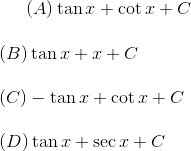
Answer:
The correct option is (A)
On reducing the above integral becomes $\sec^2x-csc^2x$
$\int\sec^2x-csc^2x\ dx = \tan x+ \cot x+C$
Question 24: Choose the correct answer $\int \frac{e ^x ( 1+x)}{\cos ^ 2 ( e ^xx )} dx \: \: equals$
$\\(A) -\cot (ex^x) + C \\\\ (B) \tan (xe^x) + C\\\\ (C) \tan (e^x) + C \\\\ (D) \cot (e^x) + C$
Answer:
The correct option is (B)
Let $e^xx = t$ .
So, $(e^x.x+ 1.e^x)dx = dt$
(1+ $x$ ) $e^x\ dx =dt$
therefore,
$\int \frac{e^x(1+x)}{\cos^2(e^x.x)}dx =\int\frac{dt}{\cos^2t}$
$\\=\int \sec^2t dt\\ =\tan t +C\\ =\tan(e^x.x)+C$
Also, read
- Integrals Class 12 NCERT Solutions Exercise 7.1
- Integrals Class 12 NCERT Solutions Exercise 7.2
- Integrals Class 12 NCERT Solutions Exercise 7.4
- Integrals Class 12 NCERT Solutions Exercise 7.5
- Integrals Class 12 NCERT Solutions Exercise 7.6
- Integrals Class 12 NCERT Solutions Exercise 7.7
- Integrals Class 12 NCERT Solutions Exercise 7.8
- Integrals Class 12 NCERT Solutions Exercise 7.9
- Integrals Class 12 NCERT Solutions Exercise 7.10
- Integrals Class 12 NCERT Solutions Miscellaneous Exercise
Topics covered in Chapter 7 Integrals: Exercise 7.3
- Integration using trigonometric identities: If the integration involves trigonometric functions, we use some known identities to find the integrals.
Here are some known trigonometric identities that are used in integrals.
Trigonometric Identity |
$\sin^2 x = \frac{1 - \cos(2x)}{2}$ |
$\cos^2 x = \frac{1 + \cos(2x)}{2}$ |
$\sin x \cos x = \frac{1}{2} \sin(2x)$ |
1 + tan²x = sec²x |
1 + cot²x = cosec²x |
sin²x + cos²x = 1 |
Also, read,
JEE Main Highest Scoring Chapters & Topics
Just Study 40% Syllabus and Score upto 100%
Download EBookNCERT Solutions Subject Wise
Students can refer to these structured NCERT solutions of other subjects provided below to gain a complete edge.
- NCERT Solutions Class 12 Chemistry
- NCERT Solutions for Class 12 Physics
- NCERT Solutions for Class 12 Biology
- NCERT Solutions for Class 12 Mathematics
CBSE Class 12th Syllabus: Subjects & Chapters
Select your preferred subject to view the chapters
Subject-Wise NCERT Exemplar Solutions
Students can explore the following links for detailed NCERT exemplar solutions of other subjects.
Frequently Asked Questions (FAQs)
Q: What are the topics asked in NCERT solutions for Class 12 Maths chapter 7 exercise 7.3 ?
A:
Topics like finding out integrals of trigonometric functions, square root functions etc. are asked in the examination.
Q: Where is the use of Integration ?
A:
Integration can be used to find the area, volume etc. in physics and other disciplines.
Q: Is exercise 7.3 important for Board examinations ?
A:
Yes, it is significant for the board examinations. 5 markers are generally asked from this exercise only.
Q: What is the level of questions in exercise 7.3 class 12 Maths ?
A:
Moderate level of questions are there in this exercise,
Q: Is this helpful for Physics Topics also?
A:
Yes, some functions like sinx, cosx etc. are used in physics calculations. Hence can be referred for Physics topics also.
Q: How many questions are there in Class 12th Maths chapter 7 exercise 7.3 ?
A:
In total there are 24 questions in this exercise
Q: Is it necessary to solve every question of the exercise?
A:
No, just try to solve maximum and cover maximum concepts. Some questions which are based on the same concepts can be skipped.
Q: Should I refer to any other book for this chapter for Boards?
A:
No, as NCERT questions are more than sufficient for Boards. You can revise these questions only.
Articles
Related Stories
|
Upcoming School Exams

Certifications By Top Providers
Explore Top Universities Across Globe
Questions related to CBSE Class 12th
On Question asked by student community
Have a question related to CBSE Class 12th ?
Hello,
Since you have passed 10th and 12th from Delhi and your residency is Delhi, but your domicile is UP, here’s how NEET counselling works:
1. Counselling Eligibility: For UP NEET counselling, your UP domicile makes you eligible, regardless of where your schooling was. You can participate in UP state
Hello,
You can access Free CBSE Mock tests from Careers360 app or website. You can get the mock test from this link : CBSE Class 12th Free Mock Tests
Hope it helps !
Yes, it is possible for a student who has done their 12th grade already to take upto 4 exams of their requirement. This is possible through the NIOS, NATIONAL INSTITUTE OF OPEN SCHOOLING. Get more info about the exam and the board through the following link.
For CBSE the PREVIOUS YEARS PAPERS can be accessed through the following link for the Concerned subjec by careers360.
Consequently Careers360 does also have a chapter wise scheme of PYQs, you can access the STUDY MATERIAL (PYQs.) from the following link -
https://school.careers360.com/boards/cbse/cbse-question-bank
Thankyou.
Hello,
Sorry, but JoSAA does not accept marks from two different boards for the same qualification during counselling. However, you can use your NIOS marks to meet the JEE Main/Advanced eligibility criteria if they are better than your CBSE marks. You can use your NIOS marks for the eligibility check,
Colleges After 12th

Applications for Admissions are open.
This ebook serves as a valuable study guide for NEET 2025 exam.
NEET Previous 10 Year Questions
Get nowThis e-book offers NEET PYQ and serves as an indispensable NEET study material.
JEE Main Important Physics formulas
Get nowAs per latest syllabus. Physics formulas, equations, & laws of class 11 & 12th chapters
JEE Main Important Chemistry formulas
Get nowAs per latest syllabus. Chemistry formulas, equations, & laws of class 11 & 12th chapters
JEE Main high scoring chapters and topics
Get nowAs per latest 2024 syllabus. Study 40% syllabus and score upto 100% marks in JEE
JEE Main Important Mathematics Formulas
Get nowAs per latest syllabus. Maths formulas, equations, & theorems of class 11 & 12th chapters
CBSE Class 12th Notifications
Never miss CBSE Class 12th update
Get timely CBSE Class 12th updates directly to your inbox. Stay informed!