
NCERT Solutions for Exercise 9.3 Class 12 Maths Chapter 9- Differential Equations
Upcoming Event
CBSE Class 12th Exam Date:17 Feb' 26 - 17 Feb' 26
NCERT Solutions For Class 12 Maths Chapter 9 Exercise 9.3
NCERT Solutions for Exercise 9.3 Class 12 Maths Chapter 9 Differential Equations are discussed here. These NCERT solutions are created by subject matter expert at Careers360 considering the latest syllabus and pattern of CBSE 2023-24. NCERT solutions for exercise 9.3 Class 12 Maths chapter 9 comes under topic 9.4 of NCERT Class 12 Mathematics Book. The questions in exercise 9.3 Class 12 Maths are related to the concepts of forming a Differential Equation that represents a given family of curves. Differential equations related to the family of lines, parabolas, ellipse, circles etc are discussed. The procedures to form the differential equation that represents the family of a curve are detailed before the Class 12th Maths chapter 6 exercise 9.3. The other concepts discussed in the unit are detailed in the following exercises.
12th class Maths exercise 9.3 answers are designed as per the students demand covering comprehensive, step by step solutions of every problem. Practice these questions and answers to command the concepts, boost confidence and in depth understanding of concepts. Students can find all exercise together using the link provided below.
Also read -
Access NCERT Solutions for Class 12 Maths Chapter 9 Exercise 9.3
Differential Equations Class 12 Chapter 9 Exercise: 9.3
$\frac{x}{a} + \frac{y}{b} = 1$
Answer:
Given equation is
$\frac{x}{a} + \frac{y}{b} = 1$
Differentiate both the sides w.r.t x
$\frac{d\left ( \frac{x}{a}+\frac{y}{b} \right )}{dx}=\frac{d(1)}{dx}$
$\frac{1}{a}+\frac{1}{b}.\frac{dy}{dx} = 0\\ \frac{dy}{dx} = -\frac{b}{a}$
Now, again differentiate it w.r.t x
$\frac{d^2y}{dx^2} =0$
Therefore, the required differential equation is $\frac{d^2y}{dx^2} =0$ or $y^{''} =0$
$y^2 = a(b^2 - x^2)$
Answer:
Given equation is
$y^2 = a(b^2 - x^2)$
Differentiate both the sides w.r.t x
$\frac{d\left ( y^2 \right )}{dx}=\frac{d(a(b^2-x^2))}{dx}$
$2y\frac{dy}{dx}= -2ax\\ \\ y.\frac{dy}{dx}= -ax\\ \\ y.y^{'}=-ax$ -(i)
Now, again differentiate it w.r.t x
$y^{'}.y^{'}+y.y^{''}= -a\\ (y^{'})^2+y.y^{''}=-a$ -(ii)
Now, divide equation (i) and (ii)
$\frac{(y^{'})^2+y.y^{''}}{y.y^{'}}= \frac{-a}{-ax}\\ \\ x(y^{'})^2+x.y.y^{''}=y.y^{'}\\ \\ x(y^{'})^2+x.y.y^{''}-y.y^{'}=0$
Therefore, the required differential equation is $x(y^{'})^2+x.y.y^{''}-y.y^{'}=0$
Answer:
Given equation is
$y = ae^{3x} + b e^{-2x}$ -(i)
Differentiate both the sides w.r.t x
$\frac{d\left ( y \right )}{dx}=\frac{d(ae^{3x}+be^{-2x})}{dx}$
$y^{'}=\frac{dy}{dx}= 3ae^{3x}-2be^{-2x}\\ \\$ -(ii)
Now, again differentiate w.r.t. x
$y^{''}= \frac{d^2y}{dx^2} = 9ae^{3x}+4be^{-2x}$ -(iii)
Now, multiply equation (i) with 2 and add equation (ii)
$2(ae^{3x}+be^{-2x})+(3a-2be^{-x}) = 2y+y^{'}\\ 5ae^{3x} = 2y+y^{'}\\ ae^{3x}= \frac{2y+y^{'}}{5}$ -(iv)
Now, multiply equation (i) with 3 and subtract from equation (ii)
$3(ae^{3x}+be^{-2x})-(3a-2be^{-x}) = 3y-y^{'}\\ 5be^{-2x} = 3y-y^{'}\\ be^{-2x}= \frac{3y-y^{'}}{5}$ -(v)
Now, put values from (iv) and (v) in equation (iii)
$y^{''}= 9.\frac{2y+y^{'}}{5}+4.\frac{3y-y^{'}}{5}\\ \\ y^{''}= \frac{18y+9y^{'}+12y-4y^{'}}{5}\\ \\ y^{''}= \frac{5(6y-y^{'})}{5}=6y-y^{'}\\ \\ y^{''}+y^{'}-6y=0$
Therefore, the required differential equation is $y^{''}+y^{'}-6y=0$
Answer:
Given equation is
$y = e^{2x}(a+bx)$ -(i)
Now, differentiate w.r.t x
$\frac{dy}{dx}= \frac{d(e^{2x}(a+bx))}{dx}= 2e^{2x}(a+bx)+e^{2x}.b$ -(ii)
Now, again differentiate w.r.t x
$y^{''}= \frac{d^2y}{dx^2}= \frac{d}{dx}\frac{dy}{dx} = 4e^{2x}(a+bx)+2be^{2x}+2be^{2x}= 4e^{2x}(a+bx)+4be^{2x}$ -(iii)
Now, multiply equation (ii) with 2 and subtract from equation (iii)
$4e^{2x}(a+bx)+4be^{2x}-2\left ( 2e^{2x}(a+bx)+be^{2x} \right )=y^{''}-2y^{'}\\ \\ 2be^{2x} = y^{''}-2y^{'}\\ \\ be^{2x}= \frac{y^{''}-2y^{'}}{2}$ -(iv)
Now,put the value in equation (iii)
$y^{''}=4y+4.\frac{y^{''}-2y^{'}}{2}\\ \\ y^{''}= 4y+2y^{''}-4y^{'}\\ \\ y^{''}-4y^{'}+4y=0$
Therefore, the required equation is $y^{''}-4y^{'}+4y=0$
$y=e^x(a\cos x + b\sin x)$
Answer:
Given equation is
$y=e^x(a\cos x + b\sin x)$ -(i)
Now, differentiate w.r.t x
$\frac{dy}{dx}= \frac{d(e^{x}(a\cos x+b\sin x))}{dx}= e^{x}(a\cos x+b\sin x)+e^x(-a\sin x+b\cos x )$ -(ii)
Now, again differentiate w.r.t x
$y^{''}= \frac{d^2y}{dx^2}= \frac{d}{dx}\frac{dy}{dx} =e^{x}(a\cos x+b\sin x)+e^x(-a\sin x+b\cos x )$ $+e^x(-a\sin x+b\cos x )+e^x(-a\cos x-b\sin x)$
$=2e^x(-a\sin x+b\cos x )$ -(iii)
Now, multiply equation (i) with 2 and multiply equation (ii) with 2 and add and subtract from equation (iii) respectively
we will get
$y^{''}-2y^{'}+2y = 0$
Therefore, the required equation is $y^{''}-2y^{'}+2y = 0$
Question:6 Form the differential equation of the family of circles touching the y-axis at origin.
Answer:
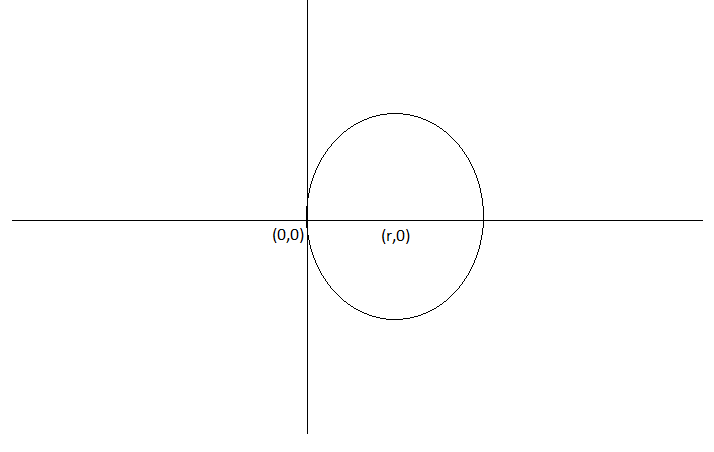 If the circle touches y-axis at the origin then the centre of the circle lies at the x-axis
Let r be the radius of the circle
Then, the equation of a circle with centre at (r,0) is
$(x-r)^2+(y-0)^2 = r^2$
$x^2+r^2-2xr+y^2=r^2\\ x^2+y^2-2xr=0$ -(i)
Now, differentiate w.r.t x
$2x+2y\frac{dy}{dx}-2r=0\\ y\frac{dy}{dx}\Rightarrow yy^{'}+x-r=0$
$yy^{'}+x=r$ -(ii)
Put equation (ii) in equation (i)
$x^2+y^2=2x(yy^{'}+x)\\ y^2=2xyy^{'}+x^2$
Therefore, the required equation is $y^2=2xyy^{'}+x^2$
Answer:
Equation of perabola having vertex at origin and axis along positive y-axis is
$x^2= 4ay$ (i)
Now, differentiate w.r.t. c
$2x= 4a\frac{dy}{dx}\\ \\ \frac{dy}{dx} =y^{'}= \frac{x}{2a}$
$a=\frac{x}{2y^{'}}$ -(ii)
Put value from equation (ii) in (i)
$x^2= 4y.\frac{x}{2y^{'}}\\ xy^{'}-2y = 0$
Therefore, the required equation is $xy^{'}-2y = 0$
Question:8 Form the differential equation of the family of ellipses having foci on y-axis and centre at origin.
Answer:
Equation of ellipses having foci on y-axis and centre at origin is
$\frac{x^2}{b^2}+\frac{y^2}{a^2} = 1$ -
Now, differentiate w..r.t. x
$\frac{2x}{b^2}+\frac{2y}{a^2}.\frac{dy}{dx}=0\\$ -(i)
Now, again differentiate w.r.t. x
$\frac{2}{b^2}+\frac{2}{a^2}.y^{'}.y^{'}+\frac{2y}{a^2}.y^{''}=0\\ \\ \frac{1}{b^2}=-\frac{1}{a^2}\left ( (y^{'})^2+yy^{''} \right )$ -(ii)
Put value from equation (ii) in (i)
Our equation becomes
$\frac{2y}{a^2}y^{'}-\frac{2x}{a^2}\left ( (y^{'})^2+yy^{''} \right )=0\\ \\ 2yy^{'}-2(y^{'})^2x+2yy^{''}x=0\\ \\ xyy^{''}-x(y^{'})^2+yy^{'}= 0$
Therefore, the required equation is $xyy^{''}-x(y^{'})^2+yy^{'}= 0$
Answer:
Equation of hyperbolas having foci on x-axis and centre at the origin
$\frac{x^2}{b^2}+\frac{y^2}{a^2} = 1$
Now, differentiate w..r.t. x
$\frac{2x}{b^2}+\frac{2y}{a^2}.\frac{dy}{dx}=0\\$ -(i)
Now, again differentiate w.r.t. x
$\frac{2}{b^2}+\frac{2}{a^2}.y^{'}.y^{'}+\frac{2y}{a^2}.y^{''}=0\\ \\ \frac{1}{b^2}=-\frac{1}{a^2}\left ( (y^{'})^2+yy^{''} \right )$ -(ii)
Put value from equation (ii) in (i)
Our equation becomes
$\frac{2y}{a^2}y^{'}-\frac{2x}{a^2}\left ( (y^{'})^2+yy^{''} \right )=0\\ \\ 2yy^{'}-2(y^{'})^2x+2yy^{''}x=0\\ \\ xyy^{''}-x(y^{'})^2+yy^{'}= 0$
Therefore, the required equation is $xyy^{''}-x(y^{'})^2+yy^{'}= 0$
Question:10 Form the differential equation of the family of circles having centre on y-axis and radius 3 units.
Answer:
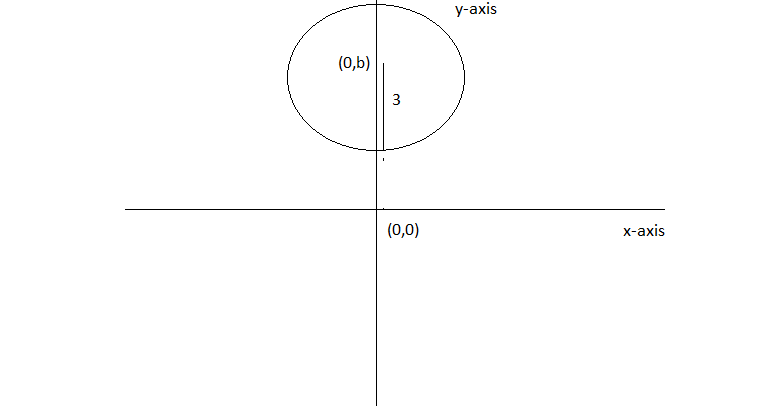 Equation of the family of circles having centre on y-axis and radius 3 units
Let suppose centre is at (0,b)
Now, equation of circle with center (0,b) an radius = 3 units
$(x-0)^2+(y-b)^2=3^2 \ \ \ \ \ \ \ \ \ \ \ -(i)\\ x^2+y^2+b^2-2yb = 9$
Now, differentiate w.r.t x
we get,
$2x+2yy^{'}-2by^{'}= 0\\ 2x+2y(y-b)= 0\\ (y-b)=\frac{-x}{y^{'}} \ \ \ \ \ \ \ \ \ \ \ \ \ -(ii)$
Put value fro equation (ii) in (i)
$(x-0)^2+(\frac{-x}{y^{'}})^2=3^2 \\ x^2+\frac{x^2}{(y^{'})^2}=9\\ x^2(y^{'})^2+x^2=9(y^{'})^2\\ \\ (x^2-9)(y^{'})^2+x^2 = 0$
Therefore, the required differential equation is $(x^2-9)(y^{'})^2+x^2 = 0$
Question:11 Which of the following differential equations has $y = c_1e^x + c_2e^{-x}$ as the general solution?
(A) $\frac{d^2y}{dx^2} + y = 0$
(B) $\frac{d^2y}{dx^2} - y = 0$
(C) $\frac{d^2y}{dx^2} +1 = 0$
(D) $\frac{d^2y}{dx^2} -1 = 0$
Answer:
Given general solution is
$y = c_1e^x + c_2e^{-x}$
Differentiate it w.r.t x
we will get
$\frac{dy}{dx} = c_1e^x-c_2e^{-x}$
Again, Differentiate it w.r.t x
$\frac{d^2y}{dx^2} = c_1e^x+c_2e^{x}=y\\ \frac{d^2y}{dx^2} - y = 0$
Therefore, (B) is the correct answer
Question:12 Which of the following differential equations has $y = x$ as one of its particular solution?
(A) $\frac{d^2y}{dx^2} - x^2\frac{dy}{dx} + xy =x$
(B) $\frac{d^2y}{dx^2} + x\frac{dy}{dx} + xy =x$
(C) $\frac{d^2y}{dx^2} - x^2\frac{dy}{dx} + xy =0$
(D) $\frac{d^2y}{dx^2} + x\frac{dy}{dx} + xy =0$
Answer:
Given equation is
$y = x$
Now, on differentiating it w.r.t x
we get,
$\frac{dy}{dx} = 1$
and again on differentiating it w.r.t x
we get,
$\frac{d^2y}{dx^2} = 0$
Now, on substituting the values of $\frac{d^2y}{dx^2} , \frac{dy}{dx} \ and \ y$ in all the options we will find that only option c which is $\frac{d^2y}{dx^2} - x^2\frac{dy}{dx} + xy =0$ satisfies
Therefore, the correct answer is (C)
More About NCERT Solutions for Class 12 Maths Chapter 9 Exercise 9.3
Examples 4 to 8 are given before the exercise 9.3 Class 12 Maths to get an idea of the concepts discussed in the NCERT Book of Class 12 Maths chapter topic 9.4. And 12 questions are given in the Class 12 Maths chapter 9 exercise 9.3 for practice and these are solved here by mathematics expert faculties. It is better to try to solve the questions without looking for solutions. If any doubts arise while solving use NCERT solutions for Class 12 Maths chapter 9 exercise 9.3.
CBSE Class 12th Syllabus: Subjects & Chapters
Select your preferred subject to view the chapters
Also Read| Differential Equations Class 12th Notes
Benefits of NCERT Solutions for Class 12 Maths Chapter 9 Exercise 9.3
The Class 12 Maths chapter 9 exercise 9.3 are curated by mathematics faculties and can be used for the preparation of the CBSE board exams.
Rather than exam point of view solving exercise will give an insight to the concepts studied.
JEE Main Highest Scoring Chapters & Topics
Just Study 40% Syllabus and Score upto 100%
Download EBookKey Features Of NCERT Solutions for Exercise 9.3 Class 12 Maths Chapter 9
- Comprehensive Coverage: The solutions encompass all the topics covered in ex 9.3 class 12, ensuring a thorough understanding of the concepts.
- Step-by-Step Solutions: In this class 12 maths ex 9.3, each problem is solved systematically, providing a stepwise approach to aid in better comprehension for students.
- Accuracy and Clarity: Solutions for class 12 ex 9.3 are presented accurately and concisely, using simple language to help students grasp the concepts easily.
- Conceptual Clarity: In this 12th class maths exercise 9.3 answers, emphasis is placed on conceptual clarity, providing explanations that assist students in understanding the underlying principles behind each problem.
- Inclusive Approach: Solutions for ex 9.3 class 12 cater to different learning styles and abilities, ensuring that students of various levels can grasp the concepts effectively.
- Relevance to Curriculum: The solutions for class 12 maths ex 9.3 align closely with the NCERT curriculum, ensuring that students are prepared in line with the prescribed syllabus.
Also see-
NCERT Solutions Subject Wise
Subject Wise NCERT Exemplar Solutions
Frequently Asked Questions (FAQs)
Q: How many questions are solved in the NCERT solutions for Class 12 Maths chapter 9 exercise 9.3?
A:
12 questions are explained through exercise 9.3 Class 12 Maths.
Q: What is the number of multiple-choice questions in the Class 12 Maths chapter 9 exercise 9.3?
A:
Two objective questions with 4 choices are given in the Class 12th Maths chapter 6 exercise 9.3.
Q: What type of curve is discussed in example 6 of Class 12 chapter 9?
A:
Ellipse.
Q: What are the concepts to be covered before solving exercise 9.3?
A:
Students must be able to differentiate the given function. For this students should be aware of basic differentiation.
Q: Is the chapter differential equations important for CBSE board students?
A:
Yes, as NCERT is followed by CBSE students it is important to cover this chapter.
Q: Whether the concepts of differential equations are used in physics?
A:
Yes, to solve certain problems or to represent a certain type of motions differential equations are used.
Q: What are the topics covered before exercise 9.3 of Class 12 Maths?
A:
The concepts of order and degree of differential equations and general and particular solutions are covered.
Q: Which topic is covered in exercise 9.3?
A:
The NCERT Class 12 exercise 9.3 covers the topic of forming differential equations of a family of curves.
Articles
Related Stories
|
Upcoming School Exams

Certifications By Top Providers
Explore Top Universities Across Globe
Questions related to CBSE Class 12th
On Question asked by student community
Have a question related to CBSE Class 12th ?
Hello,
Since you have passed 10th and 12th from Delhi and your residency is Delhi, but your domicile is UP, here’s how NEET counselling works:
1. Counselling Eligibility: For UP NEET counselling, your UP domicile makes you eligible, regardless of where your schooling was. You can participate in UP state
Hello,
You can access Free CBSE Mock tests from Careers360 app or website. You can get the mock test from this link : CBSE Class 12th Free Mock Tests
Hope it helps !
Yes, it is possible for a student who has done their 12th grade already to take upto 4 exams of their requirement. This is possible through the NIOS, NATIONAL INSTITUTE OF OPEN SCHOOLING. Get more info about the exam and the board through the following link.
For CBSE the PREVIOUS YEARS PAPERS can be accessed through the following link for the Concerned subjec by careers360.
Consequently Careers360 does also have a chapter wise scheme of PYQs, you can access the STUDY MATERIAL (PYQs.) from the following link -
https://school.careers360.com/boards/cbse/cbse-question-bank
Thankyou.
Hello,
Sorry, but JoSAA does not accept marks from two different boards for the same qualification during counselling. However, you can use your NIOS marks to meet the JEE Main/Advanced eligibility criteria if they are better than your CBSE marks. You can use your NIOS marks for the eligibility check,
Colleges After 12th

Applications for Admissions are open.
This ebook serves as a valuable study guide for NEET 2025 exam.
NEET Previous 10 Year Questions
Get nowThis e-book offers NEET PYQ and serves as an indispensable NEET study material.
JEE Main Important Physics formulas
Get nowAs per latest syllabus. Physics formulas, equations, & laws of class 11 & 12th chapters
JEE Main Important Chemistry formulas
Get nowAs per latest syllabus. Chemistry formulas, equations, & laws of class 11 & 12th chapters
JEE Main high scoring chapters and topics
Get nowAs per latest 2024 syllabus. Study 40% syllabus and score upto 100% marks in JEE
JEE Main Important Mathematics Formulas
Get nowAs per latest syllabus. Maths formulas, equations, & theorems of class 11 & 12th chapters
CBSE Class 12th Notifications
Never miss CBSE Class 12th update
Get timely CBSE Class 12th updates directly to your inbox. Stay informed!